What Is the Best Glue for Rubber?
Are you looking for the best glue for rubber? There is no single answer: the right choice mainly depends on how you work, the viscosity you need, the size of the surface to be bonded, and the stresses the part will be exposed to.
Rubber is used in many different fields: automotive repairs, DIY, footwear, seals and gaskets, scale modeling, RC, accessories, technical parts, and everyday repairs. Depending on the application, you may need a very liquid glue that quickly flows between two surfaces, a thicker glue that stays exactly where it is applied, or a more flexible adhesive for a part that will continue to move.
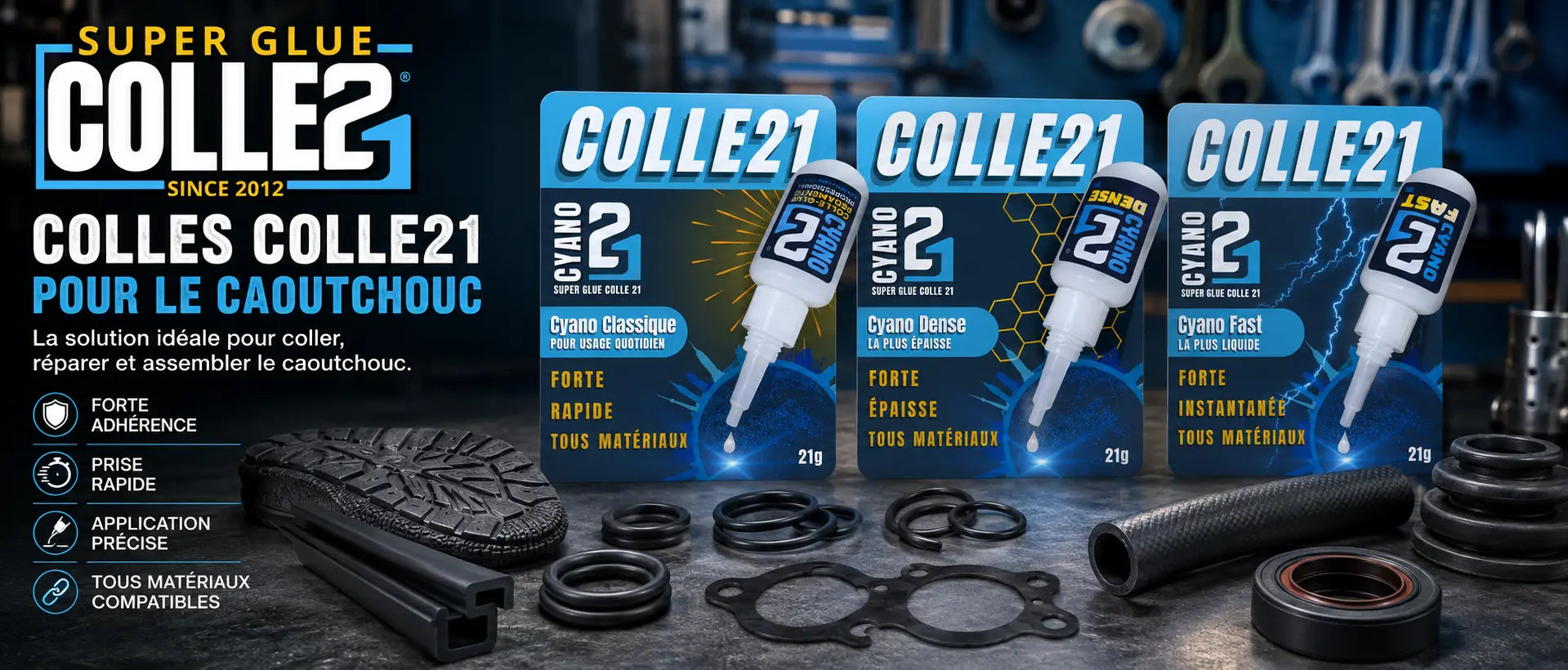
The SUPER GLUE Colle21 range includes different viscosities, ranging from very liquid glue to gel, making it suitable for DIY, scale modeling, automotive applications, and professional repairs.
The goal is simple: to help you choose the SUPER GLUE Colle21 that truly matches the way you work.
What Is the Best Glue for Rubber?
For bonding rubber, SUPER GLUE Colle21 cyanoacrylate adhesives provide a fast, precise, and strong solution for a wide range of applications.
All our main adhesives can be suitable for rubber, but each one offers a different viscosity and behavior:
- FAST: very liquid, it is particularly suitable for tightly fitted assemblies and small areas where the glue needs to penetrate quickly through capillary action.
- CLASSIC: versatile and easy to use, it is an excellent solution for everyday rubber repairs.
- SLOW DRY: provides more time to position the parts correctly before setting, which can be useful on longer surfaces or whenever precise alignment is required.
- DENSE: thicker and easier to control, helping to reduce unwanted running during application.
- GEL: ideal when you want the glue to stay exactly where it is applied.
- FLEX: particularly useful when the bonded part remains exposed to movement, vibration, or slight deformation.
- BLACK: a thick black adhesive suitable for certain technical repairs, especially when a black finish is more discreet on the part being repaired.
The best glue for rubber is therefore the one that best matches your project and the way you prefer to work.
Someone who is used to working with very fluid adhesives may prefer FAST, while someone looking for greater control during application may choose DENSE or GEL.
👉 Discover the complete SUPER GLUE Colle21 range.
Liquid Glue or Thick Glue for Rubber?
The choice mainly depends on the application and on how you want to apply the adhesive.
A very liquid glue such as SUPER GLUE Colle21 FAST easily penetrates between two surfaces that are already correctly positioned. It is particularly useful when two rubber parts fit together perfectly or when the adhesive needs to penetrate into a small crack.
By contrast, SUPER GLUE Colle21 DENSE has a higher viscosity. It allows the glue to be applied precisely without spreading too quickly around the bonding area.
This can be particularly useful for vertical surfaces, parts that are difficult to hold in position, uneven areas, and repairs where highly precise application is required.
For users who want even greater control, SUPER GLUE Colle21 GEL is an excellent alternative. Its texture allows the product to remain in place while the parts are being positioned.
If the rubber remains exposed to movement, vibration, or slight deformation, SUPER GLUE Colle21 FLEX may be particularly suitable.
The right choice therefore depends less on the material itself than on the desired result and the way you work.
When Can Glue Be Used on Rubber?
Rubber can be found in a huge number of everyday objects and technical components.
Depending on the type of rubber and the stresses placed on the part, SUPER GLUE Colle21 adhesives can be used to :
- repair certain rubber parts,
- Reattach small seals and gaskets,
- Repair automotive accessories or components,
- Work on scale-modeling and RC parts,
- Bond rubber to metal, bond rubber to certain plastics,
- Repair certain shoe soles or footwear components,
- Carry out small DIY repairs.
Because many different types of rubber and surface treatments exist, it is always recommended to perform a small preliminary test when the exact composition of the material is unknown.
How to Glue Rubber Properly
Surface preparation is almost as important as choosing the right adhesive.
To achieve a clean and durable bond :
- Clean and degrease the surfaces thoroughly to remove dust, oil, and residue;
- Check the positioning of the parts before applying the glue;
- Use a reasonable amount of SUPER GLUE Colle21; choose the viscosity that best suits your needs;
- Bring the surfaces together correctly;
- Hold the parts in position while the adhesive sets;
- Avoid putting the repaired part under immediate stress.
Using too much glue does not necessarily improve the bond. A thin, clean, and even application often produces better results.
For technical, treated, or unknown types of rubber, we recommend testing the adhesive on a small area first.
How to Glue Rubber to Plastic
The result depends greatly on the type of plastic involved.
Materials such as ABS and certain common plastics can be relatively easy to bond, whereas low-surface-energy plastics such as PP, PE, and PTFE are significantly more difficult to glue.
For these materials, Colle21 offers PRIMER21, designed to prepare difficult surfaces before applying a SUPER GLUE Colle21 cyanoacrylate adhesive.
Surface preparation therefore becomes especially important when bonding rubber to technical plastics.
How to Glue Rubber to Metal
Bonding rubber to metal is also common, particularly in automotive work, DIY projects, and certain technical repairs.
Before applying your SUPER GLUE Colle21, the metal surface should be
- Clean,
- Dry,
- Free of dust,
- Properly degreased.
You can then choose the viscosity according to the application: FAST for a very tight-fitting assembly, CLASSIC for versatile use, DENSE for greater control, or FLEX when a certain degree of flexibility remains important.
Why Choose SUPER GLUE Colle21?
The strength of SUPER GLUE Colle21 lies in offering a wide range of bonding solutions, allowing every user to choose the viscosity that truly matches their working habits.
Some users need an extremely fast and liquid adhesive. Others prefer more time to position their parts. Some want a thick glue that barely runs, while others need a more flexible solution.
That is why SUPER GLUE Colle21 offers different formulations rather than a single adhesive intended to meet every requirement in exactly the same way.
With a particularly extensive range of adhesives, activators, primers, and complementary products, SUPER GLUE Colle21 makes it possible to find a suitable solution for many different repairs while maintaining an excellent price-to-quality ratio.
What Our Customers Say About SUPER GLUE COLLE21
Customer satisfaction is also an important factor when choosing a bonding solution.
SUPERGLUE COLLE21⭐⭐⭐⭐⭐ has more than 500 Google reviews, from private users, model makers, craftspeople, and professionals who use Colle21 products for a wide variety of applications.
This feedback also helps us continue developing a range that meets different expectations in terms of precision, speed, transparency, viscosity, flexibility, and ease of use.
SUPER GLUE Colle21: Manufacturers of Cyanoacrylate Glues and Professional Adhesives
Since 2012, SUPER GLUE Colle21 has been developing cyanoacrylate glues and adhesive solutions for both private users and professionals.
With more than 140 products, the range can meet very different requirements through multiple adhesive viscosities as well as activators, primers, preparation products, and bonding accessories.
SUPER GLUE Colle21 solutions are used in many different fields, including scale modeling, DIY, repairs, automotive applications, 3D printing, aquascaping, fishing, RC, decoration, and professional applications.
This diversity allows us to offer a bonding solution suited to every need and every way of working.
Are You a Professional?
👷♂️ Are you an automotive bodywork professional, dental technician, nail technician, store owner, scale-modeling professional, or would you like to become a distributor or professional customer of SUPER GLUE Colle21?
Colle21 develops professional cyanoacrylate glues and adhesive solutions designed for many demanding sectors, including automotive bodywork, dental applications, nail care, scale modeling, industry, and more.
With more than 140 products, our range covers a wide variety of technical requirements: different viscosities, activators, primers, and specialized bonding solutions for professional use.
👉 As a professional, you can benefit from an exclusive professional catalogue, dedicated pricing and preferential conditions, personalized support tailored to your activity, and the creation of customized labels featuring your own brand or store name.
📩 Contact us to receive your professional catalogue and discover the solutions best suited to your sector.
FAQ – Glue for Rubber
What glue should I use for rubber?
A SUPER GLUE Colle21 cyanoacrylate adhesive is suitable for many rubber applications. The choice mainly depends on the required viscosity, the level of precision you need, and the amount of flexibility required.
Which SUPER GLUE Colle21 should I choose for rubber?
FAST is suitable for users looking for a very liquid adhesive, CLASSIC offers excellent versatility, Slow Dry provides more time to position parts correctly, DENSE and GEL provide greater application control, while FLEX is particularly useful when the repair must withstand movement or vibration.
Is liquid glue or gel glue better for rubber?
It depends on how you work. A liquid adhesive easily penetrates between two closely fitted surfaces, while a gel adhesive stays in place more effectively and makes vertical or highly precise applications easier.
Can rubber be glued to metal?
Yes. It is important to thoroughly clean and degrease the metal before using your SUPER GLUE Colle21 to promote good adhesion.
Can rubber be glued to plastic?
Yes, but the result depends on the type of plastic. Certain plastics such as PP, PE, or PTFE may require the use of PRIMER21 Colle21 before applying the cyanoacrylate adhesive.
Which glue should I choose for rubber that moves or vibrates?
When the part remains exposed to movement or vibration, SUPER GLUE Colle21 FLEX can be a particularly suitable solution.
Where can I buy SUPER GLUE Colle21?
Discover all our solutions directly through our SUPER GLUE Colle21 range or through our Colle21 Amazon Store.