What causes glue whitening?
You have just made a collage with a SUPER GLUE cyanoacrylate and, a few moments later, a thin white film appears around the repair? This phenomenon is well known and is called bleaching, blooming or frosting of cyanoacrylate.
But what causes glue whitening?
The answer is more complex than a simple adhesive quality problem. Humidity, excess glue, cyanoacrylate vapors, but also the preparation and handling of the parts can have a significant influence.
And one element is often forgotten: our own fingers.
A surface that appears perfectly clean may retain invisible traces of perspiration, humidity or greasy residue. The cyanoacrylate vapors can then settle and polymerize on these contaminants, which promotes the appearance of the famous white veil.
Understanding this reaction allows you to better avoid it and, above all, to choose the right one. SUPER GLUE COLLE21 depending on the desired result.

What is whitening of cyanoacrylate glue?
The whitening of cyanoacrylate glue corresponds to the appearance of a white or slightly opaque deposit around the glued area.
In the field of adhesives, this phenomenon is generally called:
- blooming ;
- frosting ;
- white veil of cyanoacrylate.
During bonding, some of the cyanoacrylate molecules not yet polymerized may volatilize. These molecules can then encounter moisture on the surfaces around the joint and polymerize there.
The result?
A very fine amount of material hardens around the bonding and becomes visible in the form of halo or whitish deposit.
This is particularly noticeable on black, shiny or transparent pieces.
This blooming phenomenon is well documented in the operation of cyanoacrylate adhesives.
Why can SUPER GLUE turn white around the bonding?
It is important to make a distinction :
the glue itself does not necessarily turn white.
Visible whitening may appear around the bonding area, when cyanoacrylate vapors or molecules are deposited on surrounding surfaces.
Several factors can promote this phenomenon:
- presence of humidity;
- fingerprints;
- sweating;
- contaminants present on the surface;
- excessive use of glue;
- residue around the joint;
- significant handling of the part before gluing.
This is why two people can use the exact same SUPER GLUE and achieve two different aesthetic results.
The bonding technique and surface preparation therefore play an essential role.
Can fingerprints cause glue to bleach?
Yes, they can promote the phenomenon
This is probably one of the most overlooked causes.
When you take a part between your fingers, even with hands that seem perfectly clean, you can place on its surface:
- sweating;
- humidity;
- fatty substances naturally present on the skin;
- dust;
- different contaminants invisible to the naked eye.
A fingerprint can therefore be present without being visible.
When you then apply a SUPER GLUE cyanoacrylate, the vapors can be deposited preferentially on some of these residues and polymerize there.
A phenomenon used to reveal fingerprints
This phenomenon is sufficiently real and reproducible to be exploited in the field of forensics.
The technique called cyanoacrylate fuming uses cyanoacrylate vapors to make visible latent fingerprints present on certain non-porous surfaces such as glass or plastic.
The polymerized cyanoacrylate is deposited on the residue of the impression and produces a visible whitish mark.
This helps to understand why an invisible imprint left on a model piece, plexiglass or a shiny surface can become much more visible after using cyanoacrylate glue.
A room can appear clean… without actually being clean
This is a very common error.
You take a coin out of its packaging and you think:
“It’s new, so it’s clean. »
Not necessarily.
Before arriving in your hands, this piece has potentially been manipulated:
- during its manufacture;
- during quality control;
- during its packaging;
- during transport;
- by a seller;
- by another person;
- or simply by yourself a few minutes before.
It can therefore appear perfectly clean visually while having invisible residue on its surface.
This is especially important when working on:
- a model canopy;
- glass;
- plexiglass;
- clear plastic;
- a shiny surface;
- a black room;
- a very detailed miniature.
On these materials, the slightest white deposit becomes immediately visible.
The right reflex: always clean and degrease before gluing
To reduce the risk of money laundering, adopt a simple rule:
clean → degrease → dry → stick.
Even when the room appears clean.
Before using your SUPER GLUE COLLE21, clean the surface thoroughly with a solution compatible with the material and then allow it to dry completely.
Then:
👉 keep your hands clean;
👉 avoid touching the surfaces intended for bonding;
👉 handle delicate parts by their edges if possible;
👉 use clean tweezers for particularly small or transparent items.
On a glass roof or a transparent part, this precaution can make a real difference in the aesthetic quality of the final result.
The less you touch a surface after cleaning, the less likely you are to redeposit contaminants on it.
Too much SUPER GLUE can also promote whitening
Another common mistake is to think:
“The more glue I use, the stronger my collage will be. »
With cyanoacrylate, this reasoning can be counterproductive.
Too much leaves more product exposed around the bonding area. Unpolymerized molecules can then contribute more to the blooming phenomenon.
Specialized technical resources on cyanoacrylates identify excess product and humidity around the joint among the factors associated with frosting or blooming.
The correct method is therefore to search for:
precision rather than quantity.
Apply only the amount of SUPER GLUE COLLE21 necessary for your assembly.
What are the main causes of glue whitening?
If we have to answer the question very simply “what is the cause of glue whitening? », several factors must be distinguished.
1. Cyanoacrylate vapors
Cyanoacrylate molecules that find themselves outside the bonding zone can be deposited on neighboring surfaces and polymerize there.
2. Humidity
Humidity is involved in the polymerization of cyanoacrylates and can promote the formation of deposits around the bonding.
3. Fingerprints
The residue left by our fingers can become areas where the cyanoacrylate settles and polymerizes. This mechanism also forms the basis of scientific methods of revealing fingerprints.
4. An insufficiently cleaned surface
Grease, dust, humidity and other contaminants can degrade the cleanliness of the final result.
5. Excessive amount of cyanoacrylate
Using too much glue increases the quantity of product likely to remain exposed at the periphery of the bonding.
6. Excessive handling
Thoroughly cleaning a part and then putting your fingers back on the surface to be glued eliminates a lot of the prep work.
How to avoid glue bleaching?
To obtain as clean a bond as possible with a SUPER GLUE COLLE21, remember these six reflexes:
1. Always clean the room
Even when it is new.
2. Degrease the surface
Only use a product compatible with the material in question.
3. Let it dry completely
A clean but still damp surface is not ready to receive glue.
4. Do not touch the prepared area again
Handle the part from the sides or use clean pliers when possible.
5. Use little cyanoacrylate
Precise bonding does not necessarily require a large quantity of product.
6. Choose the glue according to the desired result
When the aesthetic finish is particularly important, the choice of adhesive technology becomes essential.
It is precisely here that FLEX 21 and ULTRA GLUE meet two different needs.
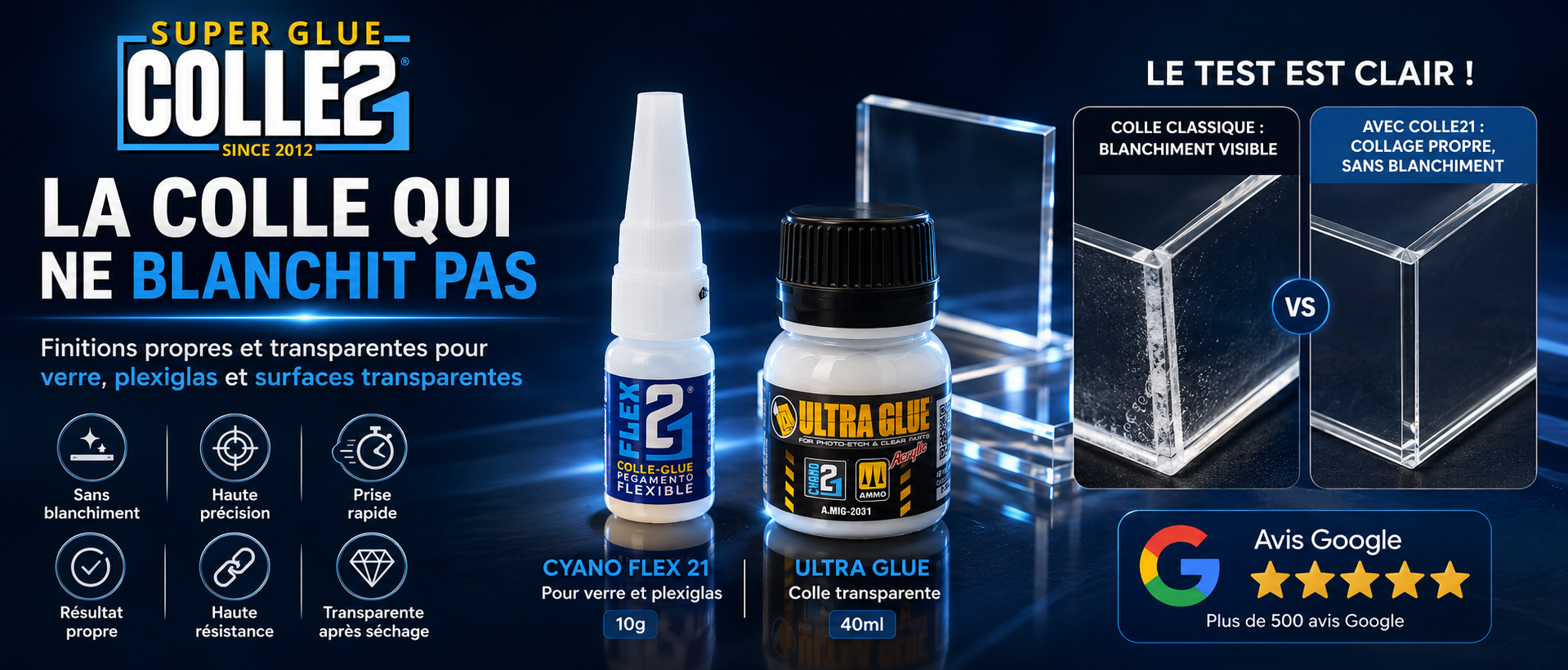
FLEX 21: a transparent and flexible SUPER GLUE COLLE21
The SUPER GLUE COLLE21 FLEX 21 is a transparent cyanoacrylate adhesive developed to provide flexible bonding.
It is particularly interesting when an assembly must support:
- movements;
- vibrations;
- shocks;
- certain dynamic constraints.
Colle21 presents FLEX 21 as a transparent and flexible cyanoacrylate intended in particular for plexiglass, glass, model making, DIY and various technical applications.
ULTRA GLUE: for transparent parts and highly visible bonding
When aesthetics becomes a priority, ULTRA GLUE Colle21 & AMMO gives a different answer.
Unlike FLEX 21, ULTRA GLUE is not a classic cyanoacrylate.
This is a transparent resin glue particularly intended for precision work and delicate assemblies, in particular:
- transparent canopies;
- transparent parts;
- photo-etches;
- small accessories;
- modeling elements where the collage remains visible.
His file Colle21 specifically presents it as a clean, invisible solution for delicate rooms and transparent canopies.
👉 Discover ULTRA GLUE Colle21 & AMMO
FLEX 21 or ULTRA GLUE: which one to choose against white marks?
The two products do not meet exactly the same need.
Choose FLEX 21 when you are mainly looking for:
- a real SUPER GLUE cyanoacrylate ;
- rapid setting;
- transparent glue;
- flexible assembly;
- better adaptation to movements and vibrations.
Choose ULTRA GLUE when you favor:
- a transparent glass roof;
- a very visible piece;
- the discretion of the joint;
- precision gluing;
- a clean aesthetic finish;
- reducing the risk of experiencing the visual effects associated with the vapors of a classic cyanoacrylate.
In both cases, preparation of the part remains fundamental.
Even the best glue will produce a cleaner result on a properly cleaned and prepared surface.
In model making: clean, degrease, dry… then touch as little as possible
This rule is worth remembering:
CLEAN → DEGREASE → DRY → DON’T TOUCH → STICK
It is especially important when working on a canopy, a shiny miniature body, a black part or plexiglass.
Good preparation does not only improve bonding.
It also helps to obtain a cleaner, more professional finish.
It’s a simple detail, but often it is precisely these details that make the difference between visible bonding and a repair that is perfectly integrated into the project.
Our customers’ opinions on SUPER GLUE COLLE21 ⭐⭐⭐⭐⭐
User satisfaction is also an important element in choosing a bonding solution.
SUPERGLUE COLLE21⭐⭐⭐⭐⭐has more than 500 Google reviews, coming from individuals, modelers, craftsmen and professionals who use the products Colle21 for many applications.
This feedback also allows us to continue to develop a range that meets different expectations: precision, speed, transparency, viscosity, flexibility and ease of use.

SUPER GLUE COLLE21: manufacturer of cyano glues and partner of professionals
Since 2012, SUPER GLUE GLUE21 develops and distributes a complete range of cyanoacrylate glues and professional adhesive solutions, intended for both individuals and professionals.
With more than 140 references, our range meets many applications: different viscosities of cyanoacrylates, flexible glues, gels, activators, primers and specialized bonding solutions.
👷♂️ Are you a professional or would you like to become a distributor of SUPER GLUE COLLE21?
Professionals can benefit from a dedicated catalog, of preferential rates and conditions, of a personalized support as well as the possibility of creating custom labels or in co-branding with their brand or brand.
We support many professions and sectors: bodywork, dental prosthesis, nail prosthesis, model making, DIY, repair, 3D printing, aquascaping, fishing, radio control, industry, decoration and specialized shops.
📩 Contact us to receive our professional catalog and discover the SUPER GLUE COLLE21 solutions adapted to your activity.

FAQ – What causes glue whitening?
What causes glue whitening?
Whitening of cyanoacrylate glue is generally associated with blooming : cyanoacrylate molecules can volatilize and then polymerize on humidity or certain contaminants located around the joint, creating a visible whitish deposit.
Why does my SUPER GLUE leave a white mark?
The presence of humidity, excessive amounts of glue, contaminants or fingerprints can contribute to making the blooming phenomenon more visible.
Can fingerprints react with cyanoacrylate vapors?
Cyanoacrylate vapors can actually polymerize on fingerprint residue. This property is also used in certain scientific techniques for revealing fingerprints on glass and plastic.
Should a new part be degreased before gluing?
Yes, especially when the finish is important. A new part may have been manipulated during its manufacturing, packaging or transport. Cleaning it before gluing allows you to start on a better prepared surface.
Does adding a lot of SUPER GLUE improve bonding?
Not necessarily. With cyanoacrylate, it is generally better to apply a controlled and precise quantity rather than an excess which overflows around the joint.
Which glue to choose for a transparent canopy?
For canopies and other delicate transparent parts, ULTRA GLUE Colle21 & AMMO is specifically presented by Colle21 for this type of application and for a clean and discreet finish.
What is FLEX 21 used for?
FLEX 21 is a SUPER GLUE COLLE21 transparent and flexible cyanoacrylate, particularly suitable when the assembly must withstand movements, vibrations or shocks.
How to limit the risk of money laundering?
Remember four words:
clean, degrease, dry, limit handling.
Then add a precise quantity of glue and choose the adhesive that really corresponds to the material and the desired aesthetic result.
So, what causes glue whitening?
Whitening of cyanoacrylate glue therefore does not automatically mean that the glue is bad.
This is a phenomenon that can be influenced by cyanoacrylate fumes, humidity, contaminants, fingerprints, amount of glue applied and surface preparation.
And it is precisely this last point that many users neglect.
A part can appear perfectly clean while retaining invisible traces from previous handling.
To put all the chances on your side:
a suitable glue + a perfectly clean surface + a controlled quantity + the minimum of handling = a much cleaner bond.
For your projects requiring a transparent and flexible cyanoacrylate, discover SUPER GLUE COLLE21 FLEX 21.
For glass roofs and transparent parts where the aesthetic finish is a priority, discover ULTRA GLUE Colle21 & AMMO.
🚀 We Stay Sticky!
Discover the whole range SUPER GLUE COLLE21.
Also find our products on the Official Amazon Store Colle21.

🎯 Let's stick with it Colle21 ! 🚀