Why do some glues not stick to plastic? How to glue PP and PE
Why don't glues hold on certain plastics? Have you ever tried to glue a plastic part with strong glue, but a few seconds or minutes later everything comes off?
The problem is not always with the glue. Some plastics are naturally much more difficult to bond than others. This is particularly the case of polypropylene (PP) and of polyethylene (PE), two materials widely used in DIY, automobiles, model making, industry and even everyday objects.
In this type of situation, it is often necessary to properly prepare the surface before applying a SUPER GLUE COLLE21. The Primer Colle21 is precisely designed to facilitate the bonding of certain difficult plastics.
Why don't some glues hold on plastic?
Not all plastic materials have the same surface characteristics.
Certain plastics such as ABS, PVC or polystyrene can generally be glued quite easily with a suitable glue.
Conversely, the PP and PE have low surface energy. This means that the glue has more difficulty adhering properly to the material.
Even a high-performance adhesive can therefore have limited adhesion if the surface has not been prepared correctly.
This is why, before looking for ever more powerful glue, you must start by identifying the material to be assembled.
Why are polypropylene and polyethylene difficult to bond?
The polypropylene (PP) and the polyethylene (PE) are appreciated for their resistance, their lightness and their low sensitivity to humidity.
These qualities, however, become a real challenge when they have to be glued together.
Their surface is not very reactive. A conventional glue can remain on the surface without creating a sufficiently strong bond with the material.
We find PP and PE in particular in:
- automobile parts;
- boxes and containers;
- certain toys;
- DIY equipment;
- technical accessories;
- model parts;
- certain industrial parts;
- many molded plastic objects.
When we search how to glue PP or PE, surface preparation is therefore as important as the choice of glue.
How to glue PP and PE correctly?
To obtain a more reliable bond, it is advisable to proceed step by step.
Start by cleaning the surface thoroughly to remove dust, grease and residue.
Depending on the part, light sanding can also help improve mechanical grip.
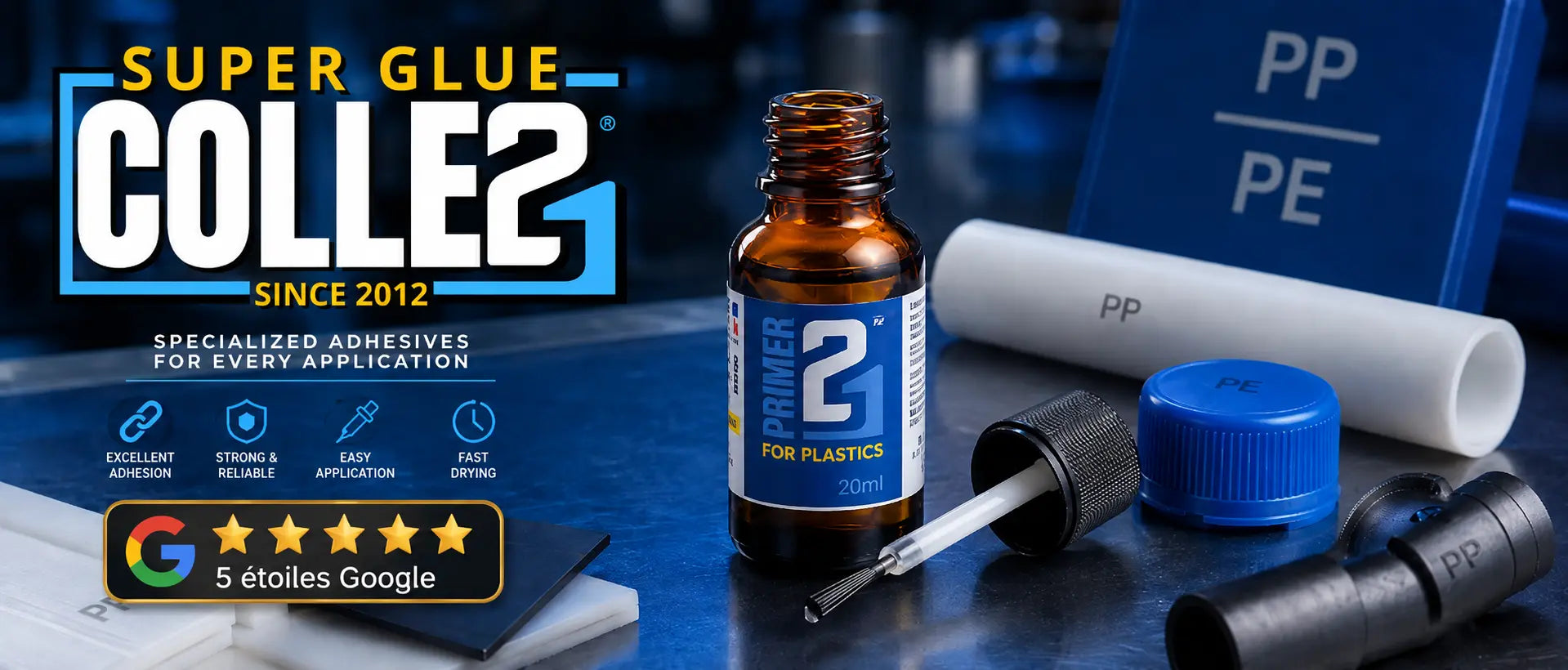
On particularly difficult plastics such as PP or PE, the use of Primer Colle21 allows you to prepare the surface before applying the glue.
Once this step is completed, you can apply the SUPER GLUE COLLE21 adapted to the type of work to be carried out.
What is a Primer used for before bonding?
A Primer is a surface preparation product.
Its role is not to replace glue. It prepares the material to promote adhesion of the adhesive.
On some low energy surfaces like PP or PE, this step can make a real difference.
The Primer Colle21 30ml is especially interesting when you have to work on plastics that are usually resistant to conventional glues.
The principle is simple: first prepare the difficult surface, then use the SUPER GLUE COLLE21 corresponding to the type of collage sought.
Which SUPER GLUE COLLE21 to use after the Primer?
The choice depends on the part to be assembled and the desired result.
For versatile bonding, a SUPER GLUE COLLE21 classic can be suitable for many applications.
For a vertical surface or when it is necessary to prevent the glue from dripping, a denser glue is often more practical.
The DENSE 21g Colle21 is particularly interesting when a precise and controlled application is sought.
For areas requiring more filling or a thicker application, the GEL Colle21 can also be an interesting solution.
You can also discover the full range of SUPER GLUE COLLE21 in order to choose the viscosity corresponding to your use.

Is Primer necessary on all plastics?
No.
You should not use a Primer systematically before each bonding.
Many materials can be bonded directly with a SUPER GLUE COLLE21, provided the surfaces are clean and properly prepared.
The Primer Colle21 becomes especially useful when the material has a surface that is particularly difficult to bond.
This is particularly the case for :
PP – polypropylene
PE – polyethylene
HDPE – high density polyethylene
LDPE – low density polyethylene
Identifying the material before bonding therefore allows you to select the right method from the start.
How to recognize PP or PE?
The material is sometimes indicated directly on the part using a marking.
You can find in particular :
PP for polypropylene
PE for polyethylene
HDPE for high density polyethylene
LDPE for low density polyethylene
When the material is not clearly identified, it is best to consult the manufacturer's documentation before starting bonding.
This check can save a lot of unnecessary testing.
Why is surface preparation as important as glue?
Excellent glue cannot always compensate for a dirty, greasy or difficult-to-glue surface.
Before applying a SUPER GLUE COLLE21, it is therefore recommended to :
- clean both surfaces thoroughly;
- eliminate traces of grease;
- let the parts dry;
- carry out light sanding if necessary;
- use a Primer Colle21 when the material requires it.
The final quality of the bond therefore depends as much on the preparation as on the adhesive used.
SUPER GLUE COLLE21: solutions for different materials
Since 2012, Colle21 develops a complete range of cyanoacrylate glues and products intended for bonding.
The range SUPER GLUE COLLE21 includes different viscosities to meet a wide variety of needs: fluid, dense glues, gels, flexible products, activators, primers and application accessories.
This diversity allows you to work in many worlds :
model making, DIY, repair, 3D printing, automotive, aquascaping, fishing, radio-controlled, decoration and professional applications.
The objective is not simply to offer a strong glue, but to have the right bonding system for the right material.
Our customers’ opinions on SUPER GLUE COLLE21
User satisfaction is also an important element in choosing a bonding solution.
SUPERGLUE COLLE21⭐⭐⭐⭐⭐has more than 500 Google reviews, coming from individuals, modelers, craftsmen and professionals who use the products Colle21 for many applications.
This feedback also allows us to continue to develop a range that meets different expectations : precision, speed, transparency, viscosity, flexibility and ease of use.

SUPER GLUE COLLE21 : producers of cyano glue and professional adhesives
Colle21 offers more than 140 references intended for both individuals and professionals.
Thanks to a wide range of SUPER GLUE COLLE21, activators, primers and complementary products, it is possible to adapt the bonding to the material, the desired viscosity and the constraints of each application.
The DENSE 21g Colle21 is for example particularly appreciated for work requiring a thick and controllable glue, while the FREEZE Colle21 is ideal when an even thicker glue is desired.
For difficult plastics, the Primer Colle21 completes the bonding system by preparing the surface before applying the glue.
Professionals, distributors, specialized stores and businesses can also benefit from solutions adapted to their needs.

FAQ – How to glue PP and PE?
Why doesn't my glue stick to plastic?
The problem may come from the nature of the plastic. Some materials like PP or PE have low surface energy, which makes adhesion more difficult.
What glue to use for polypropylene?
It is possible to use a SUPER GLUE COLLE21 suitable, but PP is a difficult plastic to glue. Preparing the surface with Primer Colle21 helps improve adhesion conditions before applying the glue.
Can you glue polyethylene with super glue?
Yes, but PE is one of the materials that is difficult to glue. It is recommended to prepare the surface well and use the Primer Colle21 before applying the appropriate SUPER GLUE COLLE21.
What is Primer for? Colle21 ?
The Primer Colle21 prepares the surface of certain difficult plastics such as PP and PE to promote glue adhesion.
Should PP or PE be sanded before gluing?
Light sanding can help improve mechanical adhesion, but on particularly difficult plastics, it does not necessarily replace the use of a suitable primer.
Which SUPER GLUE COLLE21 to choose?
It depends on the application. For a thicker, more controllable glue, you can choose the DENSE 21g Colle21. For a gel consistency, GEL Colle21 is another option. You can find the entire range on the page SUPER GLUE COLLE21.
Where to buy Primer Colle21 ?
Find all our solutions directly on our SUPER GLUE range Colle21 or on our Amazon store Colle21.

Let's stick with it Colle21 !