
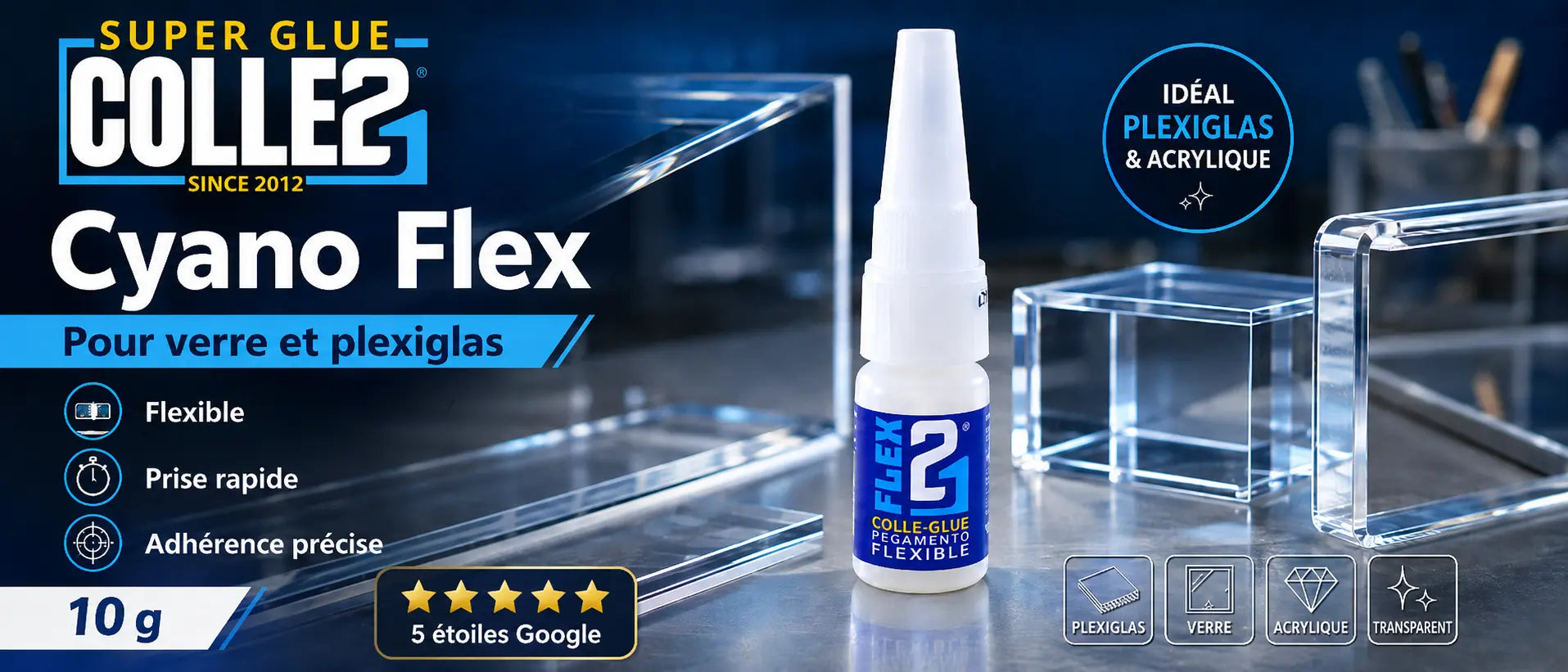
What is the most suitable glue for Plexiglas?
What glue to use for plexiglass? Plexiglas is appreciated for its transparency, its lightness and its aesthetic appearance. It is found in windows, decorative objects, signs, models, transparent protections, displays, technical parts or even in numerous DIY and model-making projects.
But when it is necessary to repair or assemble two Plexiglas elements, a question often arises: what glue to use for Plexiglas without leaving white marks?
For this type of transparent material, the choice of glue is particularly important. Unsuitable glue can create marks, a whitish veil around the collage or deteriorate the visual appearance of the piece.
For assemblies where aesthetics are essential, the SUPER GLUE Colle21 FLEX21 constitutes a particularly interesting solution thanks to its flexible formulation and its very low risk of white traces linked to cyanoacrylate vapors.

What is the best glue for Plexiglas?
To glue Plexiglas, it is important to use a glue capable of providing good adhesion while preserving the transparent appearance of the material.
In many projects, a traditional cyanoacrylate glue can provide rapid and strong setting. However, on transparent parts, a known phenomenon must be taken into account: whitening cyanoacrylate glue, sometimes called blooming.
This phenomenon can cause the appearance of a veil or white marks around the bonding area.
For this reason, when the aesthetic result is a priority, we particularly recommend the SUPER GLUE Colle21 FLEX21.
It is particularly suitable for assemblies for which we are looking for:
- clean gluing;
- good resistance;
- more flexibility;
- a reduced risk of white marks;
- a discreet result on transparent materials.
Why can glue leave white marks on Plexiglas?
When certain cyanoacrylate glues harden, vapors may be released.
These vapors may settle around the bonding area, particularly on smooth, shiny or transparent surfaces.
The result can take the form:
- with a whitish veil;
- halos;
- small white marks;
- a loss of transparency around the collage.
On a black, opaque or barely visible part, this phenomenon can sometimes go unnoticed.
On transparent Plexiglas, however, it becomes much more annoying.
It is precisely for this reason that the choice of a suitable glue is essential.
The SUPER GLUE Colle21 FLEX21 is particularly interesting for work where you want to maintain a clean appearance and limit traces linked to cyanoacrylate vapors.
SUPER GLUE Colle21 FLEX21: particularly interesting for transparent parts
On a transparent material, mechanical performance is not enough.
The result must also be aesthetic.
A white mark around a repair can be very visible, particularly on:
- a miniature display case;
- a model;
- a modeling element;
- a display;
- a Plexiglas plate;
- transparent protection;
- a decoration;
- a collector's item.
The SUPER GLUE Colle21 FLEX21 is therefore particularly recommended when the objective is to obtain a discreet and clean bond.
For detailed work, it is better to apply a very small amount of glue exactly where it is needed rather than using too much.
Excessive quantity does not necessarily improve bond strength and increases the risk of overflow.
How to glue Plexiglas correctly?
The quality of the result depends as much on the glue chosen as on the preparation of the surfaces.
1. Clean both surfaces
Before bonding, the surfaces must be:
- clean;
- dry;
- free from dust;
- free of fat;
- free from fingerprints in the assembly area.
A contaminated surface can significantly reduce adhesion.
2. Check the fit of the parts
Position the two parts before applying the glue.
This step ensures that the surfaces match correctly and avoids unnecessary repositioning once the glue has been deposited.
3. Apply very little glue
With cyanoacrylate glue, a small amount is usually sufficient.
Drop it SUPER GLUE Colle21 FLEX21 only on the area to be assembled.
4. Position parts accurately
Once the glue has been applied, assemble the two elements respecting their final position.
Hold them correctly for the time necessary for them to set.
5. Avoid handling the collage immediately
Even if the setting is rapid, it is preferable not to unnecessarily stress the assembly just after gluing.
Final resistance continues to develop after initial setting.
Can we use classic SUPER GLUE on Plexiglas?
Yes, depending on the exact nature of the part and the application.
A SUPER GLUE Colle21 can provide excellent adhesion to many materials.
However, on a transparent surface, the main concern is often less resistance and more the final appearance of the collage.
Traditional cyanoacrylate can generate vapors that can cause bleaching around the bonded area.
This is why, when the room must remain particularly clean and transparent, the SUPER GLUE Colle21 FLEX21 is generally a more suitable choice.
Can you repair a crack in Plexiglas with cyanoacrylate glue?
It depends on the importance of the crack and the stresses to which the part will be subjected.
For a small break or the assembly of two correctly adjusted elements, a SUPER GLUE Colle21 FLEX21 can be an effective solution.
On the other hand, a large crack on a heavily stressed structural part requires more in-depth analysis.
You must always take into account:
- the size of the repair;
- the thickness of the Plexiglas;
- the weight supported;
- vibrations;
- movements;
- exposure to shocks;
- the temperature.
A glue should always be chosen based on the actual use of the part.
How much glue to use on Plexiglas?
One of the most common mistakes is to think that the more glue you apply, the stronger the bond will be.
With cyanoacrylate, this is generally not true.
A thin, properly distributed layer is often much more effective than an excessive amount.
Too much glue can:
- overflow onto the transparent surface;
- make the collage less aesthetic;
- increase the quantity of residue around the assembly;
- complicate the positioning of the parts.
With the SUPER GLUE Colle21 FLEX21, simply apply the amount needed for assembly.
Our customers’ opinions on SUPER GLUE COLLE21
User satisfaction is also an important element in choosing a bonding solution.
SUPERGLUE COLLE21⭐⭐⭐⭐⭐has more than 500 Google reviews, coming from individuals, modelers, craftsmen and professionals who use the products Colle21 for many applications.
This feedback also allows us to continue to develop a range that meets different expectations: precision, speed, transparency, viscosity, flexibility and ease of use.

SUPER GLUE Colle21, producers of cyano glue and professional adhesives
Since 2012, SUPER GLUE COLLE21 develops and distributes a complete range of cyanoacrylate glues and professional adhesive solutions, intended for both individuals and professionals.
With more than 140 references, our range meets many applications: different viscosities of cyanoacrylates, flexible glues, gels, activators, primers and specialized bonding solutions.
👷♂️ Are you a professional or would you like to become a distributor of SUPER GLUE COLLE21?
Professionals can benefit from a dedicated catalog, of preferential rates and conditions, of a personalized support as well as the possibility of creating custom labels or in co-branding with their brand or brand.
We support many professions and sectors: bodywork, dental prosthesis, nail prosthesis, model making, DIY, repair, 3D printing, aquascaping, fishing, radio control, industry, decoration and specialized shops.
📩 Contact us to receive our professional catalog and discover the SUPER GLUE COLLE21 solutions adapted to your activity.

FAQ – What glue to use for Plexiglas?
What glue should I use to glue transparent Plexiglas?
For a collage where the visual aspect is important, the SUPER GLUE Colle21 FLEX21 is particularly interesting, in particular because it limits the risk of white traces associated with the vapors of certain cyanoacrylates.
Why does my glue leave white marks on Plexiglas?
These traces can be caused by the vapors released during the polymerization of a cyanoacrylate glue. They can settle on transparent surfaces and form a whitish veil.
How to glue Plexiglas without white marks?
Use a very small amount of glue, avoid spills, work on perfectly clean surfaces and choose a formulation with a low risk of whitening such as SUPER GLUE Colle21 FLEX21.
Is FLEX21 only intended for Plexiglas?
No. The SUPER GLUE Colle21 FLEX21 can be used for different applications where more flexible glue and clean bonding are desired.
Why choose flexible glue?
A flexible glue can better support small vibrations or movements of certain parts than an extremely rigid glue. This can be interesting on assemblies subject to slight mechanical stresses.
Can we use a lot of glue to strengthen the bond?
No. A large quantity does not necessarily mean greater strength. A thin, correctly positioned layer generally provides a cleaner, more efficient bond.
So, which glue to choose for Plexiglas?
To glue Plexiglas, you don't just have to look for a powerful glue.
It is also necessary to protect the transparency and aesthetics of the room.
On this type of material, white traces linked to the vapors of certain cyanoacrylates can quickly become visible.
For this reason, the SUPER GLUE Colle21 FLEX21 is a particularly suitable solution when you are looking for a clean, resistant, flexible and discreet bond.
The secret to a good result remains simple: clean surfaces correctly, use very little glue, work with precision and choose a glue suited to the material.
With its wide range of bonding solutions, SUPER GLUE Colle21 allows you to select the product best suited to the needs of each project.
You can find the products SUPER GLUE Colle21 directly on our site and also on our official Amazon store Colle21.

🎯 Let's stick with it Colle21 !