Can you stick to a painted surface? Yes, in some cases, but the strength of the bond depends as much on the paint as on the glue used.
When you apply a SUPER GLUE Colle21 on a painted surface, the glue first adheres to the coat of paint, and not directly to the metal, plastic or wood underneath.
This means that loose, peeling, greasy or fragile paint can become the weak point of the entire repair.
The essential rule is therefore simple:
solid and perfectly adherent paint → gluing possible
fragile or peeling paint → it is better to prepare the surface before sticking

Why can paint reduce adhesion?
A paint creates an intermediate layer between the glue and the material.
Even if a SUPER GLUE Colle21 adheres perfectly to this paint, the whole thing may come off if the paint itself comes off the support.
Before gluing, check that the paint:
- does not flake;
- does not come off;
- is not powdery;
- is not greasy;
- is completely dry;
- holds up well when you rub it lightly.
A good collage always starts with a stable, clean and properly prepared surface.
Should you remove paint before sticking?
Not systematically.
If the paint is well adherent, clean and resistant, it is sometimes possible to stick directly on it.
On the other hand, for a repair subject to significant stress, it may be preferable to remove the paint locally in order to stick directly to the material.
It is particularly interesting on:
- metal;
- certain mechanical parts;
- structural repairs;
- surfaces with old or damaged paint.
In this case, you can perform a light localized sanding, remove dust then carefully degrease before gluing.
Pay attention to visible painted or varnished surfaces
On a decorative piece, a model, a bodywork or an already painted object, the aesthetic result is also important.
Some cyanoacrylate glues can leave marks, cause slight whitening around the bonding or change the appearance of certain paints or varnishes.
Before applying a SUPER GLUE Colle21 on a visible surface, it is therefore advisable to:
- carry out a test on a discrete area;
- use very little glue;
- avoid dripping;
- work on a clean, dry surface;
- do not touch the area after degreasing.
What a SUPER GLUE Colle21 use on a painted surface?
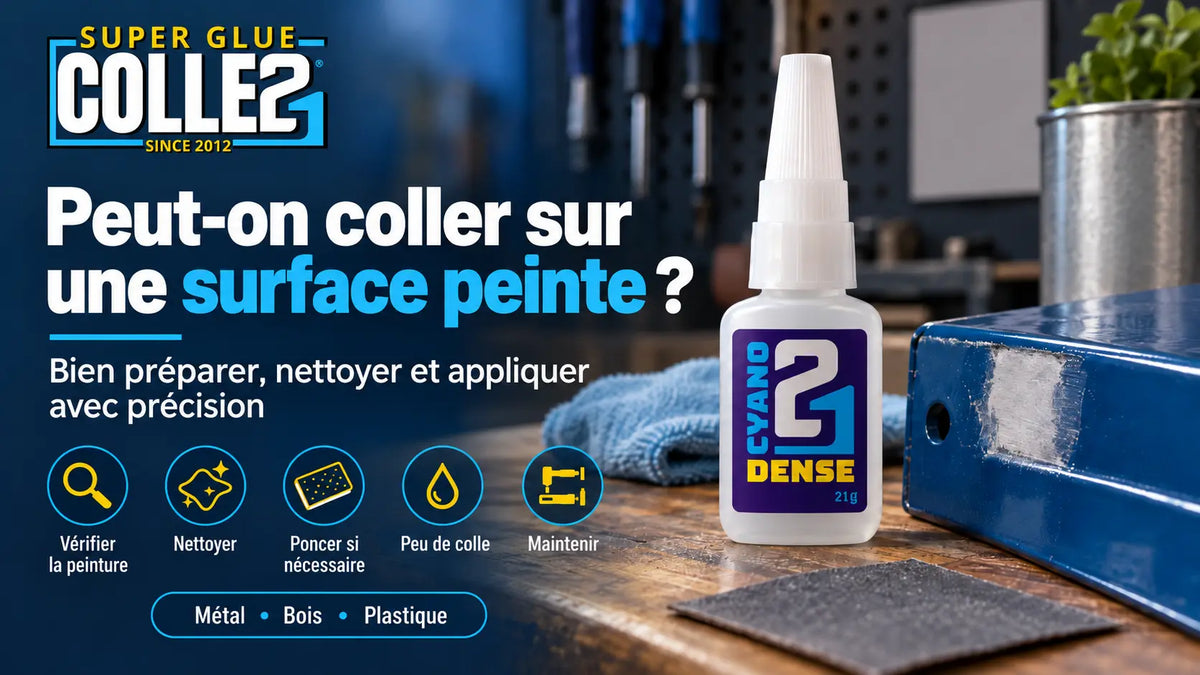
For an application requiring more control, SUPER GLUE Colle21 DENSE 21g can be particularly interesting.
Its high viscosity allows better control of the application and limits dripping on surrounding areas.
It is particularly practical for:
- small repairs;
- vertical surfaces;
- precise assemblies;
- parts with slight irregularities;
- works where it is necessary to precisely control the quantity of glue.
👉 Discover SUPER GLUE Colle21 DENSE 21g
How to properly glue a painted surface?
1. Check the condition of the paint
It must be perfectly fixed to the support.
2. Clean and degrease
Dust, oils and fingerprints can reduce adhesion.
3. Sand only if necessary
If the paint is fragile or if you are looking for significant mechanical resistance, remove the surface layer locally.
4. Use little glue
With cyanoacrylate, an excessive amount does not necessarily improve resistance.
5. Assemble without moving parts
Hold the items correctly while setting.
The method can therefore be summarized as follows:
check → clean → sand if necessary → degrease → stick → maintain
Can we stick directly to a painted body?
For a small light fixing, this may be possible if the paint is perfectly resistant.
But when a part must undergo vibrations, significant stress or prolonged use, the bonding will always depend on adhesion of paint to bodywork.
For a professional or heavily loaded repair, specific preparation of the support is therefore often preferable.
The mistake to avoid: believing that the glue sticks directly to the material
This is probably the most important point.
If you are gluing painted metal, your glue will not bond directly to the metal.
She actually achieves:
part → glue → paint → metal
If the paint comes off, the entire assembly can go with it.
For demanding repairs, working directly on properly prepared material often allows for better reliability.
Our customers’ opinions on SUPER GLUE COLLE21 ⭐⭐⭐⭐⭐
User satisfaction is also an important element in choosing a bonding solution.
SUPERGLUE COLLE21⭐⭐⭐⭐⭐ has more than 500 Google reviews, coming from individuals, modelers, craftsmen and professionals who use the products Colle21 for many applications.
This feedback also allows us to continue to develop a range that meets different expectations: precision, speed, transparency, viscosity, flexibility and ease of use.
If you like our service or our products, do not hesitate to leave us a reviews.
Your opinion is very important to us and helps us to improve and make our products and know-how known.

SUPER GLUE COLLE21: manufacturer of cyano glues and partner of professionals
Since 2012, SUPER GLUE COLLE21 develops and distributes a complete range of cyanoacrylate glues and professional adhesive solutions, intended for both individuals and professionals.
With more than 140 references, our range meets many applications: different viscosities of cyanoacrylates, flexible glues, gels, activators, primers and specialized bonding solutions.
👷♂️ Are you a professional or would you like to become a distributor of SUPER GLUE COLLE21?
Professionals can benefit from a dedicated catalog, of preferential rates and conditions, of a personalized support as well as the possibility of creating custom labels or in co-branding with their brand or brand.
We support many professions and sectors: bodywork, dental prosthesis, nail prosthesis, model making, DIY, repair, 3D printing, aquascaping, fishing, radio control, industry, decoration and specialized businesses.
📩 Contact us to receive our professional catalog and discover the solutions SUPER GLUE COLLE21 adapted to your activity.

FAQ – Can you stick to a painted surface?
Can you apply Super Glue directly to paint?
Yes, if the paint is clean, dry and perfectly adherent to the support. However, the final resistance will also depend on the strength of the paint.
Should you sand a painted surface before gluing it?
Not always. For a small, lightweight binding, this may be unnecessary. For a stressed repair or fragile paint, local sanding may be preferable.
Why can a collage come off with paint?
Because the glue adheres to the paint layer. If this layer comes off the material, the repair will also come off.
Can you glue painted metal?
Yes, but for an assembly subject to high stress, locally removing the paint and sticking directly to the prepared metal may be preferable.
Can you glue painted plastic?
Yes depending on the plastic and paint. It is advisable to test on a small area as some plastics and finishes may react differently.
Should a painted surface be degreased before gluing?
Yes. A clean, dry and degreased surface provides better adhesion conditions.
Conclusion: can you really stick to a painted surface?
Can you stick to a painted surface? Yes, provided that the paint itself is perfectly fixed to the support.
For a small repair, you can sometimes glue directly on it.
For bonding subject to more constraints, the best solution often consists of locally prepare the surface and, if necessary, remove the paint to reach the original material.
Remember this rule:
the strength of your bonding can never be better than the strength of the layer you are bonding to.
With SUPER GLUE Colle21, always choose the glue, viscosity and preparation suited to your repair.

Also find the products SUPER GLUE Colle21 on the SUPER GLUE official store Colle21 on Amazon.
Let's stick together with SUPER GLUE Colle21 ! 🚀