Should you sand before gluing? Why surface condition changes everything.
In many cases, yes: light sanding can improve the adhesion of an adhesive by removing the too smooth surface layer, old residues, certain paints or oxidation.
But be careful: not all materials need to be sanded.
The good reflex is to identify the surface, clean it properly and sand only when it really provides better grip.
With a SUPER GLUE Colle21, surface preparation is as important as the choice of glue.
Why sand a surface before gluing it?
A perfectly smooth surface can sometimes provide less grip for the adhesive.
A light sanding allows you to create a slightly rougher surface and can promote contact between the glue and the material.
Sanding also allows you to remove:
- certain paint residues;
- an old layer of glue;
- a shiny or varnished surface;
- slight traces of oxidation;
- certain irregularities.
The goal is not to dig or damage the part.
You simply have to prepare the area that will receive the glue.

What materials can be sanded before gluing?
Metal
On very smooth, painted or lightly oxidized metal, light sanding can improve surface preparation.
It is then imperative to remove the dust and degrease before applying the SUPER GLUE Colle21.
Plastic
Some plastics can be lightly sanded when they have a very shiny surface.
Be careful, however: not all plastics react in the same way. PP, PE and PTFE, for example, are naturally difficult to bond and may require specific preparation.
Wood
Sanding can provide a clean and even surface before gluing.
It is important to remove all dust created before applying the glue.
3D printing
On a part printed in PLA, ABS or PETG, light sanding can be useful to regularize a break or improve contact between two parts.
When should you not sand?
Systematically sanding is a mistake.
You should be particularly careful with:
- transparent plastics;
- decorative surfaces;
- painted parts that must maintain their finish;
- thin or fragile materials;
- surfaces already perfectly suited to bonding.
A scratch created unnecessarily may be impossible to remove, especially on a transparent part.
In this case, cleaning and degreasing correctly may be enough.
Sanding is not enough: you also have to clean
This is an essential step.
After sanding, the surface is generally covered with microdust.
If you immediately apply your Super Glue on it, you risk sticking more of the dust than the material itself.
The correct method is therefore:
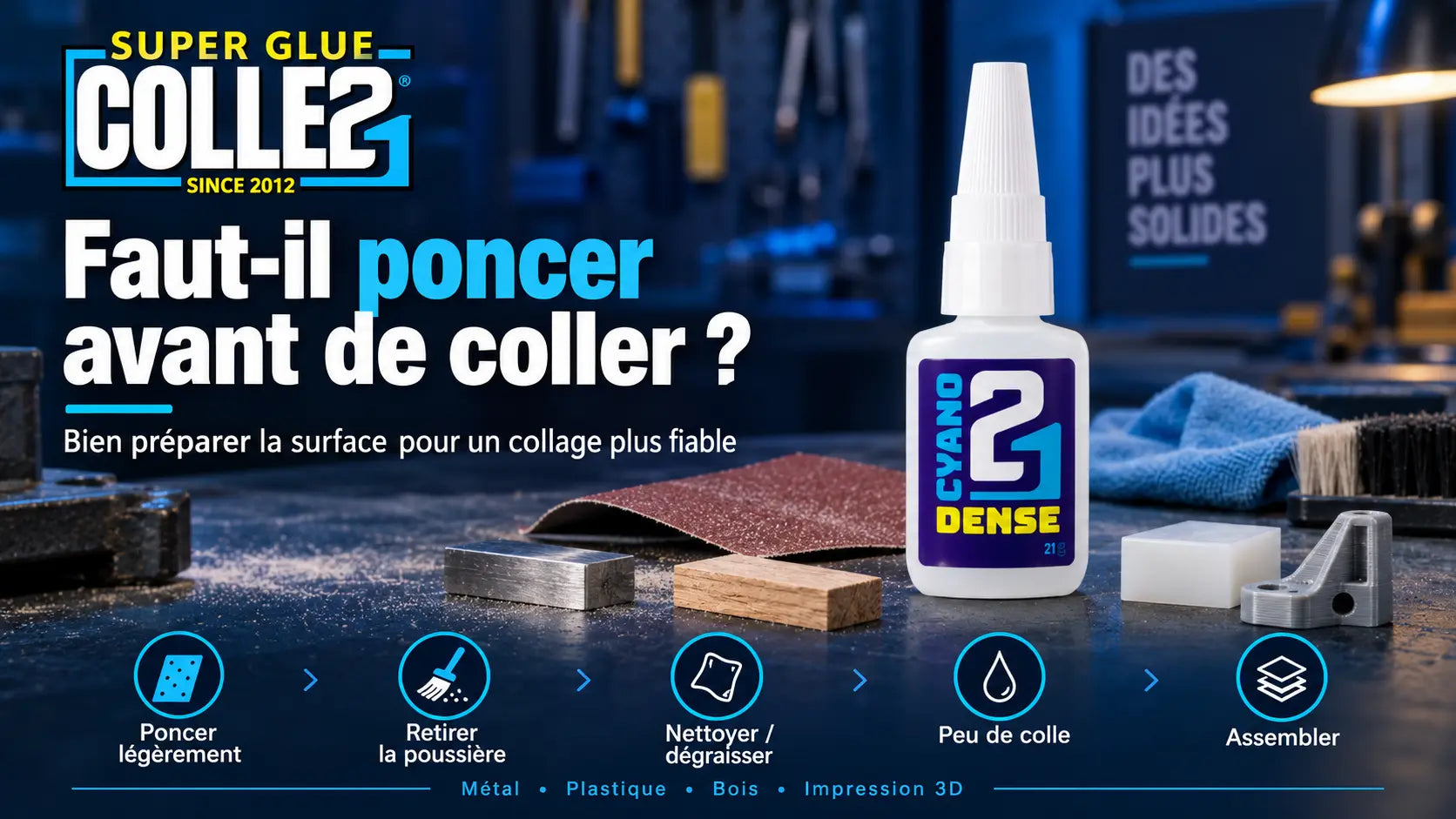
sand lightly → remove dust → clean → degrease → let dry → stick.
Also avoid touching the area with your fingers once it has been cleaned, as perspiration and greasy marks can reduce the quality of the bond.
What a SUPER GLUE Colle21 use after preparation?
The choice then depends on the geometry of the repair.
When the surface has small irregularities or better application control is required, SUPER GLUE Colle21 DENSE 21g can be particularly interesting thanks to its high viscosity.
It limits dripping and makes it easier to position the glue exactly on the prepared area.
👉 Discover SUPER GLUE Colle21 DENSE 21g
One rule remains essential:
a well-prepared surface + the right amount of glue + the appropriate viscosity = better bonding conditions.
Mistakes to avoid before gluing
Even with excellent Super Glue, certain errors can compromise the result:
- sand too hard;
- leave dust after sanding;
- stick to a greasy surface;
- touch the cleaned area with your fingers;
- using too much glue;
- choose an unsuitable glue for the material.
Sanding is therefore just one step among others.
The complete surface preparation is what allows you to obtain the best adhesion conditions.
Our customers’ opinions on SUPER GLUE COLLE21 ⭐⭐⭐⭐⭐
User satisfaction is also an important element in choosing a bonding solution.
SUPERGLUE COLLE21⭐⭐⭐⭐⭐ has more than 500 Google reviews, coming from individuals, modelers, craftsmen and professionals who use the products Colle21 for many applications.
This feedback also allows us to continue to develop a range that meets different expectations: precision, speed, transparency, viscosity, flexibility and ease of use.
If you like our service or our products, do not hesitate to leave us a reviews.
Your opinion is very important to us and helps us to improve and make our products and know-how known.

SUPER GLUE COLLE21: manufacturer of cyano glues and partner of professionals
Since 2012, SUPER GLUE COLLE21 develops and distributes a complete range of cyanoacrylate glues and professional adhesive solutions, intended for both individuals and professionals.
With more than 140 references, our range meets many applications: different viscosities of cyanoacrylates, flexible glues, gels, activators, primers and specialized bonding solutions.
👷♂️ Are you a professional or would you like to become a distributor of SUPER GLUE COLLE21?
Professionals can benefit from a dedicated catalog, of preferential rates and conditions, of a personalized support as well as the possibility of creating custom labels or in co-branding with their brand or brand.
We support many professions and sectors: bodywork, dental prosthesis, nail prosthesis, model making, DIY, repair, 3D printing, aquascaping, fishing, radio control, industry, decoration and specialized businesses.
📩 Contact us to receive our professional catalog and discover the solutions SUPER GLUE COLLE21 adapted to your activity.

FAQ – Should you sand before gluing?
Should you always sand a surface before gluing?
No. Sanding is mainly useful on certain very smooth, painted, oxidized or irregular surfaces. A surface already suitable for bonding can simply be cleaned and degreased.
Why can sanding improve bonding?
In particular, it makes it possible to eliminate certain surface layers and create more grip for the adhesive.
Should you clean after sanding?
Yes, absolutely. All dust produced must be removed before applying the glue.
Can you sand plastic before gluing it?
Yes in some cases, but it depends on the plastic. On a transparent or aesthetic part, sanding can leave permanent marks.
Can we sand a 3D printed part before gluing?
Yes. Light sanding can help even out surfaces and improve contact before using a SUPER GLUE Colle21 adapted.
Should you add more Super Glue after sanding?
No. Excessive amount of glue does not necessarily improve strength. It is better to use a small, well-distributed quantity.
Conclusion: should you sand before gluing?
Should you sand before gluing? Yes, when the surface is too smooth, irregular, painted or slightly oxidized and the material allows this preparation.
But sanding is not a systematic obligation.
The most important thing is to follow the correct method:
identify the material → prepare the surface → sand if necessary → clean and degrease → apply the correct SUPER GLUE Colle21.
Good glue works best when the surface has been properly prepared.
Also find the products SUPER GLUE Colle21 on the SUPER GLUE official store Colle21 on Amazon.

Let's stick together with SUPER GLUE Colle21 ! 🚀