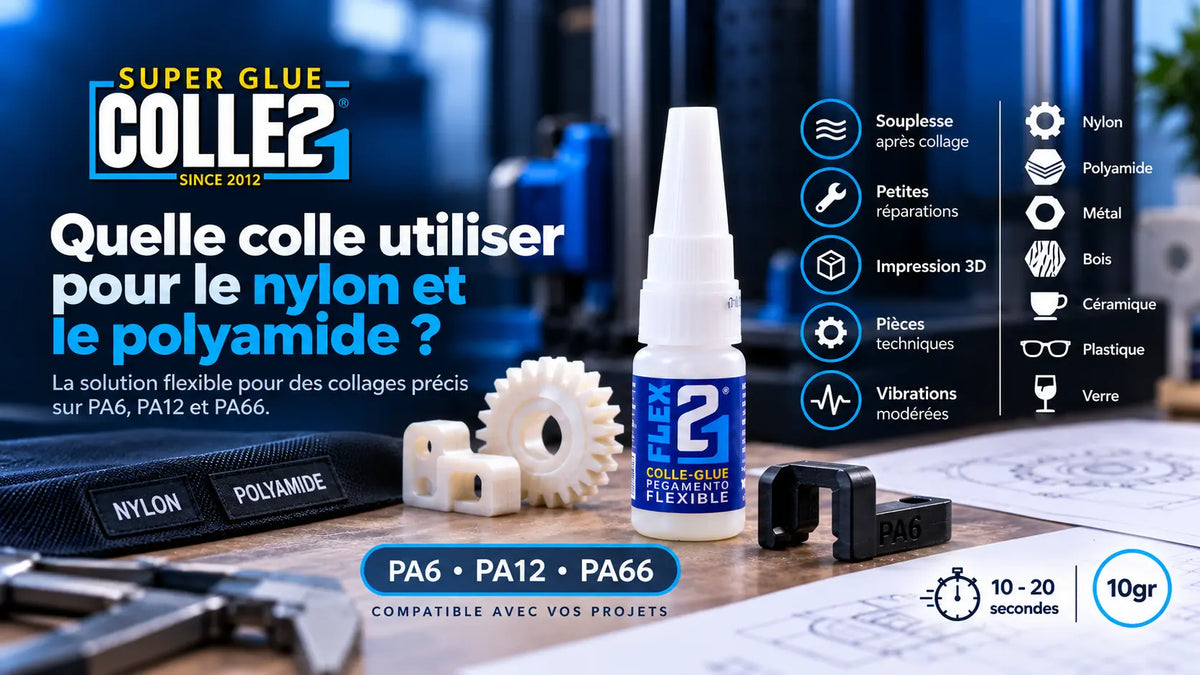
What glue should I use for nylon and polyamide? For a small repair or precise assembly, a slightly flexible cyanoacrylate glue can be an interesting solution, provided that the surface is perfectly clean, dry and properly prepared.
Nylon belongs to the family of polyamides, which we find in particular under the names PA6, PA12 or PA66. These materials are widely used in 3D printing, automobiles, model making and technical parts thanks to their mechanical resistance and their ability to withstand certain deformations.
For this type of application, SUPER GLUE Colle21 FLEX 21 can be particularly interesting when rapid bonding must maintain a certain flexibility.

Why are nylon and polyamide sometimes difficult to bond?
Nylon has very interesting properties, but its surface can be more difficult to bond than that of some conventional plastics.
Several elements can influence adhesion:
- the moisture absorbed by the material;
- the presence of manufacturing greases or lubricants;
- a very smooth surface;
- certain additives present in polyamide;
- the flexibility of the part.
The first rule is therefore simple:
Before looking for a stronger glue, first prepare the surface properly.
What a SUPER GLUE Colle21 choose nylon?
For a small repair, a 3D printed part or an assembly subject to slight movements, SUPER GLUE Colle21 FLEX 21 can be interesting.
Its cyanoacrylate formulation retains a certain flexibility after polymerization, which allows the bonding to better support vibrations and small deformations than a totally rigid adhesive.
It can be used in particular for:
- certain parts in nylon or polyamide;
- 3D prints in PA;
- small repairs;
- precise assemblies;
- parts subject to moderate vibrations or movements.
👉 Discover SUPER GLUE Colle21 FLEX 21
As nylon and polyamide formulations can vary widely, it is always advisable to carry out a test on a small area before final bonding.
How to prepare nylon before gluing it?
1. Clean and degrease
The surface must be clean, dry and free of oils, dust and fingerprints.
This step is essential, particularly on certain molded parts that may have surface residue.
2. Dry the room properly
Nylon is a material that can absorb moisture.
Before gluing, make sure that the surface is perfectly dry.
3. Lightly sand if necessary
If the polyamide is particularly smooth, a light sanding can create more mechanical grip.
All dust must then be carefully removed.
4. Apply little glue
With a SUPER GLUE Colle21, a large amount of product does not necessarily mean a stronger bond.
Apply a thin, controlled layer.
5. Maintain parts
Position the elements correctly and avoid moving them while shooting.
The method can be summarized as follows:
clean → dry → sand if necessary → degrease → apply a little glue → maintain.
What glue for 3D printed nylon?
Nylon is widely used in technical 3D printing, in particular to produce gears, supports, hinges, mechanical parts or elements that must withstand stress.
For a small repair on 3D printed PA6 or PA12, a SUPER GLUE Colle21 flexible can enable quick and precise assembly.
However, it is necessary to observe the function of the part.
A decorative or lightly stressed part does not have the same requirements as a mechanical component permanently subjected to significant stress.
For a very heavily stressed part or an important structural assembly, a epoxy glue or a technical adhesive solution suitable for polyamide may be preferable.
Nylon on nylon, metal or plastic: what's the difference?
Nylon on nylon
Properly prepare both surfaces and favor bonding capable of supporting small deformations of the material.
Nylon on metal
The metal must be completely degreased. Light sanding can also improve the preparation of some metal surfaces.
Nylon on plastic
We must identify the second plastic.
PE, PP or PTFE, for example, do not need to be treated exactly like nylon and may require specific preparation.
The right reflex is therefore always:
identify the two materials before choosing the glue.
Should you use a primer to bond nylon?
Not systematically.
Nylon should not be confused with plastics with very low surface energy such as PE, PP or PTFE.
A primer intended specifically for these plastics should therefore not be used automatically just because nylon seems difficult to bond.
For nylon or polyamide, first start with:
clean, degrease, dry and lightly sand if necessary.
Mistakes to avoid with nylon and polyamide
To obtain a more reliable bond, avoid in particular:
- to stick a damp surface;
- leave grease or fingerprints;
- using too much glue;
- stick directly to a very smooth surface without checking adhesion;
- to stress the part immediately after gluing;
- to consider all polyamides as identical.
Between a PA6, PA12, PA66 or fiber-filled nylon, behavior may vary.
A little preliminary testing therefore remains particularly useful.
Our customers’ opinions on SUPER GLUE COLLE21 ⭐⭐⭐⭐⭐
User satisfaction is also an important element in choosing a bonding solution.
SUPERGLUE COLLE21⭐⭐⭐⭐⭐ has more than 500 Google reviews, coming from individuals, modelers, craftsmen and professionals who use the products Colle21 for many applications.
This feedback also allows us to continue to develop a range that meets different expectations: precision, speed, transparency, viscosity, flexibility and ease of use.
If you like our service or our products, do not hesitate to leave us a reviews.
Your opinion is very important to us and helps us to improve and make our products and know-how known.

SUPER GLUE COLLE21: manufacturer of cyano glues and partner of professionals
Since 2012, SUPER GLUE COLLE21 develops and distributes a complete range of cyanoacrylate glues and professional adhesive solutions, intended for both individuals and professionals.
With more than 140 references, our range meets many applications: different viscosities of cyanoacrylates, flexible glues, gels, activators, primers and specialized bonding solutions.
👷♂️ Are you a professional or would you like to become a distributor of SUPER GLUE COLLE21?
Professionals can benefit from a dedicated catalog, of preferential rates and conditions, of a personalized support as well as the possibility of creating custom labels or in co-branding with their brand or brand.
We support many professions and sectors: bodywork, dental prosthesis, nail prosthesis, model making, DIY, repair, 3D printing, aquascaping, fishing, radio control, industry, decoration and specialized businesses.
📩 Contact us to receive our professional catalog and discover the solutions SUPER GLUE COLLE21 adapted to your activity.

FAQ – Which glue to use for nylon and polyamide?
What is the best glue for nylon?
It depends on the application. For a small repair requiring speed and a certain flexibility, a SUPER GLUE Colle21 FLEX 21 can be interesting. For a highly structural assembly, another adhesive technology may be preferable.
Can you use Super Glue on nylon?
Yes, a cyanoacrylate glue can work on many properly prepared polyamides. However, the exact formulation of the nylon can influence the result.
What glue should I use for 3D printed PA12?
For a small repair or precise assembly in PA12, a flexible cyanoacrylate can be used after cleaning and preparing the surfaces.
Should nylon be sanded before gluing?
Not necessarily, but light sanding can improve adhesion when the surface is particularly smooth.
Why do you need to dry nylon well before gluing?
Nylon can absorb moisture. A clean, dry surface provides the best conditions for achieving good adhesion.
Can you glue nylon to metal?
Yes. Above all, it is necessary to carefully prepare the two materials, in particular by thoroughly degreasing the metal surface.
Do PA6, PA12 and PA66 stick in the same way?
Not always. Their formulation, additives and mechanical properties may vary. It is therefore recommended to carry out a preliminary test before a major application.
Conclusion: which glue to choose for nylon and polyamide?
What glue should I use for nylon and polyamide?
For a small repair, a precise assembly or certain 3D printed parts, a SUPER GLUE Colle21 flexible can be particularly interesting.
But the product is not everything.
The quality of the bonding depends above all on the preparation:
clean surface → perfectly dry → lightly sanded if necessary → little glue → good hold during setting.
And for a highly stressed mechanical part, always adapt the bonding technology to the exact type of polyamide and the actual constraints of the assembly.
Also find the products SUPER GLUE Colle21 on the SUPER GLUE official store Colle21 on Amazon.

Let's stick together with SUPER GLUE Colle21 ! 🚀