
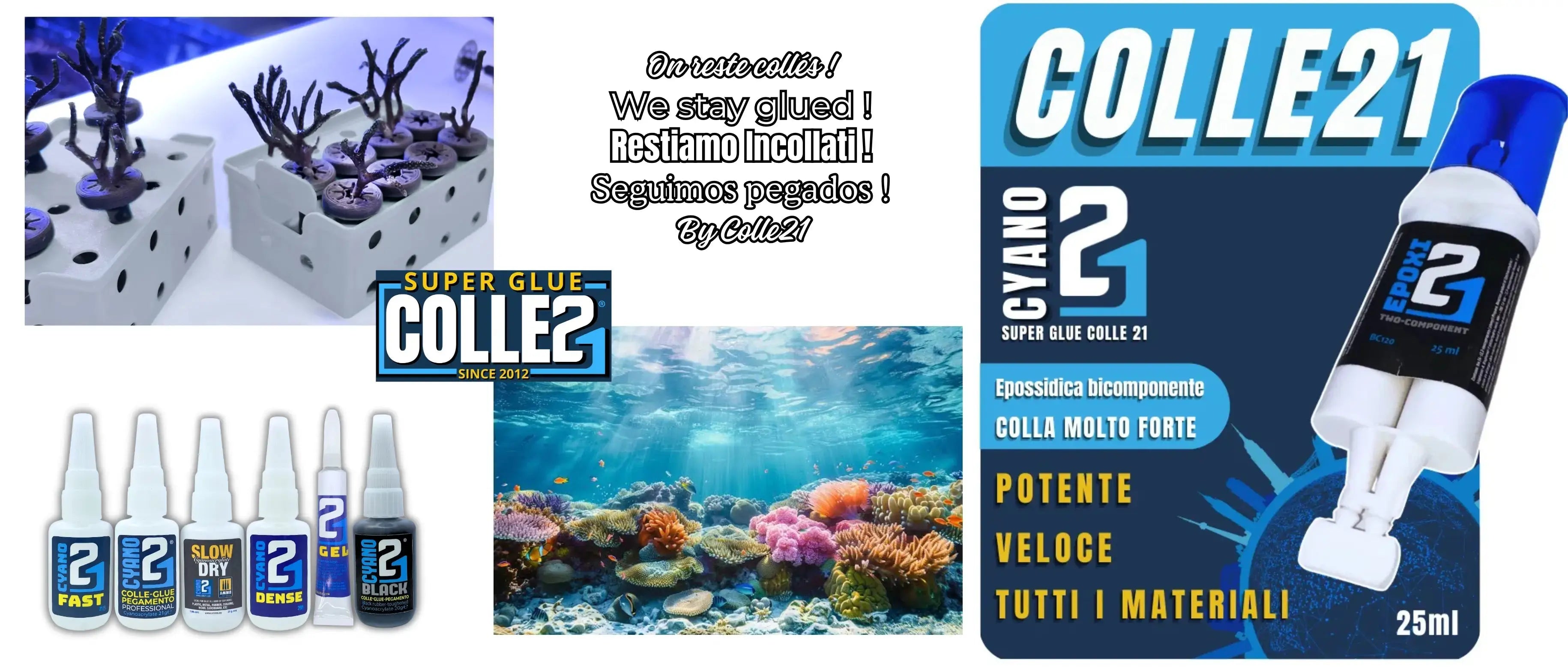
Which glue to choose for corals? Complete Guide to Fixing Fragments in a Reef Aquarium
Glue for corals, Which glue to choose for corals? Cyanoacrylate gel, epoxy and fixation on living stone: how to obtain a clean, stable and durable bond?
Which glue to choose for corals? In a reef aquarium, the positioning of corals should never be left to chance. A loosely fixed fragment may fall, come into contact with another coral, be displaced by mixing or end up in an area that does not correspond to its needs.
To avoid these problems, many aquarists use a coral glue specially adapted for fixing cuttings, plugs and small elements of reef decor.
But which glue to choose? Should we use a cyanoacrylate gel glue, an epoxy resin or a solution combining several products? How to fix a coral on a stone without damaging its tissues?
This guide helps you understand the different solutions and adopt good practices for successful collages in a marine aquarium.
Why use a Which glue to choose for corals?
Which glue to choose for corals? In a reef aquarium, corals are subject to water movement, fish, invertebrates and the manipulations necessary for maintaining the tank.
A suitable fixing makes it possible to:
✅ stabilize a coral cutting;
✅ hold a fragment on a stone or support;
✅ avoid falls caused by mixing;
✅ organize the reef scenery more precisely;
✅ position each coral according to its needs for light and water circulation;
✅ facilitate the progressive growth of the fragment on its support.
However, glue is no substitute for thoughtful installation. Before any definitive fixation, it is necessary to observe the behavior of the coral and choose a location adapted to its species.
Which glue to choose for corals?
Which glue to choose for corals? Several solutions exist for fixing a coral in a marine aquarium. The choice depends mainly on the size of the fragment, the shape of the support and the desired holding time.
Which glue to choose for corals? Cyanoacrylate gel glue
The cyanoacrylate gel glue is one of the most used solutions for small cuttings and fragments mounted on plugs.
Its thick texture has several advantages:
-
it stays in place better than a very liquid glue;
-
it facilitates dosing;
-
it allows you to work on a specific area;
-
it offers quick support;
-
it is suitable for small surfaces and localized assemblies.
For reef use, only a formulation must be selected whose compatibility with the marine aquarium and permanent immersion is clearly confirmed by the manufacturer.
Which glue to choose for corals? Resin epoxy for aquarium
Which glue to choose for corals? Epoxy resin or paste is often chosen for larger elements, irregular supports and assemblies requiring more material.
It can be used to:
-
wedge a fragment into a cavity;
-
stabilize a plug on a rock;
-
fill a space between two surfaces;
-
reinforce a heavier assembly.
Its processing time is generally longer than that of a cyanoacrylate. However, it allows you to shape the support and better match irregular shapes.
Here again, it is essential to choose an epoxy specifically intended for marine aquariums.
The combined cyanoacrylate and epoxy
For certain fixations, aquarists use a combined method:
-
a small amount of cyanoacrylate gel glue;
-
a ball of epoxy paste;
-
a new small amount of gel;
-
the positioning of the fragment on the rock.
This technique combines the rapid setting of the gel with the filling capacity of the epoxy. It can be useful for irregular supports or fragments that are more difficult to stabilize.
Which glue to choose depending on the type of coral?
The choice depends less on the name of the coral than on its shape, its fragility and its support.
For hard corals with small polyps
Hard coral fragments, often mounted on a plug or having a rigid base, can generally be fixed with glue cyanoacrylate in gel ccompatible with the reef aquarium.
The product must be applied only to the mineral part or to the support, never directly to living tissues.
For hard corals with large polyps
These corals often have more sensitive fleshy tissues. Handling must be particularly careful.
The fixation must be on the skeleton or on the plug, avoiding any contact between the glue and the tissues.
Which glue to choose for soft corals
Soft corals can be trickier to bond directly to, because their surface is soft, moist, and sometimes covered in mucus.
Depending on the species, temporary mechanical fixation may be preferable:
-
very light elastic;
-
suitable thread;
-
perforated support;
-
container with small rock debris;
-
grid or net designed for cuttings.
Once naturally attached to a small support, the coral can be positioned more easily in the decor.
How to paste a coral fragment step by step?
1. Choose the location
Before gluing, check:
-
light intensity;
-
the strength of the mixing;
-
the distance from other corals;
-
the room available for growth;
-
the stability of the stone.
A high-performance glue will never compensate for a bad location.
2. Prepare the support
Remove any crumbly debris, algae or residue from the attachment area.
When possible, work on a small, clean, relatively stable area.
3. Handle coral with care
Wear suitable gloves and avoid touching living tissue. Hold the fragment by its base, support or plug.
Some species can produce irritating or toxic substances. Hand and eye protection therefore remains recommended.
4. Apply a small amount of glue
Excessive quantity does not necessarily make the bond stronger. On the contrary, it can produce a visible mass that is difficult to control.
Place a small amount of gel on the mineral base, plug or support provided.
5. Position the fragment
Hold the fragment in the chosen location for the time necessary for initial setting.
Avoid repeated movements, which can weaken the grip.
6. Observe after fixation
After gluing, check:
-
the stability of the fragment;
-
opening of polyps;
-
absence of contact with tissues;
-
the reaction of the coral;
-
the distance from neighboring species.
Can you stick a coral directly underwater?
Some coral glues are designed to be used on a wet surface or directly in the aquarium. However, the method depends entirely on the product chosen.
With a compatible cyanoacrylate gel glue, contact with water can quickly create a thin film on the surface. It is sometimes necessary to lightly press the gel against the support in order to break this film and promote adhesion.
It is essential to follow the manufacturer's precise instructions and not improvise with an adhesive that is not intended for this purpose.
Mistakes to avoid with coral glue
Using glue without checking its compatibility
Not all super glues are automatically suitable for the marine aquarium. Additives, colorants, solvents or secondary components may vary depending on formulations.
Put some glue on living tissues
The glue must be applied to the mineral base, skeleton, plug or support. Direct contact with fabrics can damage the coral.
Using too much product
A large quantity of glue is more visible and does not guarantee better fixation.
Choosing a permanent location too quickly
Before permanently fixing a coral, observe its light and mixing needs. A poorly chosen location may require a subsequent move.
Stick to an unstable surface
The rock or support must be sufficiently strong. If the surface disintegrates, the bonding may come off with the surface layer.
Neglecting growth space
A small fragment can become a large colony. It is necessary to anticipate its development and the risks of contact with neighboring corals.
Coral glue or aquarium silicone?
Coral glue and aquarium silicone do not meet the same needs.
The cyanoacrylate gel glue is mainly used to attach fragments, plugs or small elements to a support.
The epoxy paste is useful when the assembly requires more volume or filling.
The silicone for aquarium mainly used for assembling or repairing certain glass elements. It generally requires a full polymerization time before re-watering and is not the most practical solution for attaching a small coral cutting.
How to choose a good one glue for corals?
Before purchasing, check the following:
✔️ clearly announced compatibility with marine aquariums;
✔️ suitability for permanent immersion;
✔️ formulation adapted to corals or reef fragments;
✔️ gel texture for better controlled application;
✔️ technical information and manufacturer's instructions;
✔️ absence of use on living tissues;
✔️ setting time corresponding to your working method.
A commercial designation such as “super glue” is not sufficient to guarantee suitable use in a reef aquarium.
Colle21, manufacturer of cyanoacrylate glues and professional adhesives
Colle21 develops a range of cyanoacrylate glues, gels, dense glues, activators and technical adhesives intended for many sectors, including model making, DIY, fishing, 3D printing and professional repairs.
As manufacturer of cyanoacrylate Super Glue and producer of professional adhesives, Colle21 attaches particular importance to the choice of viscosity, the precision of application and the adaptation of each product to its use.
For use on corals or in a reef aquarium, however, you should refer to the technical data sheet of the product concerned and obtain explicit confirmation of its compatibility with permanent immersion and marine organisms before use.
FAQ – Everything you need to know about coral glue
What is the best glue for corals?
For small rigid cuttings and plugs, a cyanoacrylate gel glue explicitly compatible with reef aquariums is often the most practical solution. An aquarium epoxy paste may be preferable for heavy or irregular features.
Can you use any super glue in a reef aquarium?
No. It is necessary to check the formulation and the manufacturer's instructions. Not all super glues are automatically intended for permanent immersion or contact with a reef environment.
Why choose gel glue?
The gel flows less, stays better on the application area and facilitates the precise positioning of a fragment.
Can we apply the glue directly to the coral?
The glue should be applied to the mineral base, skeleton or plug, not to living tissue.
What glue should I use for a large fragment?
For a heavier element, a marine aquarium compatible epoxy paste or a method combining cyanoacrylate gel and epoxy may provide better stability.
Can you stick a coral underwater?
Some products are designed for application on wet surfaces or underwater. You must follow the manufacturer's instructions exactly.
Why is my fragment coming loose?
The cause may be a dirty, crumbly or too smooth surface, an insufficient or excessive quantity of product, too short a holding time or an unstable support.
How long should the coral be maintained?
It depends on the glue used. Respect the setting time indicated on the packaging or the technical sheet.
Can you move a coral after gluing?
This is sometimes possible, but removal may damage the media, plug or rock. It is better to test the location before final fixation.
Does glue replace good decor installation?
No. The hardscape should remain stable on its own as much as possible. The glue is used to secure the fixing, not to compensate for a dangerous structure.
Where to discover the products Colle21 ?
Find the full range Colle21 on our official store:
Also discover a selection of our professional cyanoacrylate glues, gels, dense glues, activators and accessories on our shop Amazon official Colle21.
Before any use in a reef aquarium, consult the technical sheet of the chosen product and check its compatibility with corals and permanent immersion.
Conclusion
Choose one coral glue requires more precautions than for traditional bonding. The stability of the fragment, protection of living tissues, compatibility with seawater and composition of the adhesive must be taken into account.
A suitable cyanoacrylate gel glue can make it easier to attach small cuttings, while an epoxy paste intended for aquariums is better suited to large or irregular assemblies.
The best result always depends on three elements: a well-chosen location, careful handling and a product whose compatibility with the reef aquarium is clearly established.
🎯 When a single letter can change the choice… and the result of your purchase.
⚠️ Beware of imitations: Colle21 is written with an “E”.