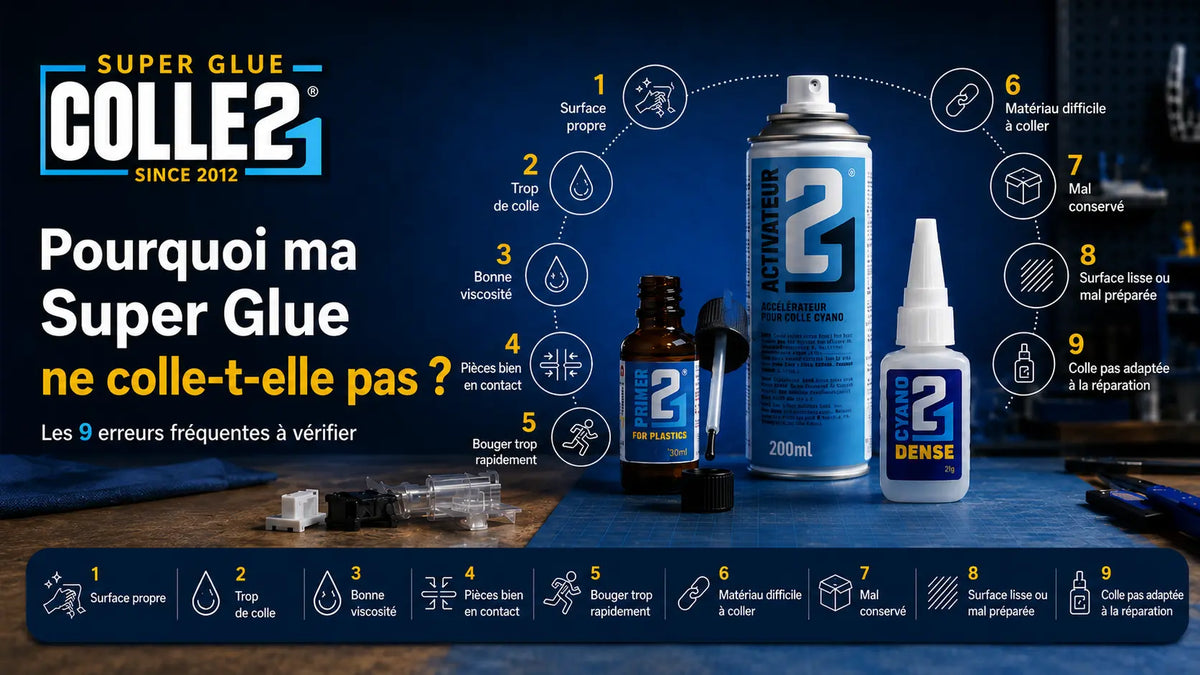
Why is my Super Glue not sticking? This is a common question, and the answer does not necessarily come from the quality of the glue.
A SUPER GLUE Colle21 can be very effective, but strong bonding depends on several elements: clean surface, suitable quantity, good viscosity, sufficient contact between parts and product adapted to the material.
Here are the main causes of a bond that does not hold.

1. The surface is dirty or greasy
Why is my Super Glue not sticking?
Even when a part appears clean, it may contain grease, dust, fingerprints, oil, moisture or manufacturing residue.
These contaminants create a barrier between the SUPER GLUE Colle21 and the surface.
Before bonding, it is therefore essential to clean, degrease and dry both parts carefully.
2. You are using too much Super Glue
Why is my Super Glue not sticking?
With cyanoacrylate glue, more glue does not mean more strength.
Too thick a layer can slow setting and prevent the surfaces from being close enough.
Instead apply a small amount of SUPER GLUE Colle21, then immediately put the two pieces together.
Less glue, but better applied, often gives a better result.
3. You are not using the correct viscosity
Not all repairs require the same Super Glue.
Liquid glue is suitable for perfectly fitted surfaces. Where there is a slight gap or uneven surfaces, a thicker glue is often preferable.
SUPER GLUE Colle21 offers different viscosities: liquid, Fast, Dense, Gel, Flex and other specialized formulations.
For example, SUPER GLUE Colle21 DENSE allows for controlled application and is suitable for irregular surfaces or assemblies with a slight gap.
👉 Discover SUPER GLUE Colle21 DENSE 21 g
Sometimes the problem is simply of unsuitable viscosity.
4. The two parts are not in sufficient contact
Cyanoacrylate glue works particularly well when surfaces are very close to each other.
If the gap is too large, liquid glue may not be suitable.
You must then choose a Gel or Dense formula, improve the fit or fill in the missing part.
5. You move pieces too quickly
Super Glue is quick, but the pieces must remain correctly positioned while setting.
After application of SUPER GLUE Colle21, assemble, press and let set without moving the elements.
Clean → apply → assemble → press → let set.
6. The material is difficult to glue
Metal, wood, ceramics, some plastics and rubber can be bonded with a suitable cyanoacrylate. On the other hand, polypropylene (PP), polyethylene (PE) and PTFE are more difficult to bond.
In these cases, a specific primer may be necessary before applying the glue.
👉 Discover the SUPER GLUE primer Colle21
However, the primer is not essential for all materials: you must first identify the material to be glued.
An activator can also speed up setting and facilitate certain bonding.
👉 Discover the SUPER GLUE activator Colle21
7. Your Super Glue is old or poorly stored
Improperly stored cyanoacrylate glue can change viscosity or lose effectiveness.
If it becomes very thick, forms lumps or takes an unusually long time to set, check its condition and storage conditions.
8. Surfaces are too smooth or poorly prepared
Some very smooth surfaces offer little mechanical grip. Depending on the material, light sanding may improve adhesion.
However, this preparation must be adapted to the part so as not to damage it.
9. Glue is not suitable for repair
There is no one Super Glue that is perfect for all situations.
A vertical repair, a thin crack, a flexible part or a gap to be filled require different products.
This is why SUPER GLUE Colle21 offers more than 140 references : different viscosities, Gel, Dense, Flex glues, activators, primers and specialized solutions.
The objective is simple:
use the correct SUPER GLUE Colle21 for the right material and the right repair.
Our customers’ opinions on SUPER GLUE COLLE21 ⭐⭐⭐⭐⭐
User satisfaction is also an important element in choosing a bonding solution.
SUPERGLUE COLLE21⭐⭐⭐⭐⭐ has more than 500 Google reviews, coming from individuals, modelers, craftsmen and professionals who use the products Colle21 for many applications.
This feedback also allows us to continue to develop a range that meets different expectations: precision, speed, transparency, viscosity, flexibility and ease of use.
If you like our service or our products, do not hesitate to leave us a reviews.
Your opinion is very important to us and helps us to improve and make our products and know-how known.

SUPER GLUE COLLE21: manufacturer of cyano glues and partner of professionals
Since 2012, SUPER GLUE COLLE21 develops and distributes a complete range of cyanoacrylate glues and professional adhesive solutions, intended for both individuals and professionals.
With more than 140 references, our range meets many applications: different viscosities of cyanoacrylates, flexible glues, gels, activators, primers and specialized bonding solutions.
👷♂️ Are you a professional or would you like to become a distributor of SUPER GLUE COLLE21?
Professionals can benefit from a dedicated catalog, of preferential rates and conditions, of a personalized support as well as the possibility of creating custom labels or in co-branding with their brand or brand.
We support many professions and sectors: bodywork, dental prosthesis, nail prosthesis, model making, DIY, repair, 3D printing, aquascaping, fishing, radio control, industry, decoration and specialized shops.
📩 Contact us to receive our professional catalog and discover the solutions SUPER GLUE GLUE21 adapted to your activity.

FAQ – Why is my Super Glue not sticking?
Why is my Super Glue not holding?
The most common causes are a dirty or greasy surface, an excessive amount of glue, poor viscosity, poor contact between parts or a material that is difficult to bond.
Do you have to use a lot of Super Glue to get a solid bond?
No. A thin, even layer is generally preferable to a large amount of product.
Why does my Super Glue stay liquid?
This can be caused by an excessive amount of glue, gluing conditions, the material or old or poorly preserved glue.
What viscosity of Super Glue to choose?
For two perfectly fitted surfaces, liquid cyano is usually suitable. For an irregular surface or a slight gap, a SUPER GLUE Colle21 DENSE or Gel may be more appropriate.
Why doesn't my Super Glue stick to certain plastics?
Some plastics like PP, PE and PTFE have low surface energy and are naturally difficult to bond.
Specific preparation may then be necessary.
Should you sand before using Super Glue?
It depends on the material.
Light sanding can improve adhesion on certain surfaces, but it is not recommended in all situations.
Conclusion: why is my Super Glue not sticking?
If your Super Glue does not stick, no need to add more product.
Check instead the cleanliness of the surfaces, the quantity of glue, the chosen viscosity, the material, the fit of the parts and the condition of your glue.
The secret to a good collage is to use the good SUPER GLUE Colle21, on the right material and with the right method.
With more than 140 references, SUPER GLUE Colle21 offers solutions suitable for DIY, model making and professional applications.
Find the products SUPER GLUE Colle21 on our site as well as on the SUPER GLUE official store Colle21 on Amazon.

Let's stick together with SUPER GLUE Colle21 ! 🚀