
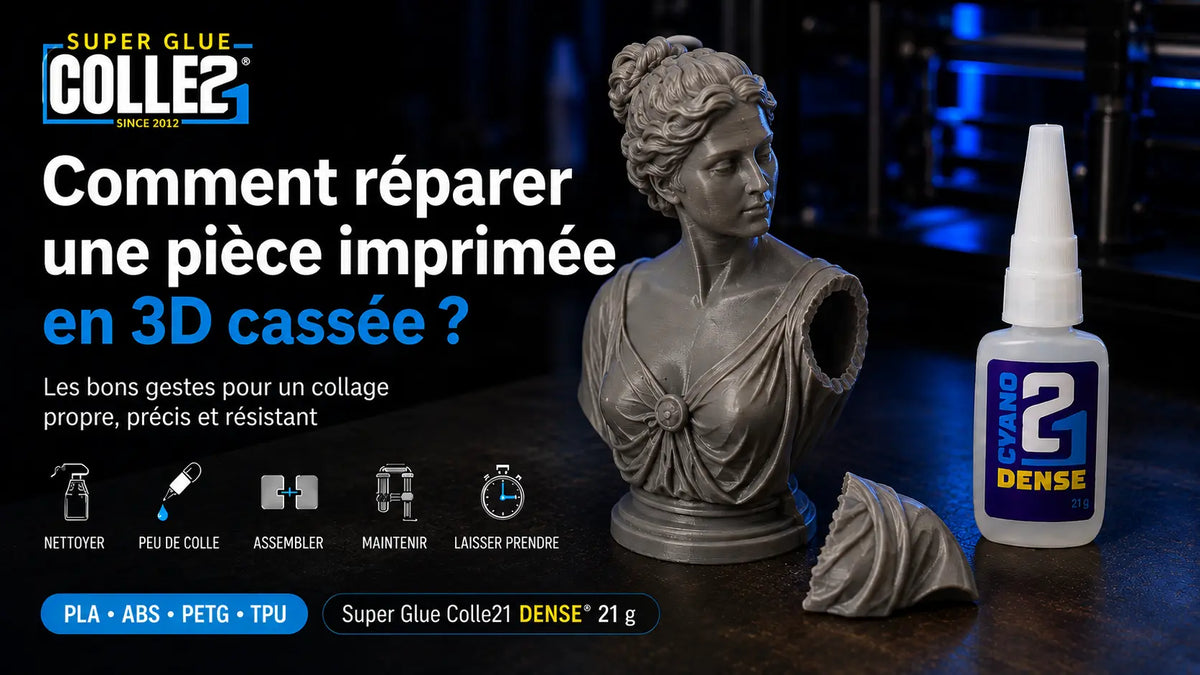
How to repair a broken 3D printed part ? A part made of PLA, ABS, PETG or resin can break after a fall, an impact, poor handling or simply because an area that is too thin.
In many cases, it is not necessary to completely reprint the part.
With good preparation and SUPER GLUE Colle21 adapted, it is possible to carry out a clean, precise and resistant repair.
The first step, however, is to identify the printed material, because not all filaments stick together in exactly the same way.

What glue should I use to repair a 3D print?
For a rigid 3D printed part, cyanoacrylate glue is often a practical solution thanks to its rapid setting and precision.
SUPER GLUE Colle21 DENSE 21 g has a high viscosity which allows better control of the application and prevents the glue from dripping all over the part.
It is particularly interesting when :
- the break is not perfectly regular;
- a slight space exists between the two parts;
- the repair is vertical;
- you need to precisely position the glue;
- you want to avoid dripping.
👉 Discover SUPER GLUE Colle21 DENSE 21 g
The range SUPER GLUE Colle21 also includes different viscosities in order to adapt the bonding to the geometry of the part and the material used.
How to repair a 3D printed part step by step?
1. Check that the two pieces fit together correctly
Before using the glue, reposition the two parts dry.
They must return to their original location as precisely as possible.
If any pieces of plastic protrude or prevent the surfaces from meeting properly, carefully remove them.
2. Clean and degrease the area
Dust, fingerprints, grease or print residue may reduce adhesion.
The surface must be:
- clean;
- dry;
- dust-free;
- fat free.
On some 3D prints, a light sanding of the bonding area can also provide a more regular surface.
3. Apply little SUPER GLUE Colle21
A common mistake is to use a lot of glue thinking that the repair will be more resistant.
With a cyanoacrylate, this is generally not necessary.
Apply a small amount of SUPER GLUE Colle21 DENSE on the rupture zone.
The Dense viscosity helps keep the product more in the desired location.
4. Assemble and hold the parts
Immediately reposition both parts and hold them correctly.
It is important not to move the piece while setting.
On a complex part, if necessary use a clamp, a support or a system to maintain the original alignment.
PLA, ABS, PETG, TPU: are all 3D prints repaired the same?
No.
3D printing uses many materials and each has different characteristics.
The PLA is one of the most used filaments and can be assembled and repaired with a suitable cyanoacrylate glue.
TheABS and the PETG also require good surface preparation and it is always recommended to test compatibility on a small area.
The TPU, on the other hand, is flexible. A rigid glue is therefore not necessarily the best choice when significant bending must be maintained.
There is a simple rule to remember:
always choose the glue based on the material AND the mechanical behavior of the part.
A decorative part, a mechanical support and a flexible part do not have the same needs.
What if part of the 3D printing is missing?
When both pieces are present, the repair mainly consists of repositioning and regluing them.
But when a fragment has disappeared, adding a lot of glue is not the right solution.
It is then necessary to consider reconstruction or filling of the missing part before finishing.
The repaired area can then be sanded, adjusted or repainted depending on the type of part.
For a heavily mechanically stressed part, it may also be necessary to strengthen the design or reprint the part with a different thickness or print orientation.
Mistakes to avoid when repairing a 3D print
To obtain a clean result, above all avoid :
- to stick a dusty or greasy surface;
- to use too much glue;
- to move the pieces during setting;
- to choose a glue that is too liquid when the break has a space;
- repair without checking the filament type;
- to immediately stress the part after gluing.
The quality of the repair therefore depends as much on preparation and method than the glue itself.
Our customers’ opinions on SUPER GLUE COLLE21 ⭐⭐⭐⭐⭐
User satisfaction is also an important element in choosing a bonding solution.
SUPERGLUE COLLE21⭐⭐⭐⭐⭐ has more than 500 Google reviews, coming from individuals, modelers, craftsmen and professionals who use the products Colle21 for many applications.
This feedback also allows us to continue to develop a range that meets different expectations : precision, speed, transparency, viscosity, flexibility and ease of use.
If you like our service or our products, do not hesitate to leave us a reviews.
Your opinion is very important to us and helps us to improve and make our products and know-how known.

SUPER GLUE COLLE21 : manufacturer of cyano glues and partner of professionals
Since 2012, SUPER GLUE COLLE21 develops and distributes a complete range of cyanoacrylate glues and professional adhesive solutions, intended for both individuals and professionals.
With more than 140 references, our range meets many applications: different viscosities of cyanoacrylates, flexible glues, gels, activators, primers and specialized bonding solutions.
👷♂️ Are you a professional or would you like to become a distributor of SUPER GLUE COLLE21?
Professionals can benefit from a dedicated catalog, of preferential rates and conditions, of a personalized support as well as the possibility of creating custom labels or in co-branding with their brand or brand.
We support many professions and sectors: bodywork, dental prosthesis, nail prosthesis, model making, DIY, repair, 3D printing, aquascaping, fishing, radio control, industry, decoration and specialized shops.
📩 Contact us to receive our professional catalog and discover the solutions SUPER GLUE COLLE21 adapted to your activity.

FAQ – How to repair a broken 3D printed part ?
Can you glue a broken 3D print back together ?
Yes.
Many 3D printed parts can be repaired with a suitable glue, provided the surfaces are properly prepared and repositioned.
Which Super Glue to use for 3D printing ?
For a repair requiring controlled application, SUPER GLUE Colle21 DENSE is particularly interesting thanks to its high viscosity.
Can we glue PLA with cyanoacrylate glue?
Yes, cyanoacrylate glue can be used to assemble or repair many PLA printed parts. Surface preparation and adjustment remains essential.
Should you sand a 3D print before regluing it ?
Light sanding can be useful when the break area is irregular or has defects preventing the two surfaces from joining properly.
Do you need to use a lot of glue to strengthen a 3D printed part ?
No.
Excessive quantity does not necessarily improve the repair. A controlled layer and good contact between parts are generally preferable.
Can a part be repaired if a piece is missing ?
Yes, for small areas, reconstruction can be considered.
For a heavily used or damaged part, a new print can sometimes remain the most reliable solution.
Conclusion : repair rather than reprint?
Know how to repair a broken 3D printed part often allows you to avoid restarting several hours of printing for a simple break.
The method is simple:
identify the filament → clean → check the fit → apply a little glue → assemble → hold → let set.
For many rigid and precise repairs, SUPER GLUE Colle21 DENSE constitutes a practical solution thanks to its high viscosity and controlled application.
You can find the solutions SUPER GLUE Colle21 on our site as well as on the SUPER GLUE Colle21 shop on Amazon.

Let's stick together with SUPER GLUE Colle21 ! 🚀