What glues to use for DIY?
What glue to use for DIY? The right adhesive depends above all on the materials to be joined, the size of the repair, the precision required and the constraints to which the bonding will be subjected.
Wood, metal, ceramic, leather, rubber or certain plastics do not always stick together in the same way. For small repairs and precise assemblies, cyanoacrylate glues are particularly practical, while epoxy solutions or complementary products may be preferable in other situations.
The range superglue colle21 offers different viscosities and bonding solutions allowing you to choose the product according to the project rather than systematically using the same glue.
Which glue to choose for DIY?
To choose a craft glue, start by answering four simple questions:
- What materials do you need to assemble?
- Is the area to be glued perfectly fitted or uneven?
- Should the glue penetrate into a thin space or on the contrary stay in place?
- Will the repair be subject to particular movements, vibrations or constraints?
These criteria already make it possible to guide the choice between a liquid, thick, gel, flexible or two-component glue.
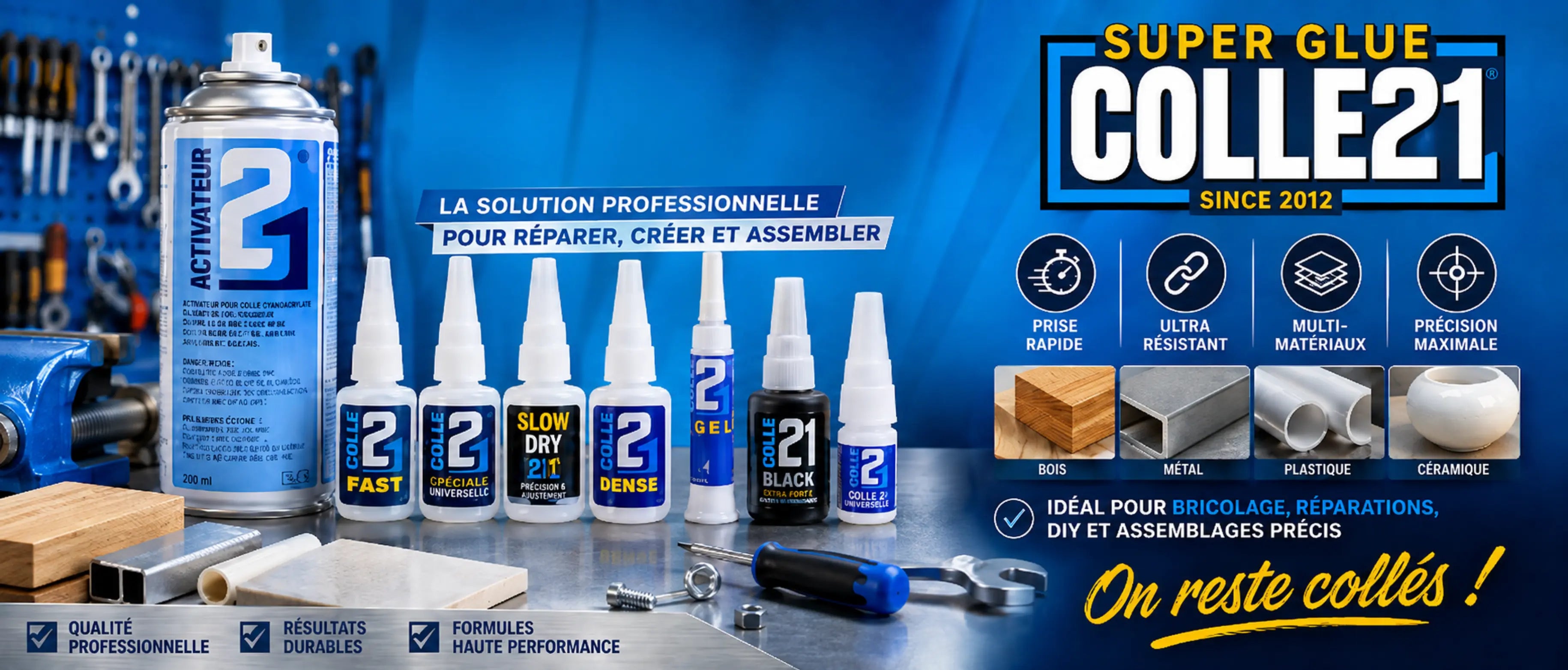
This is precisely the interest of the range superglue colle21 : have several solutions for DIY, technical repairs and precision assemblies. The store notably includes FAST, the classic cyanoacrylate, DENSE, DENSEFLEX, FLEX, GEL, BLACK, SLOW DRY, a two-component epoxy glue as well as various complementary products.
Classic cyanoacrylate glue: the versatile solution for small repairs
The SUPER GLUE Cyano Colle21 classic is suitable for many DIY jobs requiring quick and precise gluing.
It is a good basic solution for small repairs when the two surfaces fit well and a specific viscosity is not essential.
It can be interesting for:
- repair a broken object;
- assemble small parts;
- work on decorative elements;
- carry out precise technical repairs;
- carry out creative DIY work.
The range superglue colle21 offers several formats and variants of cyanoacrylate intended in particular for DIY and technical repairs.
DENSE: for precise bonding without excessive dripping
When you want more control over where the glue is deposited, a thick formulation becomes especially handy.
SUPER GLUE COLLE21 DENSE is a thick cyanoacrylate glue. It is suitable for work where a very liquid glue could move or penetrate too quickly into the surface. The collection Colle21 presents DENSE as a solution intended in particular for creative DIY and technical repairs.
It is particularly interesting for:
- vertical surfaces;
- small, precise repairs;
- slightly irregular assemblies;
- hard-to-reach places;
- projects where you want to better control the quantity of glue.
GEL: for porous, irregular or vertical surfaces
The SUPER GLUE COLLE21 GEL has a consistency that is even easier to hold in place.
The gel is particularly useful when the glue should not flow quickly or when the surface has small irregularities.
This can be interesting for DIY work on certain objects made of wood, ceramic or other porous supports, provided you check compatibility with the materials concerned. Gel formulations are commonly used to facilitate application to vertical or porous surfaces.

FAST: when the glue must penetrate a very thin space
For a crack or a perfectly fitted joint, a very fluid glue may be more effective than a gel.
Colle21 FAST is presented in the range as an ultra-liquid super glue intended in particular for DIY and technical repairs.
Its fluidity makes it particularly interesting when the adhesive must penetrate:
- a small crack;
- a very fine gap;
- two surfaces already perfectly positioned;
- an area that is difficult to reach with thick glue.
The choice between FAST, DENSE and GEL therefore depends above all on the space available between the two surfaces and the level of control sought.
FLEX and DENSEFLEX: when the bonding undergoes movements
Some DIY objects don't stay perfectly still.
Parts subject to vibrations, small flexible elements or assemblies which work lightly may require a different formulation from a classic rigid glue.
The range superglue colle21 includes in particular FLEX and DENSEFLEX. The latter is presented as a thick and flexible cyanoacrylate glue intended for DIY work and technical repairs.
The advantage is to be able to choose between:
- a more fluid formulation;
- thick glue;
- a gel texture;
- or a solution providing more flexibility.
SLOW DRY: to have more time to position the parts
Extremely fast setting is not always an advantage.
When several small parts need to be perfectly aligned, it may be helpful to have more time to complete positioning.
SUPER GLUE COLLE21 SLOW DRY meets this type of need and is one of the references offered for creative DIY and technical repairs.
It can particularly be interesting for a delicate assembly where positioning is as important as speed.
BLACK: for certain collages on dark materials
The range also includes SUPER GLUE COLLE21 BLACK, a black cyanoacrylate.
This color can be of aesthetic interest when the collage is made on a dark object and the assembled area remains slightly visible.
For a DIY where the finish matters, the choice of the color of the joint can sometimes be as important as that of the viscosity.
When to use a two-component epoxy glue?
Not all DIY projects should be done with a cyanoacrylate.
For certain larger repairs, irregular surfaces or assemblies requiring more filling, a two-component epoxy glue may be more appropriate. Epoxies are particularly used for certain durable assemblies and repairs involving gaps to be filled.
Colle21 also offers a two-component epoxy glue intended for DIY and technical repairs.
The important thing is therefore not to look for "the strongest glue", but the bonding technology adapted to your project.
Which glue to use depending on the material?
For wood
For a small repair or a precision part, a cyanoacrylate can be practical. For large joinery assemblies, a glue specifically intended for wood may be preferable depending on the project. Vinyl glues are commonly used for assembling wood, paper and cardboard.
For metal
A cyanoacrylate can be interesting for small, tight-fitting metal parts. For a larger repair or one requiring filling, an epoxy may be more suitable.
For ceramics
DENSE or GEL can be particularly practical for a precise repair, especially when it is necessary to prevent the glue from dripping.
For leather and rubber
The level of flexibility requested must be taken into account. A flexible formulation may be preferable for parts that warp regularly.
For plastic
Not all plastics stick in the same way.
Some plastics have a difficult surface to bond and may require specific preparation. The range superglue colle21 includes in particular PRIMER21, presented as a professional primer for difficult plastics.
Before any repair, identify if possible the exact nature of the plastic.
Products that also make bonding easier
A good repair doesn't just depend on glue.
The range Colle21 also includes several complementary products intended to facilitate or control work.
Activator Colle21
The Activator Colle21 exists in spray and liquid version. It is intended to accelerate the activation of cyanoacrylate glues.
PRIMER21
PRIMER21 is intended for the preparation of certain difficult plastics before bonding.
DEBONDER21
A gluing error can happen, even to experienced DIYers.
DEBONDER21 is available as a cyanoacrylate glue remover and can be useful for removing certain residues or correcting sticking.
How to make a collage during your DIY work?
Whatever glue you choose, a few good practices considerably improve the result.
1. Identify the materials
Don't choose a glue just because it's described as "strong."
Compatibility with both surfaces remains the first criterion.
2. Clean surfaces
Dust, grease, old glue residue or loose particles can interfere with adhesion.
Work on properly prepared surfaces for the material.
3. Make a blank edit
Before applying the glue, check that the two pieces fit together correctly.
4. Choose the right viscosity
FAST to penetrate a very thin space.
DENSE for precise application.
FREEZE to limit leaks.
FLEX or DENSEFLEX when greater flexibility is sought.
SLOW DRY when positioning requires more time.
5. Don’t use too much glue unnecessarily
Too much may overflow and make the repair less clean.
The goal is to apply an appropriate amount to the joint and materials.
SUPER GLUE COLLE21 for DIY and repair professionals
Craftsmen, repairers, workshops, resellers or companies: Colle21 also offers a space dedicated to professionals in order to meet the needs linked to regular use of bonding solutions.
Having different viscosities, an epoxy glue, activators, primers and accessories makes it easier to adapt the product to each intervention rather than working with a single glue for all materials.
⭐⭐⭐⭐⭐ SUPERGLUE COLLE21 – More than 500 Google reviews
User feedback can also help choose a brand and explore different uses before selecting a bonding solution.
SUPERGLUE COLLE21 ⭐⭐⭐⭐⭐ More than 500 Google reviews
Whether for a small domestic repair, creative DIY, model making or a more technical intervention, the choice must always be guided by the material, the necessary viscosity and the constraints of the repair.

FAQ – Which glues to use for DIY?
What is the best glue for crafting?
There is no one best glue for all projects. The right choice depends on the materials, the size of the bond, the precision required and the mechanical constraints.
Which glue to choose for a quick repair?
A traditional cyanoacrylate glue is particularly useful when the parts are small, close-fitting and compatible with the adhesive.
What is the difference between liquid, Dense and Gel glue?
Liquid glue penetrates more easily into fine gaps. Dense glue stays in place more and makes dosing easier. A Gel glue provides even more control on vertical or irregular surfaces.
What glue should I use for an object that moves or vibrates?
A flexible formulation such as FLEX or DENSEFLEX may be more suitable when some joint flexibility is required.
What glue to use on plastic?
It depends on the type of plastic. Some polymers are difficult to bond and may require specific preparation or primer. Always identify the material before choosing the glue.
When to use epoxy glue rather than super glue?
An epoxy may be more suitable when it is necessary to work on a larger repair, fill a space or make certain more structural assemblies.
How to prevent glue from leaking during DIY?
Use a thicker formulation, such as Dense or Gel glue, when working on a vertical surface or in an area where overflow would be troublesome.
Where to find the glues Colle21 for your DIY projects?
To discover the different viscosities, cyanoacrylate glues, flexible solutions, gels, epoxy, activators, primers and accessories, find the entire range superglue colle21.
You will then be able to select your glue according to the material, the type of repair and the level of precision sought, rather than choosing a single solution for all your work.
🚀 We stay stuck with Colle21 !

🎯 When a single letter can change the choice… and the result of your purchase.