What is the best glue for a shoemaker ? The answer depends above all on the material to be repaired, the size of the detached area, the flexibility required and the precision sought.
Leather, rubber, sole, heel, metal or synthetic materials do not present the same constraints. For the fast, precise and localized repairs, cyano glue DENSE is particularly interesting thanks to its thick texture, which facilitates dosing and limits dripping.
The product range SUPERGLUE GLUE21 also allows you to choose different viscosities and formulations depending on the work to be carried out: FAST, FLEX, DENSEFLEX, GEL, BLACK, SLOW DRY or even classic cyanoacrylate.
The objective for a shoemaker is therefore not to look for a universal glue, but to use the right glue for the right repair.
What glue do shoemakers use to repair shoes?
A shoemaker works on many materials: leather, natural rubber, textile, metal, wood, synthetic materials or decorative elements.
A small part of the sole that is starting to come off does not necessarily require the same glue as a part that is heavily stressed with each step. Likewise, a heel repair, a decorative element or a small rigid part do not have the same constraints as a large flexible surface.
For work requiring speed and precision, cyanoacrylate glues can provide a particularly practical solution.
The product range SUPERGLUE GLUE21 includes several formulations allowing the viscosity and behavior of the glue to be adapted to the repair.
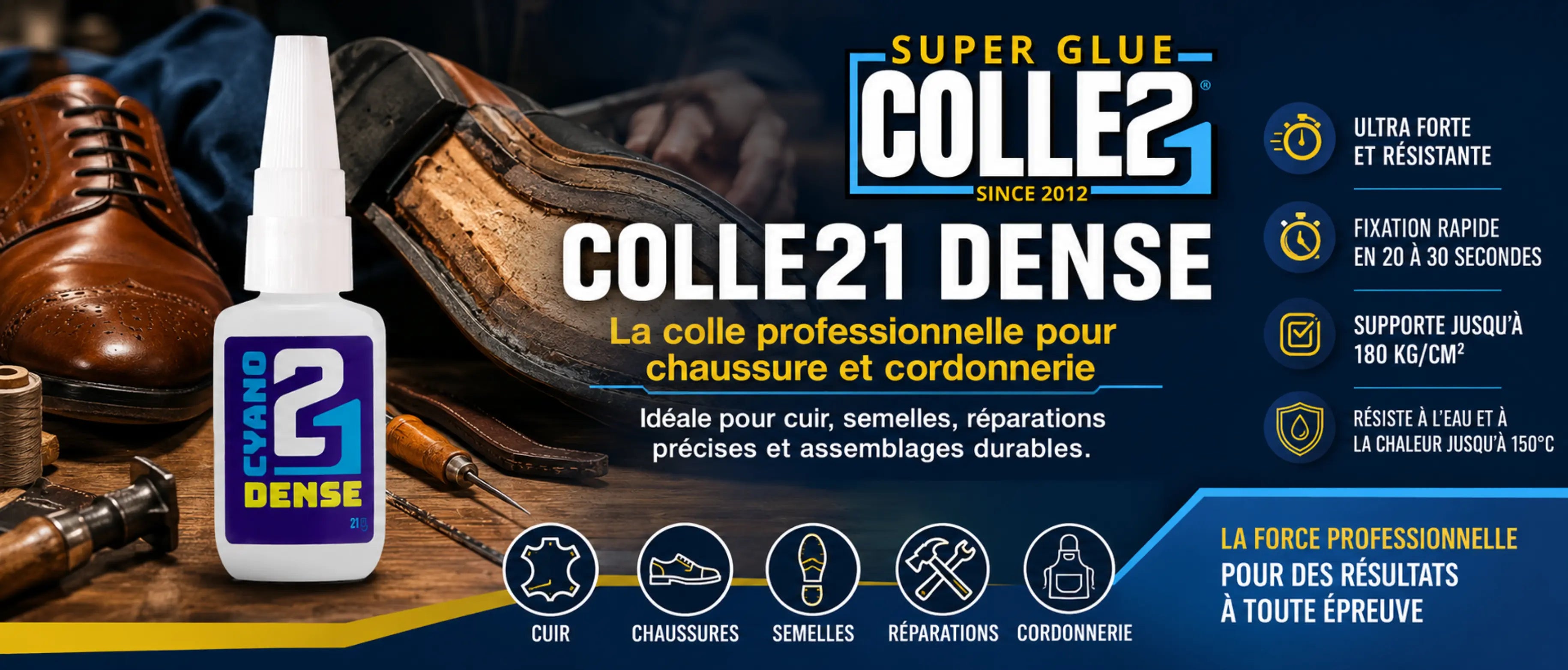
SUPER GLUE COLLE21 DENSE: a particularly interesting glue for shoemakers
For many small shoe repairs, cyano glue DENSE constitutes a particularly suitable solution when looking for precision, control and speed of application.
This is a high viscosity cyanoacrylate glue. Its thicker texture allows the glue to be deposited precisely on the area to be repaired without it spreading as easily as a very liquid formulation.
Why use Dense glue in shoemaking?
In shoe repair, precision is essential.
Glue that is too liquid can penetrate an unwanted area or overflow onto a visible finish. A thick formulation provides more control.
Cyano glue DENSE may be particularly interesting for:
- a small area of detached sole when the materials are compatible;
- certain assemblies on leather;
- natural rubber;
- certain heel repairs;
- small metal parts;
- decorative elements;
- vertical zones;
- repairs requiring a very localized depot.
Its main interest is simple: the glue stays more easily where the shoemaker wants to apply it.
One glue does not fit all shoes
A shoe undergoes bending, twisting, friction and humidity variations. Some parts work a lot during walking while others remain relatively rigid.
It is therefore important not to present cyanoacrylate as a universal solution for all shoemaking operations.
For a precise and localized repair, cyano glue DENSE can be very interesting.
For a part subject to more movement, a more flexible glue may be preferable.
This is precisely the advantage of having several formulations within the product range SUPERGLUE GLUE21.
Which SUPER GLUE COLLE21 should you choose to repair a shoe?

DENSE: for precise and controlled application
Cyano glue DENSE is our preferred reference when it is necessary to deposit the glue precisely on a small area.
Its thick texture helps limit dripping and facilitates application on vertical or difficult-to-access surfaces.
It can therefore be particularly practical for small repairs to shoes, leather elements, natural rubber, heels or parts requiring very localized application.
FLEX: for parts subject to movements
A shoe deforms with every step. Certain areas therefore require more flexibility.
SUPER GLUE COLLE21 FLEX is designed to offer more flexibility than traditional cyanoacrylate.
It can be considered when the repaired area must continue to accompany certain movements of the shoe.
DENSEFLEX: thickness and flexibility
DENSEFLEX combines two particularly interesting characteristics: a thick texture and flexible formulation.
It therefore represents an interesting alternative when the shoemaker wishes to maintain the precision of a thick glue while working on a part with greater mechanical stress.
GEL: to prevent dripping
SUPER GLUE COLLE21 GEL has a consistency that allows the glue to stay in place very easily.
It can be practical on:
- vertical surfaces;
- irregular areas;
- hard-to-reach places;
- repairs where overflow would be particularly troublesome.
FAST: to penetrate very thin spaces
FAST is the opposite of a Dense glue: its texture is very fluid.
This low viscosity allows it to penetrate into gaps or small cracks where a thick formulation would have more difficulty entering.
For a shoemaker, FAST can therefore be particularly useful when it is necessary to penetrate the glue into an extremely thin area.
BLACK: an interesting finish on dark shoes
For a black shoe, a boot or a dark item, the color of the joint can sometimes be important.
SUPER GLUE COLLE21 BLACK has a black coloring which can make certain repairs more discreet when the glue remains slightly visible.
SLOW DRY: to have more positioning time
Some repairs require a few extra seconds to correctly position the parts.
SLOW DRY allows more working time before setting compared to a very fast instant glue.
This can be useful when precise alignment is required.
How to choose a glue for leather, sole or rubber?
Before selecting a glue, four questions are essential.
What material should be glued?
Always start by precisely identifying the two surfaces.
A sole is not just “plastic”. Many different polymers can be used in shoemaking, and not all react the same way to a glue.
For materials that are difficult to identify, it is preferable to check their nature before bonding and, when possible, to carry out a test on a discreet area.
Should the repair remain flexible?
A small, rigid part does not undergo the same stresses as a sole that bends several times with each step.
For a repair that is not very mobile and very localized, a thick cyanoacrylate may be suitable.
For a heavily stressed part, FLEX or DENSEFLEX may be more relevant depending on the material.
Should drippings be absolutely avoided?
For a visible or vertical area, choose a thicker formulation like DENSE, DENSEFLEX or GEL.
Should glue penetrate a crack?
If space is extremely limited, a more fluid glue like FAST may be more suitable.
How to use a SUPER GLUE COLLE21 product to repair a shoe?
1. Identify materials
Check the material of the shoe and that of the part to be glued before application.
2. Prepare surfaces correctly
The parts to be assembled must be clean and free of dust, dirt or old residues likely to hinder bonding.
3. Choose the right viscosity
For a very precise application, choose a thick formulation.
For a very thin crack, a more fluid formulation will generally be more practical.
For a part requiring movement, consider a flexible formulation.
4. Apply a controlled amount
With cyanoacrylate, using a lot of glue does not necessarily mean obtaining a better result.
A clean, controlled application is generally preferable.
This is precisely one of the advantages of cyano glue DENSE, which allows better control of the quantity deposited.
5. Position the two parts
Once the glue is applied, position the surfaces correctly and keep them in contact according to the recommendations of the product used.
Why have several viscosities in a shoemaking workshop?
Because a shoemaker never encounters exactly the same repair.
A very fine crack requires a fluid glue.
A vertical area requires more holding.
A moving part may require more flexibility.
A small, precise part requires more control.
This is why a range including FAST, classic, DENSE, GEL, FLEX, DENSEFLEX, BLACK and SLOW DRY allows the professional to select the formulation that really corresponds to his work.
A range also designed for professionals
You are shoemaker, shoe repairer or professional leather goods ?
SUPER GLUE COLLE21 offers different bonding solutions allowing you to adapt the viscosity and flexibility of the glue to each intervention.
Cyano glue DENSE is particularly interesting for precise and localized repairs, while other references FAST, FLEX, DENSEFLEX, GEL or BLACK allow us to meet different needs encountered in the workshop. Discover the range SUPERGLUE GLUE21 and contact us to direct you towards the products most suited to your professional activity.
SUPERGLUE COLLE21 ⭐⭐⭐⭐⭐ More than 500 Google reviews
The reliability of a brand does not rest solely on the diversity of its products. User feedback is also an important element when an individual or professional is looking for a new bonding solution.
SUPERGLUE COLLE21 ⭐⭐⭐⭐⭐ More than 500 Google reviews
These reviews allow users to learn about the experiences of other customers before choosing the right solution for their needs.

SUPER GLUE COLLE21: solutions for shoemakers and repair professionals
For a shoemaker, having several glues makes it possible to respond more precisely to the different tasks encountered on a daily basis.
Cyano glue DENSE favors precision.
FAST favors fluidity.
FLEX provides more flexibility.
DENSEFLEX combines viscosity and flexibility.
GEL facilitates applications where dripping must be limited.
BLACK offers an interesting black finish for some dark repairs.
SLOW DRY allows more time to position the parts.
This complementarity makes it possible to select the glue according to the material and the work to be carried out, rather than trying to systematically use the same product.
FAQ – Which glue to choose for a shoemaker?
What is the best glue for a cobbler?
There is no single glue suitable for all repairs. For small, quick, precise and localized interventions on compatible materials, a thick cyanoacrylate like DENSE is particularly practical.
What glue should I use for a leather shoe?
A thick cyanoacrylate may be suitable for some small leather repairs. If the area is going to deform a lot, it is best to consider a flexible formulation.
What glue should I use for a sole that is coming off?
It depends on the material, the size of the detached area and its flexibility. A small localized repair and a complete resoling require different solutions.
What is the difference between DENSE and FAST?
DENSE is thick and makes application control easier. FAST is much more fluid and allows penetration into very fine gaps.
Which glue to choose for a flexible part of a shoe?
FLEX or DENSEFLEX can be interesting when the repair requires more flexibility than a classic cyanoacrylate.
What glue to use on a black shoe?
BLACK can be particularly interesting when the black coloring of the joint makes it possible to obtain a visually more discreet repair.
Why should a shoemaker use several types of glue?
Because a flexible sole, a small metal part, a thin crack or a vertical surface do not require the same application properties.
Where to buy glues Colle21 for shoe repair?
Find the different viscosities and bonding solutions on SUPERGLUE GLUE21.
For precise and localized repairs, discover directly our DENSE, a thick cyanoacrylate designed to facilitate controlled application.
You can also find our products on our Amazon store.
🚀 We stay stuck with Colle21 !

🎯 When a single letter can change the choice… and the result of your purchase.