Which glue resists vibrations? When an assembly is subjected to repeated movements, shocks or micro-vibrations, a glue that is too rigid may become less suitable. It is then preferable to choose a vibration resistant glue, capable of retaining a certain flexibility after hardening.
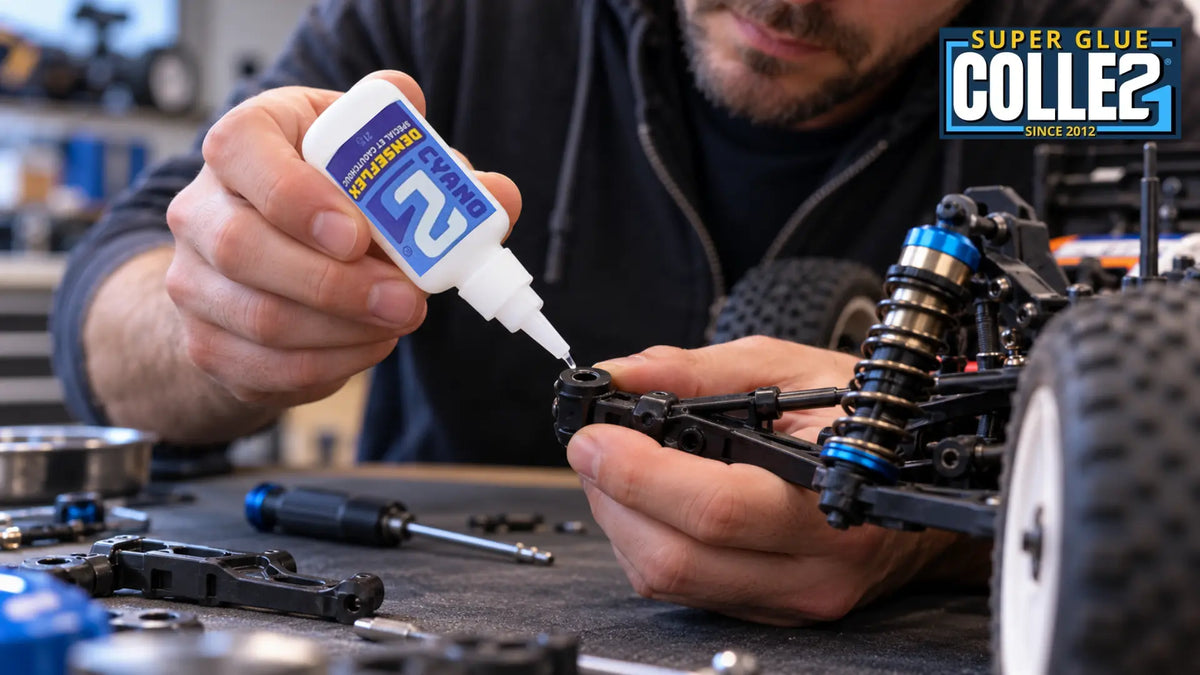
For this type of use, SUPER GLUE Colle21 DENSEFLEX – 21g combines a thick texture with a flexible formulation. It is designed for assemblies subject to vibrations, shocks, movements and mechanical stresses.
👉 Discover SUPER GLUE Colle21 DENSEFLEX – 21g

Why choose a vibration-resistant glue?
Not all parts remain perfectly still after gluing.
Certain assemblies may undergo:
-
repeated vibrations;
-
small movements;
-
shocks;
-
slight bending;
-
mechanical constraints;
-
temperature variations.
In this type of situation, a more flexible formulation can better accommodate the constraints than a very rigid glue. This is precisely the interest of SUPER GLUE Colle21 DENSEFLEX, which combines thick viscosity with greater flexibility.
Why SUPER GLUE Colle21 Does DENSEFLEX resist vibrations better?
The particularity of DENSEFLEX is to combine two important characteristics:
a thick texture + a flexible formulation.
Its viscosity allows better control of the application and limits sagging, while its flexibility helps the assembly absorb certain mechanical stresses without becoming as brittle as a totally rigid bond.
This combination is particularly interesting when a part is subjected to micro-movements or regular vibrations.
Where to use vibration resistant glue?
A glue like SUPER GLUE Colle21 DENSEFLEX can be particularly interesting for:
-
RC vehicles;
-
model making;
-
some 3D printed parts;
-
DIY ;
-
technical repairs;
-
accessories subject to movements;
-
light mechanical assemblies;
-
parts susceptible to repeated shocks.
It can adhere in particular to the metal, rubber, ceramics, wood, leather, cardboard and some plastics, excluding PE, PP and PTFE without suitable preparation.
How to use vibration resistant glue?
To achieve effective bonding, preparation remains essential.
1. Clean surfaces
Parts must be clean, dry and free of dust, grease or residue.
2. Check the fit
Position the pieces before applying the glue to check their alignment.
3. Apply a small amount
Thanks to its thick texture, SUPER GLUE Colle21 DENSEFLEX stays more easily where it is placed.
4. Assemble the pieces
Place the two surfaces in contact and hold them while setting.
5. Allow the bonding to reach its final strength
Avoid immediately subjecting the assembly to vibration or stress.
Rigid glue or flexible glue against vibrations?
Extremely stiff glue may be ideal for a part that never moves.
But when a part undergoes repeated vibrations, movements or shocks, a certain flexibility can become an advantage.
SUPER GLUE Colle21 DENSEFLEX has been developed to offer thick and precise bonding while maintaining more flexibility than traditional rigid cyanoacrylate.
However, the choice always depends on the material, the bonding surface and the intensity of the stresses.
Mistakes to avoid with vibration-resistant glue
To obtain a lasting bond, avoid:
-
stick to a greasy or dusty surface;
-
using an excessive amount of glue;
-
to stress the part immediately after gluing;
-
to choose a glue solely according to its setting speed;
-
to ignore the movements that the piece will actually undergo;
-
to use the same adhesive for all materials.
The right glue is the one that matches to the material but also to the mechanical constraints of the assembly.
Our customers’ opinions on SUPER GLUE COLLE21 ⭐⭐⭐⭐⭐
User satisfaction is also an important element in choosing a bonding solution.
SUPERGLUE COLLE21⭐⭐⭐⭐⭐ has more than 500 Google reviews, coming from individuals, modelers, craftsmen and professionals who use the products Colle21 for many applications.
This feedback also allows us to continue to develop a range that meets different expectations: precision, speed, transparency, viscosity, flexibility and ease of use.
If you like our service or our products, do not hesitate to leave us a reviews.
Your opinion is very important to us and helps us to improve and make our products and know-how known.

SUPER GLUE COLLE21: manufacturer of cyano glues and partner of professionals
Since 2012, SUPER GLUE COLLE21 develops and distributes a complete range of cyanoacrylate glues and professional adhesive solutions, intended for both individuals and professionals.
With more than 140 references, our range meets many applications: different viscosities of cyanoacrylates, flexible glues, gels, activators, primers and specialized bonding solutions.
👷♂️ Are you a professional or would you like to become a distributor of SUPER GLUE COLLE21?
Professionals can benefit from a dedicated catalog, of preferential rates and conditions, of a personalized support as well as the possibility of creating custom labels or in co-branding with their brand or brand.
We support many professions and sectors: bodywork, dental prosthesis, nail prosthesis, model making, DIY, repair, 3D printing, aquascaping, fishing, radio control, industry, decoration and specialized businesses.
📩 Contact us to receive our professional catalog and discover the solutions SUPER GLUE COLLE21 adapted to your activity.

FAQ – Which vibration-resistant glue to choose?
Which glue resists vibrations best?
A glue with a certain flexibility can be particularly interesting. SUPER GLUE Colle21 DENSEFLEX combines a thick texture with a formulation designed to better withstand vibrations, shocks and movements.
Can cyanoacrylate glue resist vibrations?
Yes, provided you choose a suitable wording. Certain flexible cyanoacrylates such as DENSEFLEX are specifically intended for assemblies subject to dynamic constraints.
What glue should I use for an RC vehicle?
For certain parts subject to vibrations and micro-movements, a flexible formulation like SUPER GLUE Colle21 DENSEFLEX can be particularly interesting.
Is DENSEFLEX suitable for metal?
Yes. The product sheet indicates in particular compatibility with metal, as well as with rubber, wood, ceramic, leather, cardboard and certain plastics.
Why choose thick glue?
A thick glue allows you to better control where the product is applied and limits drips, especially on vertical or slightly irregular surfaces.
Conclusion
To know which glue resists vibrations, it is especially important to look at the ability of the adhesive to withstand movements and stresses after curing.
A vibration resistant glue like SUPER GLUE Colle21 DENSEFLEX combines a thick texture with a flexible formulation, which makes it particularly interesting for model making, RC vehicles, DIY and certain technical repairs subject to shocks and micro-movements.
With more than 140 references, SUPER GLUE Colle21 offers a wide range of solutions allowing you to choose the glue adapted to the material, the desired viscosity and the assembly constraints.
👉 Discover the products SUPER GLUE Colle21
👉 Find SUPER GLUE Colle21 on our official Amazon store
 Let's stick together with SUPER GLUE Colle21 ! 🚀