
Why do some cyanoacrylate glues whiten? The complete guide to understanding the phenomenon and obtaining a perfect bond
How to avoid whitening of cyanoacrylate glue and obtain a clean, precise and professional result?
Colle21 with the E when a single letter can change the choice… and the result of your purchase.
Why do some cyanoacrylate glues whiten? The professional cyanoacrylate glue, also known as Super Glue, is recognized for its ultra-fast setting, strong adhesion and versatility. It is used in model making, DIY, bodywork, fishing, 3D printing, industry and many technical applications.
However, some users sometimes notice a white veil appearing around the stuck area. This phenomenon, called whitening, often raises many questions.
Why does it appear? Is it due to the quality of the glue? Can we avoid it?
In this guide, discover the real causes of cyanoacrylate glue whitening and the best practices for achieving a clean, professional bond.
What is whitening of cyanoacrylate glue?
Why do some cyanoacrylate glues whiten? Whitening (also called blooming or frosting) is a light white deposit that may appear around the bonding area.
Contrary to popular belief, this does not mean that the glue is of poor quality.
This is a chemical phenomenon linked to cyanoacrylate vapors which, during polymerization, can be deposited on neighboring surfaces.
This phenomenon is favored by several factors:
✅ air humidity
✅ excessive amount of glue
✅ poor ventilation
✅ presence of dust
✅ grease residue or fingerprints on the parts to be assembled.
Why do fingerprints promote whitening?
Why do some cyanoacrylate glues whiten? Even when a room appears perfectly clean, it may contain invisible fingerprints, composed of sebum, perspiration and other natural residues.
In contact with cyanoacrylate vapors, these residues can promote the appearance of white veil.
It is also this same chemical principle which has been exploited for many years by forensic services to reveal invisible fingerprints using cyanoacrylate vapors.
In other words, simple handling of the parts before bonding may be enough to increase the risk of bleaching.
How to avoid bleaching?
A few simple actions can considerably limit this phenomenon:
✔️ Degrease your hands thoroughly before handling the parts.
✔️ Carefully clean the surfaces to be glued, even if they appear clean.
✔️ Eliminate traces of grease, dust and fingerprints.
✔️ Use only the amount of glue needed.
✔️ Work in a properly ventilated environment.
These good practices allow you to obtain a much cleaner bond.
Colle21 Flex: a solution designed to limit whitening
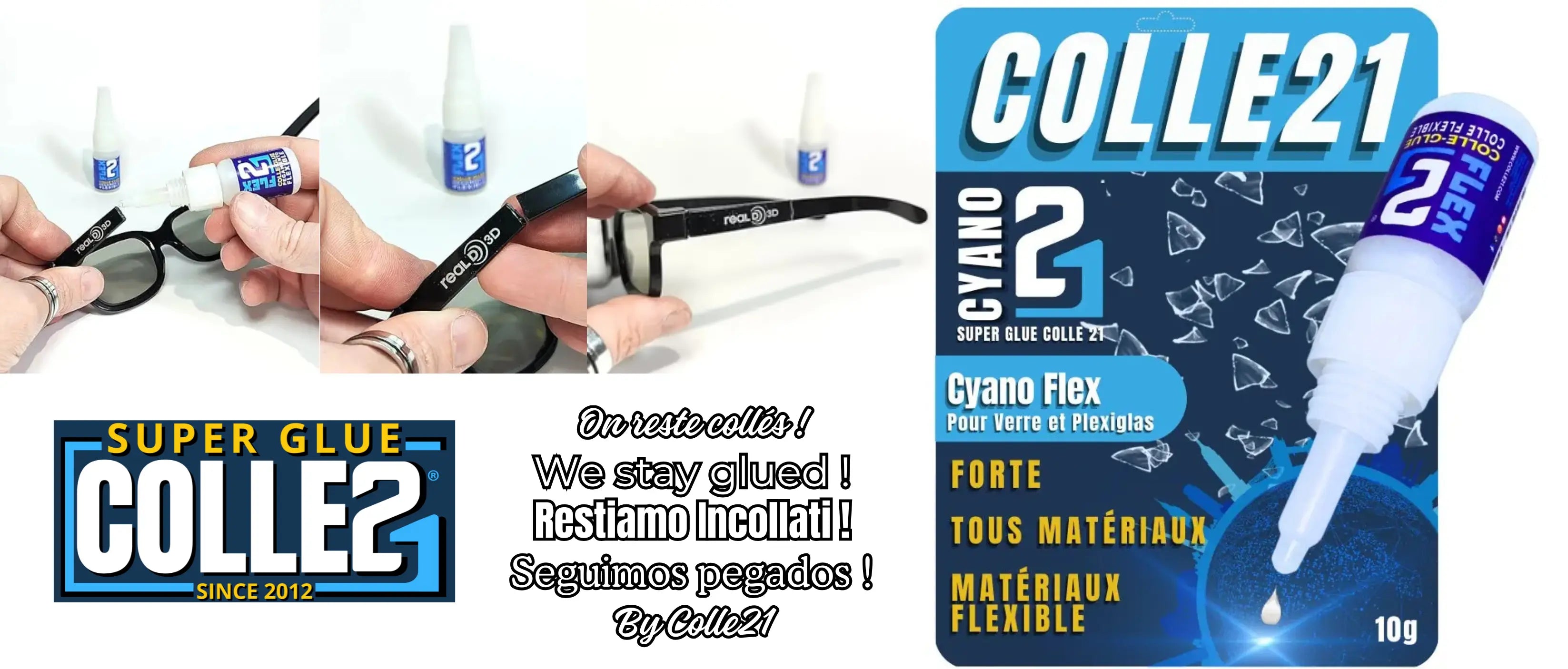
Why do some cyanoacrylate glues whiten? To meet the needs of users looking for cleaner bonding, Colle21 developed Colle21 Flex, a specially formulated elastic cyanoacrylate glue.
Thanks to its specific formulation, Colle21 Flex releases fewer vapors than a traditional cyanoacrylate, which helps reduce the risk of bleaching while maintaining excellent adhesion.
It is particularly appreciated for:
✅ its low release of vapors
✅ its great flexibility
✅ its strong resistance
✅ its excellent hold on many materials
✅ its cleaner collages on sensitive parts.
Manufacturer of cyanoacrylate Super Glue and professional adhesives
Why do some cyanoacrylate glues whiten? For many years, Colle21 develops solutions intended for individuals and professionals.
As Cyanoacrylate Super Glue manufacturer and professional adhesives producer, we design:
🔹 Liquid cyanoacrylate glues
🔹 Dense glues
🔹 Gel glues
🔹 Colle21 Flex
🔹 Activators
🔹 Primers
🔹 Debonders
🔹 UV LED resins
🔹 Technical accessories
Our objective is to offer efficient, innovative solutions adapted to each field: model making, DIY, industry, fishing, bodywork, 3D printing and many others.
FAQs
Why does my cyanoacrylate glue turn white?
Why do some cyanoacrylate glues whiten? Bleaching usually comes from cyanoacrylate vapors polymerizing on nearby surfaces. Humidity, greasy residue and fingerprints can accentuate this phenomenon.
Can fingerprints promote whitening?
Yes. Residue left by fingers can encourage the reaction of cyanoacrylate vapors and increase the appearance of a white haze.
How to avoid bleaching?
Clean the parts carefully, avoid excess glue, work in a ventilated environment and use a suitable formulation such as Colle21 Flex when relevant.
Which glue to choose to limit whitening?
Formulations generating fewer vapors, such as Colle21 Flex, make it possible to significantly reduce this phenomenon while providing a solid and durable bond.
Where to buy the products Colle21 ?
🌐 Official store:
www.colle21.com
🛒 Also find our entire range on the official Amazon store Colle21, with our professional cyanoacrylate glues, Colle21 Flex, activators, primers, UV LED resins and technical accessories.
Conclusion
Whitening of cyanoacrylate glue is not inevitable. By understanding its origin and adopting good practices — cleaning parts, removing fingerprints, precise dosage of glue and choosing a suitable formulation such as Colle21 Flex — it is possible to obtain clean, precise and durable bonds.
When a single letter can change the choice… and the result of your purchase.
⚠️ Beware of imitations: Colle21 is written with an “E”.