
Best glue for plastic: how to choose a truly effective and durable glue?
The Complete Guide to Precisely Gluing Plastic Using Super Glue Solutions Colle21
Meta title
Best glue for plastic : complete guide | Super Glue Colle21
Meta description
What is the best glue for plastic? Find out how to choose a cyanoacrylate glue depending on the type of plastic, use and constraints. Super Glue Complete Guide Colle21.
Best glue for plastic: which solution to choose according to your project?
Find the best glue for plastic may seem simple. However, plastic refers to a very large family of materials whose properties are sometimes completely different.
ABS, PVC, polystyrene, polycarbonate, resin, rigid plastic, flexible plastic, polypropylene or polyethylene: a glue capable of effectively joining one material may be less efficient on another.
That's why the best plastic glue isn't necessarily the strongest, fastest, or most expensive. It is above all the one which corresponds precisely to:
- the type of plastic;
- the shape of the parts;
- to the bonding surface;
- mechanical constraints;
- the necessary positioning time;
- to the environment in which the object will be used.
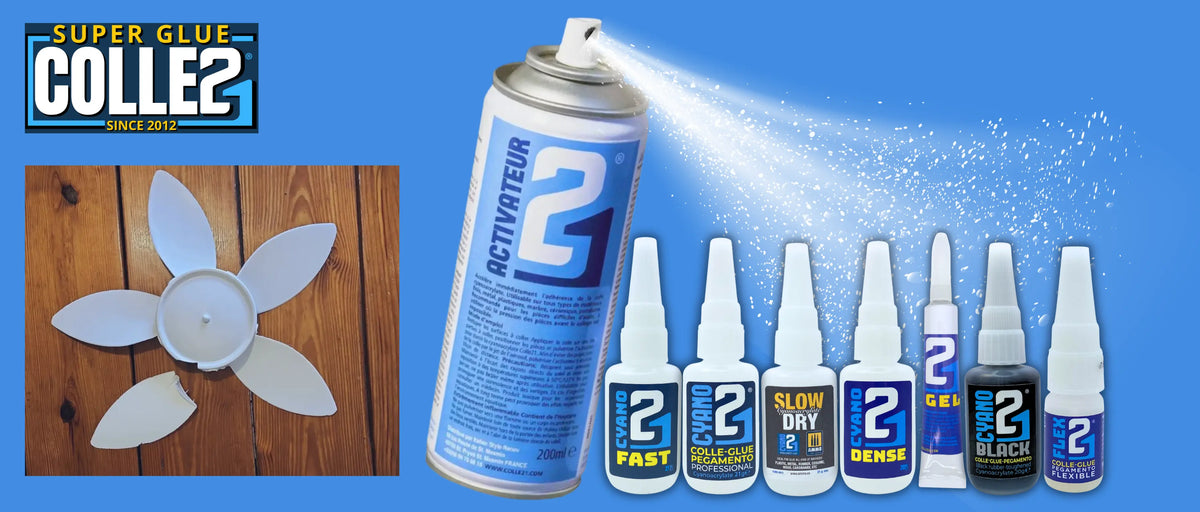
With its wide range of cyanoacrylate glues, gels, dense glues, flexible formulas, primers and activators, Super Glue Colle21 offers solutions suitable for model making, DIY, 3D printing, RC vehicles, technical repairs and many professional applications.
Why is plastic sometimes difficult to glue?
Not all plastics have the same surface energy. Some naturally provide good grip, while others repel more glue.
Difficulties can also come from:
- a very smooth surface;
- traces of grease or mold release product;
- a flexible part;
- a poorly adjusted assembly;
- an area subject to vibrations;
- of a plastic impossible to identify visually.
Before choosing a glue, it is therefore essential to identify the material when possible.
The markings present under certain objects can help you:
- ABS : acrylonitrile butadiene styrene;
- PVC : polyvinyl chloride;
- P.S. : polystyrene;
- PC : polycarbonate;
- PE : polyethylene;
- PP : polypropylene;
- P.A. : polyamide;
- PET : polyethylene terephthalate;
- PTFE : polytetrafluoroethylene.
This identification makes it possible to choose a more reliable solution and avoid unsuitable bonding.
Is cyanoacrylate glue effective on plastic?
The cyanoacrylate glue, often called Super Glue, is particularly popular for bonding many rigid plastics.
It has several advantages:
- rapid setting;
- precise dosage;
- excellent adhesion on many supports;
- low quantity of product required;
- discreet finish;
- simple use.
Cyanoacrylate glue is particularly suitable when the parts are clean, dry and properly fitted.
It is commonly used for:
- models;
- figurines;
- 3D printed parts;
- plastic accessories;
- RC vehicle parts;
- decorative objects;
- certain household repairs;
- small technical assemblies.
However, it is not automatically suitable for all plastics.
PE, PP and PTFE are particularly known to be difficult to bond. They may require a specific primer, a particular preparation or another adhesive technology.
What is the best glue for rigid plastic?
For many compatible rigid plastics, a traditional cyanoacrylate glue is an excellent solution.
Super Glue Colle21 classic
The Super Glue Colle21 classic offers a good balance between fluidity, speed and precision. Its quick setting is particularly useful for small repairs and tight-fitting assemblies.
It is particularly suitable for work requiring:
- localized application;
- short-term maintenance;
- clean gluing;
- excellent precision.
It is suitable for model making, DIY, 3D printing and many technical repairs on compatible materials.
Which glue to choose for microcracks and capillarity?
When two parts are already positioned and the glue needs to penetrate a very fine gap, an ultra-liquid formula is generally preferable.
Super Glue Colle21 FAST
The Super Glue Colle21 FAST has a very low viscosity. It can penetrate by capillary action into the small spaces between two perfectly fitted surfaces.
It is ideal for:
- microcracks;
- miniature pieces;
- very precise assemblies;
- certain model parts;
- 3D printed elements;
- areas that are difficult to access.
This formula is particularly appreciated by experienced modelers. Its great fluidity, however, requires controlled application in order to avoid overflows.
Which plastic glue to choose to avoid dripping?
Glue that is too liquid can quickly move on a plastic surface, especially when the part is vertical.
In this case, thick or dense glue is easier to control.
Super Glue Colle21 DENSE
The Super Glue Colle21 DENSE is a more viscous cyanoacrylate glue. It stays in place more during application and limits dripping.
It is recommended for:
- vertical surfaces;
- slightly irregular pieces;
- assemblies requiring more control;
- model making;
- dioramas;
- 3D printing;
- precise repairs.
Its texture allows the glue to be deposited exactly where desired, which reduces waste and improves the cleanliness of the result.
Super Glue Gel: a precise solution for vertical surfaces
For applications where glue should be virtually non-bleeding, a gel formula may be ideal.
Super Glue Colle21 FREEZE
The Super Glue Colle21 FREEZE offers a very controllable texture, particularly appreciated for:
- vertical surfaces;
- parts that are difficult to position;
- slightly porous supports;
- localized assemblies;
- visible repairs;
- projects requiring a clean application.
The gel stays where it is applied and allows you to better control the quantity used.
For some projects, it may also offer light fill power, within the limits provided by the product. However, it should not be used to fill very large spaces.
Which glue to choose for a plastic subject to vibrations?
A classic cyanoacrylate glue generally forms a rigid assembly. However, certain plastic parts can undergo:
- vibrations;
- small movements;
- shocks;
- stress variations;
- a slight bending.
In this case, a more flexible formula may provide better behavior.
Super Glue Colle21 DENSEFLEX
The Super Glue Colle21 DENSEFLEX combines high viscosity with greater flexibility after polymerization.
It is particularly interesting for:
- RC vehicles;
- some 3D printed parts;
- accessories subject to vibrations;
- technical assemblies;
- repairs requiring more flexibility.
The choice always depends on the exact material and the level of movement expected. A prior test remains recommended.
How to glue PE, PP or PTFE?
Polyethylene, polypropylene and PTFE have low surface energy. They are therefore much more difficult to stick with classic Super Glue.
To improve adhesion it may be necessary to use:
- a primer intended for difficult plastics;
- specific preparation of the support;
- a glue formulated for these materials;
- another assembly technology.
Primer Super Glue Colle21
The Super Glue Primer Colle21 allows you to prepare certain difficult surfaces before applying cyanoacrylate glue.
The general procedure consists of:
- identify plastic;
- carefully clean and degrease the surface;
- apply the primer according to the instructions;
- respect the recommended waiting time;
- apply the appropriate glue;
- assemble the pieces.
It is important to consult the product instructions and carry out a test on a discreet area.
How to prepare plastic before gluing?
Even the best glue for plastic will not give optimal results on a dirty or greasy surface.
Clean the surface
Eliminate:
- dust;
- fat ;
- oil ;
- mold release residues;
- old traces of glue;
- dirt.
Use a product compatible with plastic. Some solvents can attack, soften or dull certain materials.
Dry perfectly
Surfaces must be dry before application unless otherwise noted.
Sand lightly if necessary
On certain smooth plastics, very light sanding can increase the grip surface. Use a fine abrasive and then remove all the dust.
Check the fit of the parts
Cyanoacrylate glues generally work best on properly fitted parts. Too much space can reduce the quality of the bonding.
Perform a test
When the plastic is unknown or particularly sensitive, always test on a small, inconspicuous area.
How to correctly use a glue for plastic?
To obtain a clean and durable assembly:
- prepare surfaces;
- check their compatibility;
- apply a very small amount of glue;
- immediately bring the pieces together;
- hold them without moving them;
- allow the bonding to reach its final strength before stressing it.
Excessive amount of glue does not guarantee better resistance. On the contrary, it can:
- slow down the setting;
- cause burrs;
- leave traces;
- increase the risk of money laundering;
- make the work less precise.
A thin, properly distributed layer is generally more effective.
Why do some glues whiten plastic?
Bleaching, sometimes called whiteout, can appear around cyanoacrylate bonding.
It can be promoted by:
- excessive amount of glue;
- a lack of ventilation;
- high humidity;
- slow polymerization;
- the presence of residue around the assembly.
To limit this phenomenon:
- use as little glue as possible;
- work in a ventilated space;
- avoid touching or moving the parts;
- clean spills immediately with a compatible method;
- use a precise applicator.
On aesthetic, transparent or shiny surfaces, always test the glue beforehand.
What role does the activator play?
An activator accelerates the setting of the cyanoacrylate glue.
It can be useful for:
- quick edits;
- serial collages;
- porous materials;
- parts that are difficult to maintain;
- certain technical repairs.
Super Glue Colle21 offers liquid and spray activators.
However, the activator should not be applied unnecessarily. Excessive use can influence the appearance of the bond or its polymerization. Always follow the instructions for use.
The best glue for plastic depending on application
Model making and models
For thin parts and micro-gaps, choose liquid or FAST glue. For more control, choose a DENSE or a GEL.
3D printing
The choice depends on the filament or resin. A classic glue, DENSE, GEL or DENSEFLEX may be suitable depending on the material and constraints.
RC Vehicles
Parts exposed to vibration may require a more flexible formula. Also check the mechanical resistance and compatibility of the plastic.
DIY
For routine repairs, a classic cyanoacrylate glue is often sufficient. For vertical surfaces, use DENSE or GEL.
Dioramas and figurines
Precision and cleanliness are priority. A DENSE or GEL glue allows you to better control the application.
Technical repairs
Identify the plastic, stresses, temperature and vibration before selecting the glue.
Best value for money rather than the cheapest glue
A low-cost glue may seem economical. But if it dries in the bottle, leaks, sticks poorly or forces you to start the repair again, its real cost quickly becomes higher.
A good plastic glue should:
- to use little product;
- to succeed in gluing on the first attempt;
- to limit damage to the part;
- to obtain a clean finish;
- to save time;
- to extend the life of the repair.
At Super Glue Colle21, our goal is to offer a professional range offering excellent value for money, so that each user can select the right formula without compromising on quality.
Super Glue Colle21, manufacturer of cyanoacrylate glues and producer of professional adhesives
For more than thirteen years, Super Glue Colle21 develops and distributes cyanoacrylate glues and professional adhesives intended for enthusiasts and businesses alike.
Our range includes more than 140 bonding solutions, in particular:
- Super Glue Colle21 classic;
- Super Glue Colle21 FAST;
- Super Glue Colle21 DENSE;
- Super Glue Colle21 FREEZE;
- Super Glue Colle21 DENSEFLEX;
- Super Glue Colle21 BLACK;
- Super Glue Colle21 SLOW DRY;
- two-component glues;
- primers;
- activators;
- debond;
- UV LED resins;
- professional accessories.
This diversity allows us to meet the needs of model making, 3D printing, RC, DIY, dioramas, fishing, aquascaping and many technical applications.
Our philosophy is simple: there is no single universal glue, but a solution adapted to each project.
FAQ – Best Glue for Plastic
What is the best glue for plastic?
The best glue depends on the type of plastic, the size of the surfaces, the desired precision and the mechanical constraints. A cyanoacrylate glue is suitable for many rigid plastics, while PE, PP and PTFE may require a specific primer or solution.
What glue to use on rigid plastic?
A typical cyanoacrylate Super Glue can be effective on many compatible rigid plastics. For better control, use DENSE or GEL glue.
Which plastic glue does not flow?
A thick glue like Super Glue Colle21 DENSE or a gel formula helps limit dripping, particularly on vertical surfaces.
Can you glue PP or PE with Super Glue?
These plastics are difficult to glue. They often require a specific primer and a compatible glue. A prior test is essential.
Which glue to choose for a 3D printed part?
It depends on the material used. A classic glue, FAST, DENSE, GEL or DENSEFLEX may be suitable depending on the material, fit and constraints.
Is thicker glue stronger?
Not necessarily. Viscosity mainly influences control and application. Resistance depends on formulation, support and surface preparation.
How to avoid white marks on plastic?
Use a minimum amount of glue, work in a ventilated area and avoid spillage.
Where to buy Super Glue products Colle21 ?
Discover our full range on our official store:
Also find a selection of our glues, primers, activators and accessories on the Super Glue official Amazon store Colle21.
Conclusion
Choose the best glue for plastic is not to select the glue that is simply labeled “extra strong”.
You must identify the type of plastic, analyze the constraints of the part, choose the right viscosity and properly prepare the surfaces.
For thin assemblies, a liquid or FAST formula may be ideal. For vertical surfaces and precise work, a DENSE or GEL glue will provide more control. For parts subject to vibration, a more flexible formula may be preferable. Finally, difficult plastics like PE, PP or PTFE may require a specific primer.
Thanks to its wide range of professional solutions, Super Glue Colle21 supports individuals, enthusiasts and professionals in choosing the glue truly suited to their projects, with excellent value for money.
🌐 Discover our entire range on www.colle21.com.
📦 Also find our products on the shop Amazon official Super Glue Colle21.