Best glue 3D printing: which glue to choose to assemble and repair your printed parts?
⭐⭐⭐⭐⭐ Over 500 Google reviews
3D printing today makes it possible to manufacture figurines, prototypes, mechanical parts, decorations, models and many personalized objects. However, a successful impression is not always enough: you often have to assemble several elements, reinforce a fragile area, fill in a defect or repair a broken part.
The choice of adhesive then becomes decisive. An incorrectly adapted glue can whiten the surface, remain visible, weaken the plastic or create an imprecise assembly. Conversely, a high-performance glue offers a clear grip, a clean finish and long-lasting strength.
Thanks to its excellent quality-price ratio and its wide range of cyanoacrylate glues, activators, primers and technical products, Superglue Colle21 meets the needs of 3D printing enthusiasts and professionals alike.
Our goal is simple: to offer the best 3D printing glue for every type of project, material and level of precision.
Superglue Colle21 – Performance at the service of professionals.
What is the best glue for 3D printing?
For the majority of parts printed in PLA, ABS or resin, cyanoacrylate glue constitutes one of the fastest and most precise solutions.
A good glue for 3D printing should:
- localized application;
- rapid setting;
- a clean assembly;
- lasting resistance;
- precise gluing of small parts;
- compatibility with different materials;
- simple use, without complex hardware.
However, there is no single universal glue for all projects. The best solution depends on the printed material, the contact surface, the size of the parts and the positioning time required.
It is precisely for this reason that Superglue Colle21 offers several viscosities and several adhesion technologies.
Best 3D printing glue. Why use cyanoacrylate glue on 3D printing?
Cyanoacrylate glue, often called “super glue”, is particularly popular in 3D printing for its speed and precision.
It is particularly suitable for:
- assemble two parts of a figurine;
- attach a miniature accessory;
- repair a broken part;
- glue printed elements separately;
- create a prototype;
- consolidate a fragile point;
- combine 3D printing with wood, metal, ceramic or leather.
On properly prepared surfaces, cyanoacrylate creates a rapid bond with a very low adhesive thickness. This avoids bulky cords which can detract from the aesthetics of a room.
To obtain the best result, it is important to choose the appropriate viscosity.
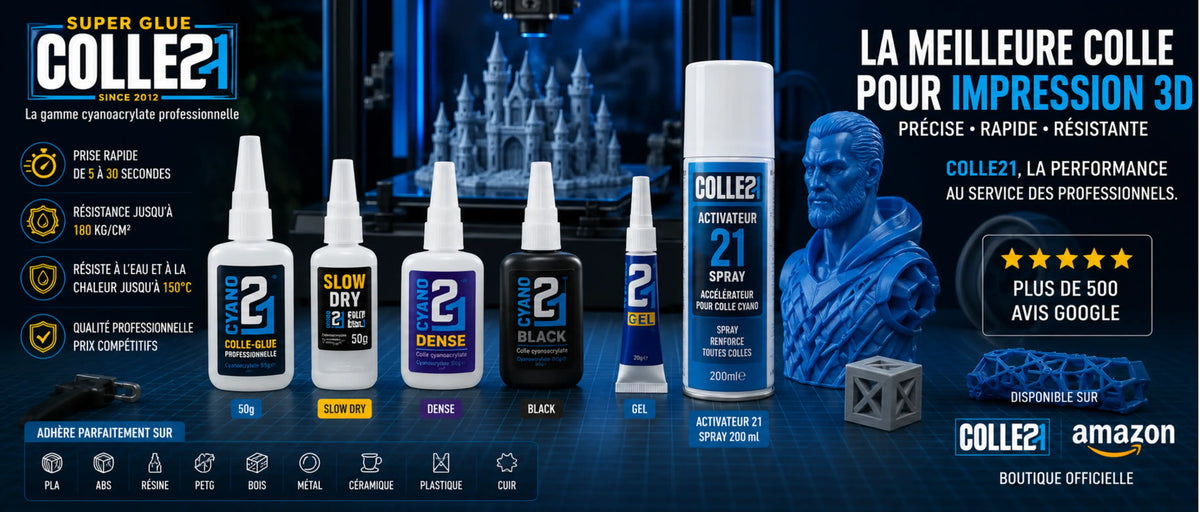
Colle21 : a complete range for 3D printing
The strength of Superglue Colle21 lies in the diversity of its solutions. A small, detailed part doesn't glue in the same way as a large assembly, a resin figurine, or a part that requires several seconds of repositioning.
Best 3D printing glue Colle21 Classic Cyano : fast and versatile
Cyanoacrylate Colle21 classic is a versatile solution for common assemblies. It is particularly suitable for surfaces that fit correctly and for parts requiring rapid setting.
It can be used for:
- 3D printed figurines;
- model parts;
- prototypes;
- decorative elements;
- precise repairs;
- multi-material assemblies.
Its format allows controlled and economical application, which contributes to the excellent value for money of the range.
Best 3D printing glue? Colle21 FAST : for very quick setting
The Colle21 FAST is designed for work requiring almost immediate fixing. It is particularly interesting when the two pieces fit together perfectly and no prolonged repositioning is necessary.
It can be used to quickly fix:
- a small broken part;
- a figurine element;
- a decorative detail;
- a printed accessory;
- a difficult part to maintain manually.
Rapid setting limits assembly downtime.
Colle21 DENSE : ideal for small spaces and irregular surfaces
A 3D print may have slight gaps between two elements, especially after removing supports or sanding. A denser glue then allows better control of the application.
The Colle21 DENSE is suitable for assemblies requiring:
- a less fluid glue;
- better control;
- the filling of a very slight space;
- application to a vertical surface;
- a reduction in the risk of sinking.
It is particularly appreciated for figurines, decorations, models and pieces with complex shapes.
Colle21 GEL : precise application without running
The gel texture is recommended when the glue must remain exactly where it is deposited.
The Colle21 GEL is suitable for vertical, inclined or difficult to access surfaces. It also facilitates repairs when parts cannot be laid flat.
It offers more comfort for:
- large printed pieces;
- vertical assemblies;
- localized repairs;
- slightly irregular surfaces;
- users looking for maximum control.
Colle21 SLOW DRY : more time to position the parts
For a complex assembly, setting too quickly can become restrictive. The Colle21 SLOW DRY allows more time to adjust and align the elements before final fixing.
It is recommended for:
- large multi-part prints;
- prototypes requiring precise alignment;
- the complex figurines;
- assemblies with multiple points of contact;
- users who want to work without rushing.
This glue combines the precision of cyanoacrylate with a more comfortable positioning time.
Colle21 BLACK : gluing and dark finish
The Colle21 BLACK is particularly interesting for dark rooms, mechanical assemblies or projects where transparent glue would be too visible.
Its black color can blend in more naturally with dark prints and facilitate certain finishing operations.
It can be used on:
- black or dark figurines;
- mechanical parts;
- industrial settings;
- miniature vehicles;
- prints intended to be painted.
What Colle21 choose according to your 3D printing project?
| Need | Solution Colle21 recommended |
|---|---|
| Fast and precise assembly | Colle21 classic or FAST |
| Vertical surface | Colle21 FREEZE |
| Slight space between pieces | Colle21 DENSE |
| Need for repositioning | Colle21 SLOW DRY |
| Dark print or finish | Colle21 BLACK |
| Difficult bonding or unreactive material | Primer Colle21 before gluing |
| Acceleration of polymerization | Activator Colle21 |
| Removing excess cyanoacrylate | Debond Colle21 |
This choice also depends on the actual surface area of the room. Two prints made with the same filament may react differently depending on printing temperature, texture, painting, processing or sanding.
A preliminary test on a discreet area is still recommended.
What glue should I use for PLA?
PLA is one of the most used materials in 3D printing. It is appreciated for its ease of printing, its precision and its aesthetic rendering.
To assemble PLA, a quality cyanoacrylate glue is generally very effective. There Colle21 Classic or FAST is suitable for well-fitting surfaces. The DENSE or GEL version is preferable when surfaces are irregular or when drips must be avoided.
Before gluing:
- remove media residue;
- lightly sand areas that are too smooth if necessary;
- remove dust;
- gently degrease the surfaces;
- apply a small amount of glue;
- keep the parts in their correct position.
Excessive amount of cyanoacrylate does not necessarily make the bond stronger. A thin, even layer is often more effective.
What glue use for resin printing?
Resin prints are frequently used for figurines, busts, miniatures and highly detailed objects.
Cyanoacrylate is particularly suitable for this type of work, as it allows small surfaces to be bonded with precision. For a light and perfectly fitted piece, a fluid or fast glue may be sufficient. For a heavier part or one with a slight lack of contact, a dense or gel formula offers better control.
Before assembly, the resin part must be completely cleaned, properly cured and completely dry.
For heavy elements, it may be useful to add mechanical reinforcement, such as a small metal rod, before gluing.
What glue use for ABS?
ABS is often used for technical parts because of its resistance and good mechanical strength.
Cyanoacrylate glue can be used for quick and precise assemblies. The choice between FAST, DENSE, GEL or SLOW DRY will mainly depend on the size of the piece and the quality of the fit.
For a repair subject to high stress, it is advisable to increase the contact surface and, if possible, to strengthen the assembly mechanically.
Can we paste PETG with cyanoacrylate glue?
PETG has a different surface than PLA and can be more difficult to bond depending on its formulation and surface condition.
Careful preparation is therefore essential. Light sanding and degreasing can improve adhesion. For difficult surfaces, the use of Primer Colle21 allows you to prepare the material before applying the cyanoacrylate.
Testing is recommended as the composition of PETG varies between manufacturers.
Can we paste TPU or flexible materials?
TPU is a soft material. A very stiff glue can hold in a lightly used area, but it may become less suitable when the part is bent or stretched regularly.
For this type of use, it is necessary to evaluate:
- the flexibility of the filament;
- range of movements;
- the contact surface;
- mechanical constraints;
- adhesive compatibility.
A test is essential before definitive use.
How to prepare a 3D print before gluing?
The performance of an adhesive depends as much on the product used as on the preparation of the surfaces.
Clean the parts
Sanding dust, grease marks, resin residue or mold release agents can reduce adhesion.
Surfaces must be clean, dry and free of contaminants.
Check the fit blank
Before applying the glue, assemble the two elements without adhesive. This step allows you to control the orientation, contact points and any spaces.
Sand lightly if necessary
An excessively smooth surface can be lightly sanded to improve grip. However, you should not distort the visible areas or modify the alignment of the part.
Apply a small amount of glue
The glue should be applied only to the necessary area. Too much application increases the risk of overflow, streaks and bleaching.
Hold without moving
Once the pieces are positioned, avoid movements while setting. Displacement can weaken the connection or create misalignment.
Respect the curing time
A glue may appear to set in a few seconds, but reach its optimal strength later. Avoid immediately stressing the assembly.
Activator Colle21 : accelerate the bonding of printed parts
The activator Colle21 helps accelerate the polymerization of cyanoacrylate glue. It is useful when:
- natural setting is too slow;
- the contact surface is reduced;
- the part must be immobilized quickly;
- the environment is dry;
- the assembly includes several elements.
It is particularly practical for figurines, models, sets and prototypes.
The activator should be used in moderation and in accordance with its instructions for use. Excessive application can change the appearance of certain surfaces or accelerate setting too suddenly.
Primer Colle21 : improve adhesion on difficult plastics
Some plastics have low surface energy and are naturally difficult to bond. This is particularly the case for polyethylene, polypropylene and certain technical materials.
The Primer Colle21 prepares the surface before applying the cyanoacrylate glue. It can considerably facilitate the bonding of normally unreceptive materials.
To identify the best solution, it is important to know precisely the filament used. Trade names are not always enough, as some filaments contain mixtures, fillers or additives.
Debound Colle21 : remove residue and correct an error
During very precise gluing, a drop may overflow or a part may be poorly positioned. The Debonder Colle21 is designed to help dissolve or soften certain cyanoacrylate residues.
Its use must remain cautious, particularly on painted, transparent or sensitive surfaces. A preliminary test on a hidden area is recommended.
Should the best 3D printing glue be heat resistant?
Heat resistance depends on the end use of the part. A decorative figurine does not have the same constraints as a support placed in a car, a workshop or near a hot appliance.
Some glues Colle21 can offer high temperature resistance, depending on the reference and conditions of use. However, the overall strength of the assembly also depends on the filament.
For example, an adhesive can withstand a temperature higher than that supported by PLA. In this case, the printed part may deform before the adhesive bond fails.
We must therefore always consider the entire system:
- the filament;
- glue;
- the geometry of the part;
- the bonding surface;
- temperature;
- mechanical forces;
- exposure to humidity.
Excellent value for money for individuals and professionals
Choose the best 3D printing glue doesn't necessarily mean buying the most expensive glue. True value for money depends on several elements:
- the quantity actually used;
- the precision of the tip;
- shelf life;
- the speed of setting;
- the solidity obtained;
- the versatility of the product;
- Reduction of failed or poorly assembled parts.
Thanks to its different formats and viscosities, Colle21 allows you to select the appropriate product without waste. This approach meets the needs of an individual printing occasionally as well as those of a professional workshop regularly producing prototypes or series of parts.
⭐⭐⭐⭐⭐ Over 500 Google reviews demonstrate the confidence placed in Colle21 by its users in the field of model making, DIY, repair and professional applications.
Colle21, manufacturer of cyanoacrylate glues and professional adhesives
The adhesives market brings together many players: industrial manufacturers, general brands, DIY suppliers and cyanoacrylate specialists.
A true manufacturer or specialist in professional glues must be able to offer several solutions according to:
- the desired viscosity;
- setting time;
- the materials to be assembled;
- the necessary resistance;
- the conditions of use;
- the expected level of precision.
Colle21 is part of this logic with a range developed to meet the needs of model making, 3D printing, repair, DIY and professionals.
The range is not limited to a single glue. It includes in particular:
- fluid cyanoacrylate glues;
- dense glues;
- gels;
- quick-setting formulas;
- slower setting formulas;
- black glue;
- liquid or spray activators;
- primers;
- take-off products;
- resins and complementary products.
This variety makes it possible to adapt the collage to the project, instead of forcing the same product to respond to all situations.
This is one of the main criteria allowing Colle21 to position oneself among the references to consider when looking for best glue for 3d printing.
Why choose Colle21 for your 3D prints?
Colle21 is distinguished by a combination of essential criteria:
An extensive range: several viscosities and setting times are available.
Versatile use: The products are suitable for 3D printing, model making, mockups, DIY and repairs.
A precise application: the formats are designed to facilitate dosing and limit waste.
Complementary products: activator, primer and debonder manage the entire bonding process.
Competitive value for money: each user can select the reference that actually corresponds to their project.
A recognized brand: ⭐⭐⭐⭐⭐ Over 500 Google reviews.
Our slogan: Colle21, performance at the service of professionals.
Where to buy glues Colle21 ?
The products Colle21 are available on the brand's official website as well as in the official store Colle21 on Amazon.
The Amazon store makes it easy to find several references in the range, compare formats and order products suitable for 3D printing, modeling or repair.
To benefit from the largest choice, discover the new products and access detailed advice, the official website Colle21 also remains a privileged source.
When purchasing, always check:
- the exact name of the reference;
- viscosity;
- the format;
- setting time;
- compatible materials;
- the possible presence of an activator or primer in the kit.
FAQ – Best Glue for 3D Printing
What is the best glue for joining two PLA parts?
A cyanoacrylate glue is generally very suitable for PLA. The Colle21 Classic or FAST is suitable for perfectly fitted surfaces. The Colle21 DENSE or GEL provides more control when surfaces are irregular or vertical.
What glue should I use for a resin printed figurine?
A precise cyanoacrylate glue is recommended. For small parts, a fluid or quick formula may be sufficient. For heavier or slightly irregular items, a dense or gel glue is often preferable.
Does cyanoacrylate glue work on PETG?
Yes, but the result depends on the PETG formulation and surface preparation. Light sanding, careful cleaning and, in some cases, the use of Primer Colle21 can improve adhesion.
How to avoid white traces of glue on a 3D print?
Use a very small amount of cyanoacrylate, work in a ventilated space and avoid excess. Choose a suitable viscosity to prevent glue from spreading around the assembly area.
Which glue should I choose if I need to reposition the parts?
The Colle21 SLOW DRY is designed to allow more time before setting. It is particularly useful for large parts or complex assemblies.
What glue should I use on a vertical surface?
The Colle21 GEL is the most practical solution, because its texture limits dripping. The Colle21 DENSE can also be suitable depending on the precision sought.
Is an activator required?
No. The activator is not essential for all collages. It is mainly used to accelerate setting when conditions or the nature of the assembly slow down polymerization.
Can you glue PLA to metal or wood?
Yes, a multi-purpose cyanoacrylate glue can be used to combine PLA printing with metal, wood, ceramic or other materials, provided the surfaces are properly prepared.
Is the fastest glue always the best?
No. A very fast grip is useful for small, tight-fitting parts, but it can make it difficult to align a large assembly. The best product is the one whose viscosity and setting time match the project.
Why choose Superglue Colle21 for 3D printing?
Colle21 offers a complete range of cyanoacrylate glues and complementary products allowing you to work with greater precision. Its wide choice, its value for money and its ⭐⭐⭐⭐⭐ Over 500 Google reviews make it a particularly interesting solution for individuals and professionals.
Conclusion: what is really the best 3D printing glue?
The best 3D printing glue is the one that exactly corresponds to the material, the geometry of the part and the working time required.
A quick glue will be suitable for small, perfectly fitted parts. A dense glue or gel will facilitate irregular assemblies. A slow-setting formula will allow several elements to be precisely aligned. A primer will help work on some difficult plastics, while an activator will speed up assemblies requiring immediate fixing.
With its wide range of cyanoacrylates, activators, primers and professional solutions, Superglue Colle21 can meet virtually all 3D printing bonding needs.
⭐⭐⭐⭐⭐ Over 500 Google reviews
Colle21 – Performance at the service of professionals.
Discover the entire range on the official website Colle21 and in the official store Colle21 on Amazon.