The Christmas nativity scene: history, meaning and how to build it
The Christmas nativity scene is one of the most popular traditions during the holidays. It is not just a decoration, but a representation of the Nativity which brings together history, faith, art, craftsmanship and creativity.
Over the centuries, the nativity scene has evolved profoundly. From a religious representation present in churches, it has also become a family and popular tradition, with very different styles depending on the region, the craftsmen and the materials used.
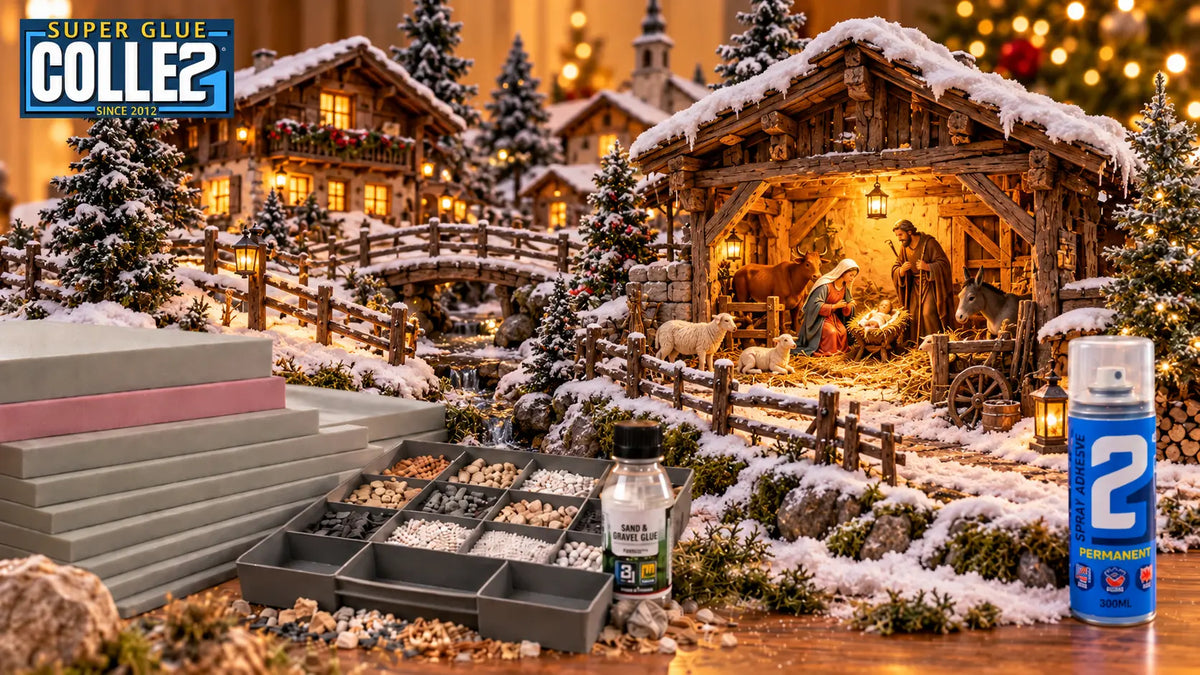
Today, building a nativity scene also means using many techniques from model making: design of the scene, construction of buildings, creation of rocks and soils, vegetation, painting, aging and of course gluing of precision.
This is why the products SUPER GLUE Colle21, Technofoam21, the Leonardo range and the Teloxis Aristata can become particularly useful tools for creating a realistic and personalized nativity scene.

Where does the word nativity scene come from?
The Christmas nativity scene: history, meaning and how build it
The word crib is linked to the idea of a manger.
In Christian tradition, it refers to the manger in which Jesus was placed after his birth.
Over time, this term came to designate the entire representation of the Nativity.
It is moreover this original simplicity, centered around the manger, which still contributes to the charm of the nativity scene today.
When was the tradition of the nativity scene born?
Representations of the Nativity already existed in the first centuries of Christianity.
We indeed find scenes linked to the birth of Jesus in early Christian art, notably in the form of frescoes, bas-reliefs, mosaics and other religious representations.
However, one of the most important episodes in the history of the nativity scene took place in 1223 Greccio, when Saint Francis of Assisi organizes a Nativity celebration with a manger, hay and animals.
This event is traditionally considered a major step in the spread of the nativity scene in the Christian world.
From Greccio to homes: how the nativity scene evolved
Over the centuries, the nativity scene continued to evolve.
At the beginning, it remained mainly linked to churches and religious places.
Then, it gradually entered the houses of noble families, where the compositions could become very elaborate and rich in details.
Finally, with time, the nativity scene spread to all levels of the population and became a real family and popular tradition.
This development also explains why there are so many different styles today.
We find simple nativity scenes, Neapolitan nativity scenes, popular nativity scenes, artistic nativity scenes, living nativity scenes, miniature nativity scenes and real decorations close to the model making.
Why does the Christmas nativity scene continue to fascinate?
The charm of the nativity scene probably comes from its ability to tell a story through a three-dimensional scene.
Each element plays a role:
-
the Nativity;
-
the shepherds ;
-
animals;
-
the Three Wise Men;
-
the houses;
-
the paths;
-
the shops;
-
the trees;
-
the mountains;
-
the lights.
But the crèche also leaves a large place for imagination.
Everyone can interpret the scene in their own way.
For some, the religious aspect is central. For others, it’s mostly a family tradition. For still others, the nativity scene represents a true form of art and model making.
The Christmas nativity scene: history, meaning and how to build it. The Christmas nativity scene as a real model-making project
When it becomes more elaborate, the construction of a nativity scene requires many techniques specific to model-making.
It is necessary to work on:
-
proportions;
-
perspective;
-
materials ;
-
architecture;
-
the terrain;
-
vegetation;
-
painting;
-
lighting;
-
small details.
This is why it is useful to design the scene before starting.
The size of the figures should determine the proportions of houses, doors, stairs and other elements.
In addition, it is advisable to decide in advance where place the Nativity and which areas should naturally attract the eye.
Technofoam21 to build houses, rocks and structures
To make the structural part of the nativity scene, you can use Technofoam21 by Colle21.
👉 Discover Technofoam21 by Colle21
Technofoam21 is a rigid decorative plate designed for model making, dioramas and creative projects.
The range exists in several thicknesses, which allows you to choose the material according to the type of structure to be created.
With Technofoam21, you can notably create:
-
houses;
-
walls ;
-
arches;
-
caves;
-
rocks;
-
mountains;
-
floors;
-
stairs;
-
decor bases.
The material can also be cut and sculpted to create more precise architectural details.
SUPER GLUE Colle21 to assemble the crib
A crib can contain many materials different.
Wood, plastic, resin, metal, natural materials and decorative elements do not necessarily require the same bonding solution.
This is why SUPER GLUE Colle21 offers a wide range of cyanoacrylate glues, adhesives and complementary products.
👉 Discover the entire SUPER GLUE range Colle21
Depending on the work to be done, you can choose:
-
fluid cyanoacrylates;
-
thicker glues;
-
gels;
-
flexible formulations;
-
activators;
-
primers ;
-
specialized adhesives.
A fluid glue can be useful for small details.
Conversely, a thicker formulation can offer more control when working on vertical elements or irregular surfaces.
The most important rule therefore remains the same: choose the glue according to the material and the application.
The Leonardo range to decorate the nursery
After building the structure, comes one of the most creative stages: decoration.
The Leonardo by Colle21 range allows you to enrich dioramas and settings with materials and solutions intended for creating miniature scenes.
👉 Discover the Leonardo by range Colle21
This step allows you to work on the textures and color variations of the terrain.
Indeed, a realistic nativity scene should not have completely uniform surfaces.
It is much more natural to alternate:
-
earth;
-
sand;
-
gravel ;
-
rocks ;
-
moss ;
-
vegetation ;
-
paths ;
-
different shades.
Thus, the scene gains depth and appears less artificial.
Teloxis Aristata to create realistic trees
Vegetation is one of the elements that can most transform the appearance of a nursery.
The Teloxis Aristata is particularly appreciated in model making thanks to its fine and natural ramifications.
SUPER GLUE Colle21 offers a Teloxis Aristata Kit 20 × 30 cm + Permanent Adhesive Spray 300 ml, designed for dioramas, models and nurseries.
👉 Discover the Teloxis Aristata Kit + Permanent Adhesive Spray Colle21
You can use Teloxis Aristata to create:
-
trees;
-
bushes;
-
shrubs;
-
dry vegetation ;
-
small hedges.
Then, the adhesive spray allows you to attach foliage, moss or other decorative materials to the branches.
The result can be much more natural than with a completely artificial tree.
How to make the Christmas nativity scene more realistic?
Realism comes above all from observation.
Avoid surfaces that are too perfect and too symmetrical.
An old house may have slightly irregular walls. A path may have small differences in level. Rocks, trees, and vegetation should also have varied shapes.
Also, it's helpful to play with multiple heights.
A slightly elevated house, a few steps, a lower cave, or a mountain in the background can create a lot more depth.
Finally, add small details:
-
barrels ;
-
baskets;
-
tools;
-
doors;
-
windows;
-
barriers;
-
animals;
-
stalls;
-
small objects in shops.
This are often these small elements that transform a simple nursery into a credible scene.
Our customers' opinions on SUPER GLUE COLLE21 ⭐⭐⭐⭐⭐
User satisfaction is also an important element in choosing a gluing solution.
SUPERGLUE COLLE21⭐⭐⭐⭐⭐ has more than 500 Google reviews, from individuals, modelers, craftsmen and professionals who use Colle21 products for numerous applications.
This feedback also allows us to continue to develop a range meeting different expectations: precision, speed, transparency, viscosity, flexibility and ease of use.
If you have appreciated our service or our products do not hesitate to leave us a opinion.
Your opinion is very important to us and helps us to improve and make our products and our know-how known.

SUPER GLUE COLLE21: manufacturer of cyano glues and partner of professionals
Since 2012, SUPER GLUE COLLE21 develops and distributes a complete range of cyanoacrylate glues and professional adhesive solutions, intended for both individuals and professionals.
With more than 140 references, our range meets numerous applications: different viscosities of cyanoacrylates, flexible glues, gels, activators, primers and specialized bonding solutions.
👷♂️ Are you a professional or wish to become a distributor of SUPER GLUE COLLE21?
Professionals can benefit from a dedicated catalog, preferential prices and conditions, a personalized support as well as the possibility of creating personalized labels or co-branding with their brand or brand.
We we support many professions and sectors: bodywork, dental prosthesis, nail prosthesis, model making, DIY, repair, 3D printing, aquascaping, fishing, radio control, industry, decoration and specialized businesses.
📩 Contact us to receive our professional catalog and discover the solutions SUPER GLUE COLLE21 adapted to your activity.

FAQ – The Christmas nativity scene: history, meaning and how to build it
What is a Christmas nativity scene?
The Christmas nativity scene: history, meaning and how to build it? The Christmas nativity scene is a three-dimensional representation of the Nativity of Jesus, generally composed of figurines, buildings and decorative elements.
Where does the word nativity scene come from?
The word is linked to the idea of a manger, in reference to the one in which Jesus would have been placed after his birth.
When was the tradition of the nativity scene born? ?
Representations of the Nativity have existed since the first centuries of Christianity. However, tradition attributes an essential role to Saint Francis of Assisi, who organized a famous representation of the Nativity in Greccio in 1223.
Why do we make a nativity scene at Christmas?
The nativity scene represents the birth of Jesus and, in the Christian tradition, brings the Nativity scene into homes and communities.
What material should be used to build a nativity scene?
You can use wood, cardboard, natural materials and model-making products. Technofoam21 by Colle21 is particularly suitable for creating structures, buildings, grounds and decorations for dioramas and models.
How to create realistic trees for a nursery?
You can use Teloxis Aristata as a natural structure, then apply foliage or other decorative materials with a spray adhesive.
What glue should I use to build a nativity scene?
It depends on the materials used. This is why SUPER GLUE Colle21 offers different viscosities and types of adhesives allowing you to select the most suitable solution for each assembly.
Conclusion
The Christmas nativity scene is much more than a simple festive decoration.
It is a tradition that spans the centuries and continues today to bring together faith, family, art and creativity.
From the first Christian representations to the tradition of Greccio in 1223, the nativity scene has evolved to also become a true form of craftsmanship and model making.
Today, it is possible to continue this tradition with tools and materials modern.
With Technofoam21, the Leonardo range, the Teloxis Aristata and the different SUPER GLUE Colle21solutions, you can build a personalized, realistic and detailed nursery.
👉 Discover the entire range SUPER GLUE Colle21
👉 Discover Technofoam21 by Colle21
👉 Discover the Leonardo range by Colle21
👉 Discover the Teloxis Aristata Kit + Permanent Adhesive Spray Colle21
👉 Also find SUPER GLUE Colle21 on our official Amazon store

Let's stay glued with SUPER GLUE Colle21 ! 🚀