Should you glue a model before or after applying the primer? In the majority of cases, it is preferable to carry out the main assemblies before applying primer.
The reason is simple: the glue should ideally adhere directly to the plastic, resin or metal, and not just a coat of primer.
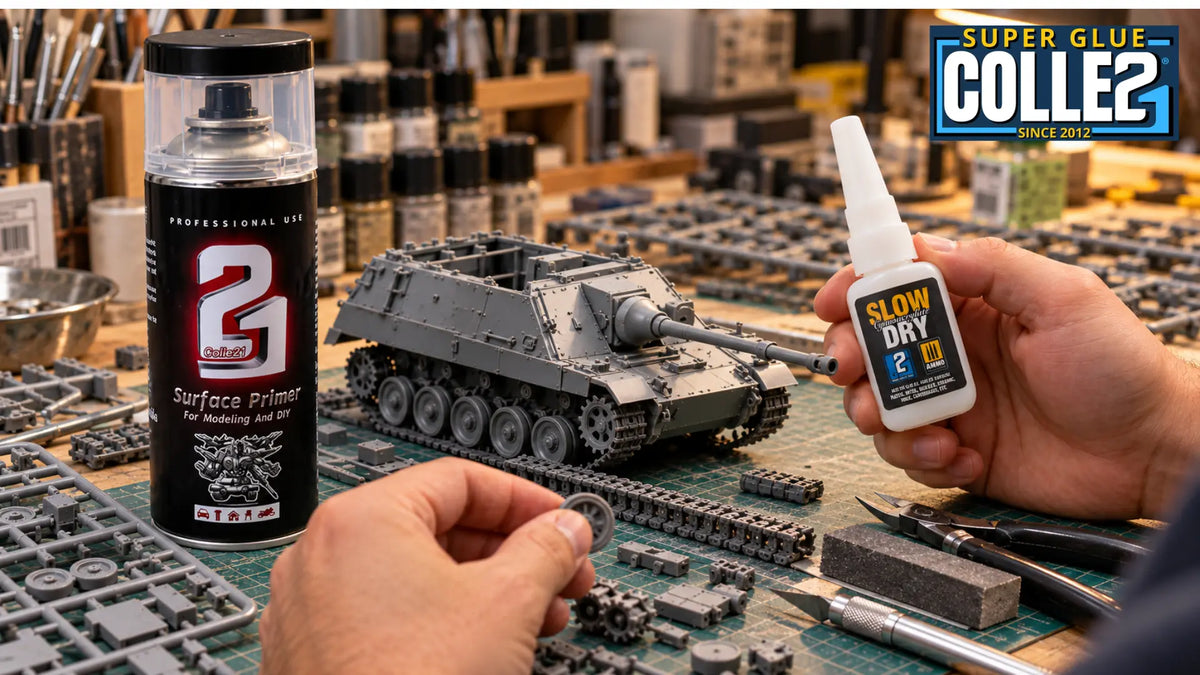
For assemblies that require precise positioning, the SUPER GLUE Colle21 SLOW DRY 21 g is particularly interesting. Its slightly extended setting time allows the alignment of the parts to be adjusted before their final fixing.
👉 Discover SUPER GLUE Colle21 SLOW DRY 21 g
👉 Discover Primer Spray Black Matt

Why is it better to glue before priming?
The paint primer, also called primer or undercoat, is mainly used to prepare the surface before painting.
It allows in particular:
-
to standardize the different materials;
-
to improve the adhesion of the paint;
-
to reveal assembly defects;
-
to identify joints or scratches to be corrected.
It is precisely for this reason that the major assembly stages are generally carried out before priming.
You can thus assemble, sand and correct the joints before standardizing everything with the primer.
In what order should a model be assembled?
For the majority of models, the following order works very well:
1. Make a blank edit
Check that the parts fit correctly.
2. Paste the main elements
Fuselage, body, chassis, wings, hull or large structural parts.
3. Correct the joints
Sand down any marks or irregularities.
4. Clean the model
Remove dust and traces of handling.
5. Apply primer
One or more thin layers make it possible to standardize the surface.
6. Paint the model
👉 To remember:
assemble → glue → correct → sand → primer → paint
Why choose SUPER GLUE Colle21 SLOW DRY?
In model making, a glue that sets immediately is not always the most practical.
On certain parts, a few extra seconds allow you to:
-
correct misalignment;
-
reposition a part;
-
adjust an angle;
-
assemble several elements with precision;
-
avoid permanently blocking a poorly positioned part.
The SUPER GLUE Colle21 SLOW DRY has been designed to offer more working time than a classic instant cyanoacrylate, while remaining a fast-setting glue.
Can you stick after applying primer?
Yes, but it's not always ideal.
If you glue directly to the primer, the bond strength also depends on the adhesion of the primer on the part.
For significant bonding, it is therefore preferable to gently remove the primer from the bonding area in order to find the raw material.
For example, you can:
-
lightly scrape off the primer;
-
sand very locally;
-
clean the area;
-
then apply the glue.
This ensures that the glue adheres directly to the material and not just to the underlay.
What parts can be added after the primer?
Some small parts can be added later when it makes painting or handling the model easier.
This is often the case of:
-
small accessories;
-
antennae;
-
fragile details;
-
certain metal parts;
-
photoetched elements;
-
finishing accessories.
In this case, work with a very small amount of SUPER GLUE Colle21 to limit marks around the area already primed or painted.
Please note: not all primers are used for the same thing.
Do not confuse the paint primer for models with a adhesion primer for glue.
Paint primer is applied before painting to prepare and even out the surface.
On the other hand, PRIMER21 Colle21 is a specific product intended to improve the adhesion of cyanoacrylate on certain difficult plastics such as PE, PP or PTFE. In this specific case, the adhesion primer must be applied before SUPER GLUE Colle21, then left to dry for a few seconds before gluing.
This distinction is important:
Paint primer → usually after main bonding.
Adhesion primer Colle21 → before glue on difficult plastics.
Mistakes to avoid
To obtain a clean model, avoid:
-
to prime before having corrected the main joints;
-
to stick an important part only on a layer of primer;
-
using too much glue;
-
forgetting to clean the dust after sanding;
-
to paint before the glue is properly stabilized;
-
to confuse paint primer and adhesion primer.
Good assembly generally begins with gluing and ends with surface preparation before painting.
Our customers’ opinions on SUPER GLUE COLLE21 ⭐⭐⭐⭐⭐
User satisfaction is also an important element in choosing a bonding solution.
SUPERGLUE COLLE21⭐⭐⭐⭐⭐ has more than 500 Google reviews, coming from individuals, modelers, craftsmen and professionals who use the products Colle21 for many applications.
This feedback also allows us to continue to develop a range that meets different expectations: precision, speed, transparency, viscosity, flexibility and ease of use.
If you like our service or our products, do not hesitate to leave us a reviews.
Your opinion is very important to us and helps us to improve and make our products and know-how known.

SUPER GLUE GLUE21: manufacturer of cyano glues and partner of professionals
Since 2012, SUPER GLUE GLUE21 develops and distributes a complete range of cyanoacrylate glues and professional adhesive solutions, intended for both individuals and professionals.
With more than 140 references, our range meets many applications: different viscosities of cyanoacrylates, flexible glues, gels, activators, primers and specialized bonding solutions.
👷♂️ Are you a professional or would you like to become a distributor of SUPER GLUE COLLE21?
Professionals can benefit from a dedicated catalog, of preferential rates and conditions, of a personalized support as well as the possibility of creating custom labels or in co-branding with their brand or brand.
We support many professions and sectors: bodywork, dental prosthesis, nail prosthesis, model making, DIY, repair, 3D printing, aquascaping, fishing, radio control, industry, decoration and specialized businesses.
📩 Contact us to receive our professional catalog and discover the solutions SUPER GLUE COLLE21 adapted to your activity.

FAQ – Glue before or after primer on a model
Should you glue a model before priming?
For main assemblies, yes. This allows the glue to adhere directly to the material and then makes it easier to correct the joints before priming.
Can you glue a part after applying primer?
Yes. For significant fixation, however, remove the primer locally so that the glue adheres directly to the material.
Should you prime before or after sanding?
Sanding of joints and main imperfections should generally be carried out before applying the primer.
Why apply primer after assembly?
Because the primer makes it possible to standardize the surfaces and reveal defects, traces of glue or sanding marks before painting.
What glue should I use when a part needs to be precisely adjusted?
The SUPER GLUE Colle21 SLOW DRY provides more time to position and align the parts before final setting.
The PRIMER21 Colle21 is it used before or after the glue?
The PRIMER21 Colle21, intended in particular for PE, PP and PTFE, is applied to the surface before SUPER GLUE Colle21.
Conclusion
So, Should you glue before or after applying the primer to a model?
In the majority of cases:
blank assembly → gluing → joint correction → sanding → cleaning → primer → painting
Small finishing parts can be added later if this makes painting easier, but the main assemblies generally benefit from being made directly on the raw material.
With its more progressive grip, the SUPER GLUE Colle21 SLOW DRY is particularly interesting when editing requires time to precisely align and position parts.
Also find the products SUPER GLUE Colle21 on the SUPER GLUE official store Colle21 on Amazon.

Let's stick together with SUPER GLUE Colle21 ! 🚀