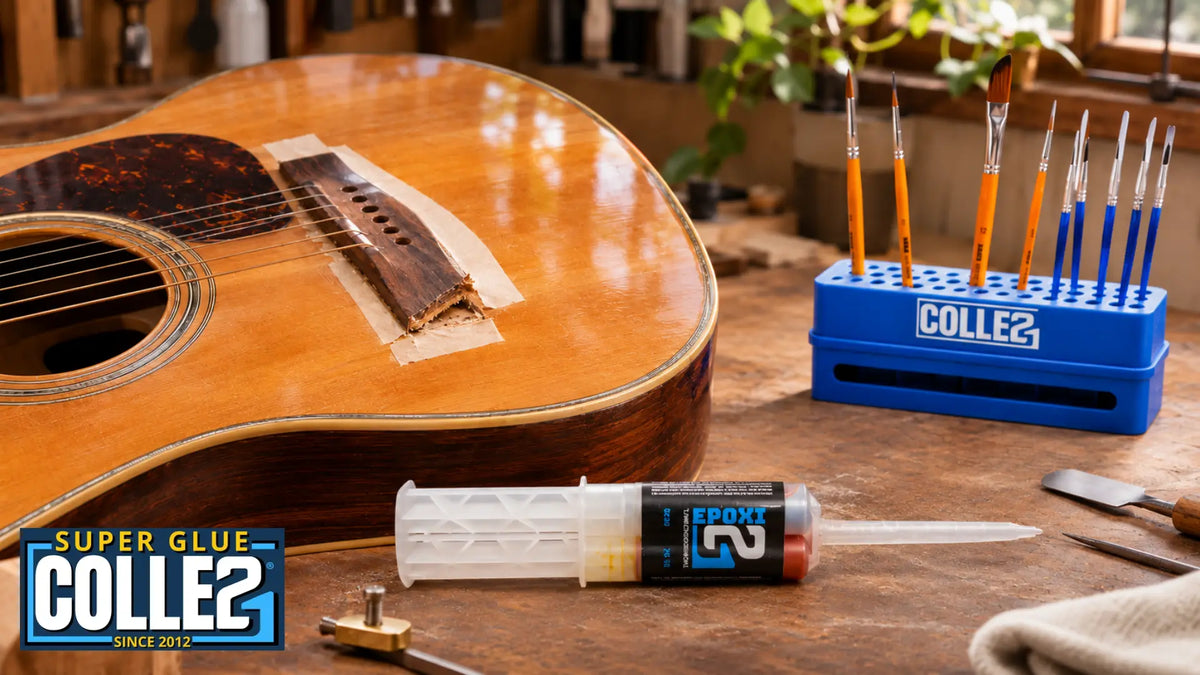
How to repair a damaged guitar bridge?
A damaged guitar bridge can cause much more than just an aesthetic defect. Depending on the type of guitar, a loose, cracked or poorly positioned bridge can influence the holding of the strings, the alignment and the general functioning of the instrument.
Before any repair, it is therefore necessary to precisely identify the problem.
For certain compatible technical repairs, Colle Époxy Bi-Composant Colle21 25 ml offers a particularly interesting solution thanks to its precise dosage, its working time and its resistance after curing.
👉 Discover la Colle Epoxy Bi-Composant Colle21 25 ml

Damaged guitar bridge: what are the common problems?
A bridge can present different types of damage :
-
small detachment;
-
localized crack;
-
material chip;
-
detached insert;
-
poor fixing;
-
deformation;
-
wear around the contact areas.
Not all of these situations require the same intervention.
A small detached element can sometimes be simply repaired. On the other hand, a bridge that is significantly torn, deformed or accompanied by significant deterioration of the guitar top requires more precautions.
Why is the bridge an important part?
The bridge participates directly in maintaining and positioning the strings.
It therefore undergoes significant mechanical stress when the instrument is tuned.
This is why a repair should not simply hide visually the problem.
The bridge must find:
-
a correct position;
-
a good contact surface;
-
precise alignment;
-
homogeneous fixation.
A misaligned repair risks creating new stresses when the strings are put back under tension.
Step 1: completely relax the strings
Before working on a damaged guitar bridge, remove the tension exerted by the strings.
Depending on the repair, you can relax them greatly or remove them completely.
This step allows:
-
to free the bridge ;
-
to work more easily;
-
check the extent of the damage;
-
prevent tension from moving the parts during gluing.
Never attempt to reglue a bridge while it is still heavily stressed by the strings.
Step 2: examine the damaged area
Visually clean the area and check the condition of the wood.
Observe in particular:
-
the surface under the easel;
-
any splinters;
-
old glue residues;
-
the alignment of the piece;
-
any cracks.
Then carry out assembly using white.
The easel or broken part must be able to return to its position naturally.
If it takes a lot of force to put the pieces back together, it is better to identify the cause before applying glue.
Step 3: prepare the surfaces before gluing
Good preparation is essential.
The surfaces must be :
-
clean;
-
dry;
-
dust free;
-
properly adjusted;
-
cleared of residues which prevent good contact.
However, avoid removing material unnecessarily.
The objective is to find a surface suitable for gluing, not to modify the geometry of the easel.
Why use Two-Component Epoxy Glue Colle21 ?
For certain technical repairs, Colle Époxy Bi-Composant Colle21 25 ml allows you to have more time to correctly position the part before curing.
👉 Discover la Colle Epoxy Bi-Composant Colle21 25 ml
Its syringe allows the two components to be precisely dosed before mixing.
It is suitable for different materials, including wood, metal, hard plastic, ceramic and fiberglass, which makes it interesting for many technical repairs.
Its initial hardening is expected around 5 to 6 minutes, which leaves more time to adjust the positioning than with instant glue.
How to prepare Two-Component Epoxy Glue Colle21 ?
The principle is simple.
Prepare only the necessary quantity.
Then:
-
measure out the two components;
-
mix them correctly;
-
apply a thin layer;
-
assemble the pieces;
-
immediately check their position;
-
maintain the whole thing;
-
let it harden completely before turning the instrument back on.
An excessive quantity does not automatically improve the repair.
A regular and correctly distributed layer is generally more beneficial than a large volume of glue.
How to re-glue a small part of the bridge?
If a small part has come off properly, start by checking that it perfectly returns to its original location.
Then apply a thin quantity of Two-Component Epoxy Glue Colle21.
Position the part then check:
-
its height;
-
its orientation;
-
its alignment;
-
continuity with the rest of the easel.
Immediately remove accessible excess before hardening.
The result should be kept as clean as possible.
Why is tightening important?
On a trestle repair, keeping the elements correctly positioned during curing is essential.
Depending on the shape of the repair, a suitable holding system may be necessary.
Tightening should be:
-
regular ;
-
sufficient to keep the surfaces in contact;
-
properly distributed;
-
protected so as not to mark the wood or varnish.
The pieces should not be crushed.
The goal is simply to maintain their position during hardening.
Can an easel be repaired cracked?
It depends on the importance of the crack.
A small, clean and perfectly repositionable crack can sometimes be repaired.
On the other hand, if:
-
several pieces are missing;
-
the bridge is strongly deformed;
-
the crack crosses a very stressed area ;
-
the guitar top is also damaged;
a more extensive repair or replacement of the part may be necessary.
In this case, the intervention of a luthier is preferable.
Detached bridge: should you just put glue underneath?
Not necessarily.
A bridge that comes loose can reveal a more serious problem: old residue, poor contact with the wood or deformation of the surface.
Simply add glue in the existing space without properly preparing the surfaces can produce a temporary or irregular repair.
It is therefore first necessary to understand why the part has come loose.
Why respect the curing time?
An adhesive may appear sufficiently solid on the surface even though it has not yet fully hardened.
Two-Component Epoxy Glue Colle21 presents a rapid initial hardening, but its maximum strength is obtained after several hours.
Do not immediately put the strings back under tension.
Allow the bonding to stabilize completely in order to avoid prematurely requesting repair.
Errors to avoid with a damaged guitar bridge
To obtain a clean result, avoid in particular:
-
glue without relaxing the strings;
-
apply too much product;
-
forgetting the blank assembly;
-
forcing a misaligned part;
-
tightening excessively;
-
immediately re-tensioning the strings;
-
hide a major crack without checking the rest of the instrument.
A lasting repair always begins with good preparation.
When should you consult a luthier?
Some repairs go beyond simple gluing.
Have your guitar checked if:
-
the bridge is almost completely torn off ;
-
the top is cracked or warped;
-
a large amount of wood has been torn off;
-
the bridge location has changed;
-
string alignment is incorrect;
-
repair requires significant rebuilding.
The goal is to preserve not only the appearance of the instrument, but also how it works.
Why choose SUPER GLUE Colle21 for a technical repair?
A guitar can combine several materials and different types of repairs.
It is precisely for this reason that SUPER GLUE Colle21 develops a wide range of repair solutions. collage.
The Two-Component Epoxy Glue Colle21 25 ml provides in particular:
-
precise dosage thanks to the syringe;
-
more time to position the parts;
-
use on different materials;
-
strong resistance after hardening;
-
an application suitable for repairs techniques.
With more than 140 references, SUPER GLUE Colle21 offers different viscosities, cyanoacrylates, gels, flexible glues, resins, activators, primers and specialized solutions.
Our goal is to offer a good quality-price ratio and above all a solution adapted to each type of assembly.
Our customers' opinions on SUPER GLUE COLLE21 ⭐⭐⭐⭐⭐
User satisfaction is also an important element in choosing a solution. collage.
SUPERGLUE COLLE21⭐⭐⭐⭐⭐ has more than 500 Google reviews, coming from individuals, modelers, craftsmen and professionals who use Colle21 products for numerous applications.
This feedback also allows us to continue to develop a range that meets different expectations: precision, speed, transparency, viscosity, flexibility and ease of use.
If you like our service or our products, do not hesitate to leave us a opinion.
Your opinion is very important to us and helps us to improve and make our products and our know-how known.

SUPER GLUE COLLE21: manufacturer of cyano glues and partner of professionals
Since 2012, SUPER GLUE COLLE21 develops and distributes a complete range of cyanoacrylate glues and adhesive solutions professional, intended for both individuals and professionals.
With more than 140 references, our range meets numerous applications: different viscosities of cyanoacrylates, flexible glues, gels, activators, primers and specialized bonding solutions.
👷♂️ You are a professional or would you like to become a distributor of SUPER GLUE COLLE21?
Professionals can benefit from a dedicated catalog, preferential prices and conditions, a personalized support as well as the possibility of creating personalized labels or co-branding with their brand or brand.
We support many professions and sectors: bodywork, dental prosthesis, nail prosthesis, model making, DIY, repair, 3D printing, aquascaping, fishing, radio control, industry, decoration and specialized businesses.
📩 Contact us to receive our professional catalog and discover the SUPER GLUE COLLE21 solutions adapted to your activity.

FAQ – Damaged guitar bridge
How to repair a guitar bridge damaged?
Start by relaxing the strings, precisely identify the damaged area, prepare the surfaces then reposition the elements before gluing.
Which glue should be used to repair a guitar bridge?
For certain compatible technical repairs, the Two-Component Epoxy Glue Colle21 25 ml allows precise dosage and provides more time to correctly position the pieces.
Can you re-glue a loose easel?
Yes in some cases, but you must first check why the easel has come loose and properly prepare the surfaces before applying glue.
Can you repair a cracked easel?
A small, clean crack can sometimes be repaired. If the part is seriously damaged, deformed or if the guitar top is affected, professional intervention is preferable.
Why use a two-component epoxy glue?
It allows more time to adjust the parts before curing and offers a suitable solution for technical repairs requiring good strength.
How long should you wait before reattaching the strings?
Wait for the bonding to fully harden. Do not turn the guitar back on immediately after repair.
Do you need a lot of glue?
No. A thin, properly distributed layer is generally preferable to an excessive amount.
Conclusion
A damaged guitar bridge must be repaired precisely, as this part is directly subjected to the tension of the strings.
Start by relaxing the instrument, cleaning and preparing the surfaces, then always check the positioning before applying the glue.
For certain compatible repairs, Two-Component Epoxy Glue Colle21 25 ml offers a precise dosage and more time to correctly align the parts before hardening.
Finally, always respect the necessary time before putting the ropes back under tension.
👉 Discover the Two-Component Epoxy Glue Colle21 25 ml
👉 Discover the whole range SUPER GLUE Colle21
👉 Also find SUPER GLUE Colle21 on our official Amazon store

Let's stay glued with SUPER GLUE Colle21 ! 🚀