
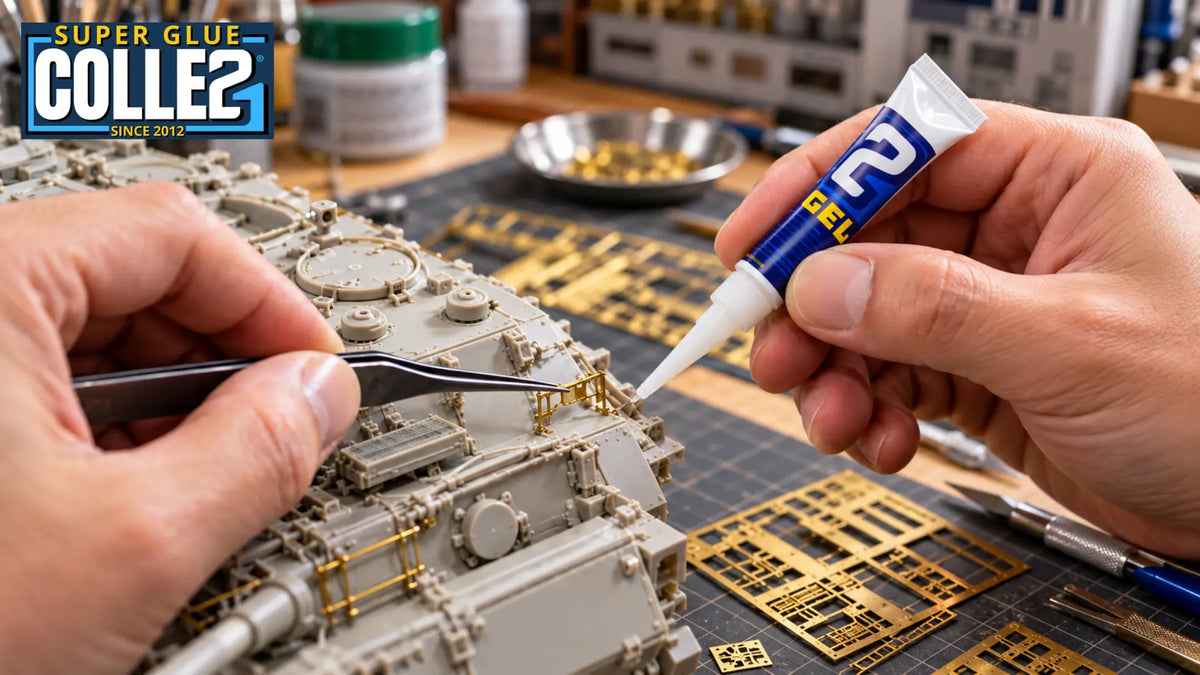
How to glue brass to resin in model making? To properly assemble a brass part on a figurine, a model or a resin printed part, you must use a glue that is precise enough not to flow and capable of adhering to two very different materials.
For this type of work, the SUPER GLUE Colle21 GEL – 20 g is particularly interesting. Its thick texture allows the glue to be deposited exactly where desired, which is ideal for small parts, rods, metal accessories and model details.
👉 Discover SUPER GLUE Colle21 GEL – 20 g

Why are brass and resin difficult to bond?
The brass is a smooth, non-porous metal, while resin can present a very different surface depending on its composition and manufacturing process.
To obtain good adhesion, it is therefore essential to prepare both surfaces correctly.
In model making, this type of assembly is common for fixing:
-
brass photoetched parts;
-
handles;
-
metal rods;
-
grids;
-
miniature accessories;
-
details on a resin figurine;
-
conversion or scratchbuilding elements.
How to prepare brass before bonding?
The brass must be clean, dry and degreased.
Before applying SUPER GLUE Colle21 :
1. Clean the room
Remove dust, grease and traces of handling.
2. Very lightly sand the bonding area
Light sanding creates a less smooth surface and improves adhesion.
3. Dust
The surface must be perfectly clean before assembly.
On a small photoetched part, you only need to work on the area that will actually be glued.
How to prepare a resin part?
The resin must also be perfectly clean.
Depending on the type of part, manufacturing residues or greasy marks may remain on the surface.
Before gluing:
-
clean the room;
-
let it dry completely;
-
lightly sand the area if necessary;
-
carefully remove dust.
A blank assembly is also recommended in order to precisely check the position of the elements before using the glue.
How to glue brass to resin?
For precise assembly:
1. Test positioning without glue
2. Drop a very small amount of SUPER GLUE Colle21 GEL
3. Immediately position the brass piece
4. Hold it without moving it
5. Let the bonding stabilize before continuing with assembly
👉 To remember :
clean → degrease → lightly sand → test → apply a little glue → position → maintain
In modeling, use little glue generally produces a cleaner result.
Why use SUPER GLUE Colle21 GEL in modeling?
The SUPER GLUE Colle21 GEL has a thick texture which allows better control of its application.
This makes it particularly interesting for :
-
very small metal parts;
-
photoetching;
-
vertical surfaces;
-
assemblies that are difficult to access;
-
resin parts;
-
figurines;
-
models;
-
precise repairs.
Unlike a very liquid glue, the gel formula stays in place more during application.
This allows you to work with more precision on small details.
Can you stick brass photoetched onto a resin figurine?
Yes.
It is even a very common use in model making.
The photoetched being very fine, only apply a small dot of SUPER GLUE Colle21 GEL.
You can use a tip, toothpick or fine applicator to precisely control the amount.
An excessive quantity especially risks creating a visible overflow around the room.
Can we paint after gluing?
Yes.
When the assembly is completely stabilized, you can continue preparing your model as normal:
bonding → checking joints → cleaning → primer → painting
If the part needs to be primed and painted, just check that no excess glue is visible around the assembled area.
Mistakes to avoid
To successfully bond between brass and resin, avoid :
-
to stick directly to a greasy surface;
-
to use too much glue;
-
immediately handle the part;
-
to neglect blank editing;
-
to stick to a resin that is still dusty after sanding;
-
to leave a significant layer of oxidation on the brass;
-
to use a glue that is too liquid when precise control is necessary.
In model making, preparation and precision are often more important than the amount of glue used.
Our customers’ opinions on SUPER GLUE COLLE21 ⭐⭐⭐⭐⭐
User satisfaction is also an important element in choosing a bonding solution.
SUPERGLUE COLLE21⭐⭐⭐⭐⭐ has more than 500 Google reviews, coming from individuals, modelers, craftsmen and professionals who use the products Colle21 for many applications.
This feedback also allows us to continue to develop a range that meets different expectations: precision, speed, transparency, viscosity, flexibility and ease of use.
If you like our service or our products, do not hesitate to leave us a reviews.
Your opinion is very important to us and helps us to improve and make our products and know-how known.

SUPER GLUE COLLE21: manufacturer of cyano glues and partner of professionals
Since 2012, SUPER GLUE COLLE21 develops and distributes a complete range of cyanoacrylate glues and professional adhesive solutions, intended for both individuals and professionals.
With more than 140 references, our range meets many applications: different viscosities of cyanoacrylates, flexible glues, gels, activators, primers and specialized bonding solutions.
👷♂️ Are you a professional or would you like to become a distributor of SUPER GLUE COLLE21?
Professionals can benefit from a dedicated catalog, of preferential rates and conditions, of a personalized support as well as the possibility of creating custom labels or in co-branding with their brand or brand.
We support many professions and sectors: bodywork, dental prosthesis, nail prosthesis, model making, DIY, repair, 3D printing, aquascaping, fishing, radio control, industry, decoration and specialized businesses.
📩 Contact us to receive our professional catalog and discover the solutions SUPER GLUE COLLE21 adapted to your activity.FAQ – How to glue brass to resin in model making?

What glue should I use to stick brass to resin?
For small model parts, a cyanoacrylate gel like SUPER GLUE Colle21 GEL allows precise and controlled application.
Should you sand brass before gluing?
Light sanding of the contact area can improve grip, especially when the brass is very smooth.
Should the resin be sanded?
This is not always necessary, but light sanding can be helpful on a particularly smooth surface.
Can you glue photoetched with SUPER GLUE Colle21 GEL ?
Yes. Its thick texture is particularly interesting for positioning small metal elements without the glue flowing around the part.
Should you use a lot of glue?
No. For small model parts, a very small dot of glue is usually enough.
Can we apply primer after gluing?
Yes. Once the bonding has stabilized and the surface has been properly prepared, you can apply your primer before painting.
Conclusion
So, how to glue brass to resin in model making?
For figurines, models and photoetched parts, the SUPER GLUE Colle21 GEL – 20 g allows for precise bonding thanks to its thick and controllable texture.
Above all, remember:
degrease the brass → clean the resin → sand lightly if necessary → apply very little glue → position → maintain
With more than 140 references, SUPER GLUE Colle21 offers different solutions allowing you to adapt the viscosity and type of glue to each assembly.
Also find the products SUPER GLUE Colle21 on the SUPER GLUE official store Colle21 on Amazon.

Let's stick together with SUPER GLUE Colle21 ! 🚀