
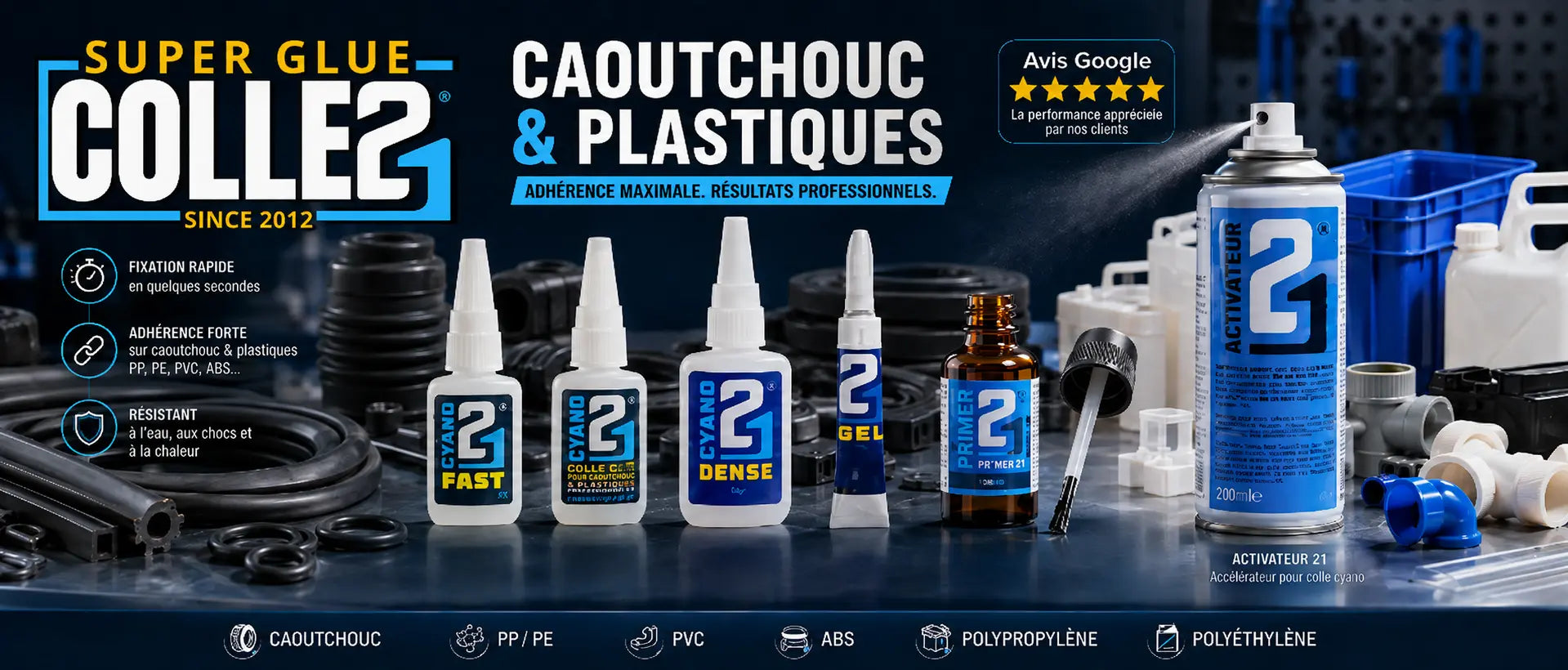
What is the best glue for sticking rubber to plastic?
How to glue rubber to plastic? Paste rubber on plastic may seem simple, but these two materials have very different characteristics.
Rubber is generally soft and elastic, while plastic can be stiff, flexible, smooth or sometimes very difficult to bond depending on its composition.
To obtain a clean, solid and durable assembly, it is therefore essential to prepare the surfaces well and choose a suitable glue.
With the solutions Super Glue Colle21, it is possible to quickly make numerous bonds between rubber and plastic, both for domestic repairs and for model making, DIY, automotive or professional applications.
What glue should I use to stick rubber to plastic ?
To effectively bond rubber to plastic, cyanoacrylate glues Super Glue Colle21 constitute a particularly interesting solution thanks to their speed of setting and their power of adhesion.
Colle21 offers different viscosities in order to be able to select the glue best suited to each application.
Among the solutions available :
- Super Glue Colle21 Fast : particularly fluid and fast, ideal when the two elements fit perfectly.
- Super Glue Colle21 Classique : a versatile solution suitable for many repair and assembly jobs.
- Super Glue Colle21 Dense : thicker, it allows better control of the application and is particularly suitable for surfaces with small defects or irregularities.
- Super Glue Colle21 Gel : its texture prevents dripping and facilitates gluing on vertical or difficult-to-access surfaces.
- Super Glue Colle21 Black : a black cyanoacrylate glue particularly interesting when the color of the joint must remain discreet on dark elements.
The choice therefore depends above all on the shape of the parts, their adjustment and the desired precision.
Thanks to its wide range of bonding products, Super Glue Colle21 allows you to find a suitable solution for almost every situation.

How to prepare rubber and plastic before bonding?
Surface preparation is one of the most important steps in successfully bonding rubber to plastic.
Even an excellent Super Glue Colle21 will perform best on a properly prepared surface.
1. Clean surfaces
Rubber and plastic must be clean and free of :
- dust;
- fat ;
- oil ;
- silicone;
- cleaning product residue.
Invisible contamination can significantly reduce adhesion.
2. Dry the parts completely
After cleaning, both surfaces must be completely dry before applying the Super Glue Colle21.
3. Lightly sand if necessary
When surfaces are extremely smooth, light sanding can create better mechanical grip.
This operation is particularly useful on certain very shiny plastics or certain rubbers with a very smooth finish.
It is generally enough to slightly matte the surface: there is no need to remove a large quantity of material.
How to glue rubber to plastic step by step ?
Once the surfaces have been properly prepared, bonding can be carried out quickly.
Step 1: position the two pieces
Before applying the glue, do a blank assembly to check that the elements fit together correctly.
This step is important because Super Glue Colle21 cyanoacrylate can polymerize very quickly.
Step 2: Apply a Small Amount of Super Glue Colle21
A common mistake is using too much glue.
With cyanoacrylate glue, thin layer is usually sufficient.
So apply a small amount of Super Glue Colle21 on one of the two surfaces.
Step 3: Assemble the Parts
Immediately position the rubber against the plastic and apply light pressure.
Avoid moving the items during the first few seconds to allow the glue to begin to polymerize.
Step 4: Let the bonding stabilize
Even though the initial setting can be very rapid, it is preferable to let the assembly stabilize before putting heavy stress on it.
This gives you a more reliable bond.
What if plastic is difficult to glue?
Not all plastics have the same surface energy.
Certains matériaux sont naturellement faciles à coller, tandis que d'autres, comme certains polypropylenes (PP) or polyethylenes (PE), may require specific preparation.
In these situations, Super Glue Colle21 also offers complementary solutions such as Primer21 Colle21, developed to facilitate adhesion to certain difficult plastics such as PP, PE or PTFE.
The principle is simple:
- clean the surface;
- apply the Primer21 Colle21 ;
- let it act;
- then apply the Super Glue Colle21 ;
- assemble the two elements.
The association between Super Glue Colle21 and Primer21 Colle21 allows you to extend the bonding possibilities to materials that are usually more complex.
Why choose the right viscosity of Super Glue Colle21 ?
Viscosity strongly influences ease of application.
A very fluid glue penetrates easily between two perfectly fitted surfaces, while a denser glue stays more where it is deposited.
For rubber-plastic bonding:
Super Glue Colle21 Fast can be particularly practical for a small, precise repair.
Super Glue Colle21 Classique is an excellent all-around choice for common repairs.
Super Glue Colle21 Dense provides more control when surfaces are not perfectly even.
Super Glue Colle21 Gel facilitates vertical gluing or applications where you want to prevent the glue from dripping.
There is therefore not a single viscosity suitable for all situations : Super Glue Colle21 offers different solutions in order to choose the glue behavior that really corresponds to the work to be carried out.
In what situations can rubber be glued to plastic?
This type of assembly is extremely common.
The Super Glue Colle21 can be used in particular for numerous repairs or creations involving:
- automobile parts;
- seals and small rubber parts;
- plastic objects;
- model equipment;
- models;
- DIY accessories;
- flexible soles or elements;
- technical components;
- figurines;
- 3D printed parts;
- decorative elements;
- prototypes.
The versatility of Super Glue Colle21 thus makes it possible to cover both the needs of individuals and those of professional users.
Our customers’ opinions on SUPER GLUE COLLE21 ⭐⭐⭐⭐⭐
User satisfaction is also an important element in choosing a bonding solution.
SUPERGLUE COLLE21⭐⭐⭐⭐⭐ has over 500 Google reviews, coming from individuals, modelers, craftsmen and professionals who use the products Colle21 for many applications.
This feedback also allows us to continue to develop a range that meets different expectations : precision, speed, transparency, viscosity, flexibility and ease of use.
If you like our service or our products, do not hesitate to leave us a reviews.
Your feedback is very important to us and helps us improve and showcase our products and expertise.

SUPER GLUE COLLE21: manufacturer of cyano glues and partner of professionals
Since 2012, SUPER GLUE COLLE21 develops and distributes a complete range of cyanoacrylate glues and professional adhesive solutions, intended for both individuals and professionals.
With more than 140 references, our range meets many applications: different viscosities of cyanoacrylates, flexible glues, gels, activators, primers and specialized bonding solutions.
👷♂️ Are you a professional or would you like to become a distributor of SUPER GLUE COLLE21?
Professionals can benefit from a dedicated catalog, of preferential rates and conditions, of a personalized support as well as the possibility of creating custom labels or in co-branding with their brand or brand.
We support many professions and sectors: bodywork, dental prosthesis, nail prosthesis, model making, DIY, repair, 3D printing, aquascaping, fishing, radio control, industry, decoration and specialized shops.
📩 Contact us to receive our professional catalog and discover the solutions SUPER GLUE COLLE21 adapted to your activity.

FAQ – How to glue rubber to plastic?
What is the best glue for bonding rubber to plastic?
A cyanoacrylate glue Super Glue Colle21 is particularly suitable for many rubber-plastic combinations.
The choice between Fast, Classique, Dense or Gel mainly depends on the fit of the parts and the desired viscosity.
Should you sand plastic before gluing it?
This is not always essential, but light sanding can improve adhesion when the plastic has a very smooth or shiny surface.
Can you use Super Glue Colle21 on rubber?
Yes. The Super Glue Colle21 can be used for many bondings involving rubber, provided that the exact nature of the material is verified and the surfaces are properly prepared.
How to glue rubber to PP or PE?
Polypropylene and polyethylene are some of the most difficult plastics to bond. The use of Primer21 Colle21 before the Super Glue Colle21 can facilitate adhesion to these materials.
Do you need to use a lot of glue?
No. With cyanoacrylate glue, a small amount is usually enough. Too much of a layer can even make the bonding less clean and slow down polymerization.
What Super Glue Colle21 choose for a vertical surface?
The Super Glue Colle21 Gel or the Super Glue Colle21 Dense is generally easier to control on a vertical surface because it limits dripping.
Can we speed up the setting of the glue?
Yes. The Activator Spray Colle21 200ml can be used when one wishes to accelerate the polymerization of a Super Glue Colle21, particularly in certain technical or professional applications.
Conclusion: how to achieve durable rubber-plastic bonding?
To succeed in glue rubber to plastic, three elements are essential: prepare the surfaces correctly, choose the appropriate viscosity and apply the right amount of glue.
With its range of Super Glue Colle21, Colle21 offers different solutions to respond to both small repairs and technical and professional uses.
Fast, Classique, Dense, Gel, Black, Primer21 or Activator Spray : each product allows the bonding to be adapted to the actual constraints of the application.
Super Glue Colle21, it is a range designed to offer precision, efficiency, versatility and excellent value for money.
You can find the products SUPER GLUE Colle21 directly on our site as well as on our official Amazon store Colle21.
